 Chuckanut Exterior
 Composite Decking Built for York's Weather, Not Just the Showroom
York sits close enough to the water and the tree line that a deck here takes a different kind of beating than one twenty minutes inland. Between the salt air drifting off Chuckanut Bay, the long stretch of driving rain that defines a Whatcom County winter, and a moss season that can run six months or more, an outdoor deck is under near-constant pressure. Composite decking is a strong answer to that pressure, but only when it's chosen and installed with this specific microclimate in mind. That's what this page is about — not composite decking in general, but composite decking as it actually performs on a York property.
We're a Chuckanut-based crew. We're not driving in from out of the area to quote a job and disappear — we're working in this neighborhood regularly, which matters more than it sounds like once you get into the details below.
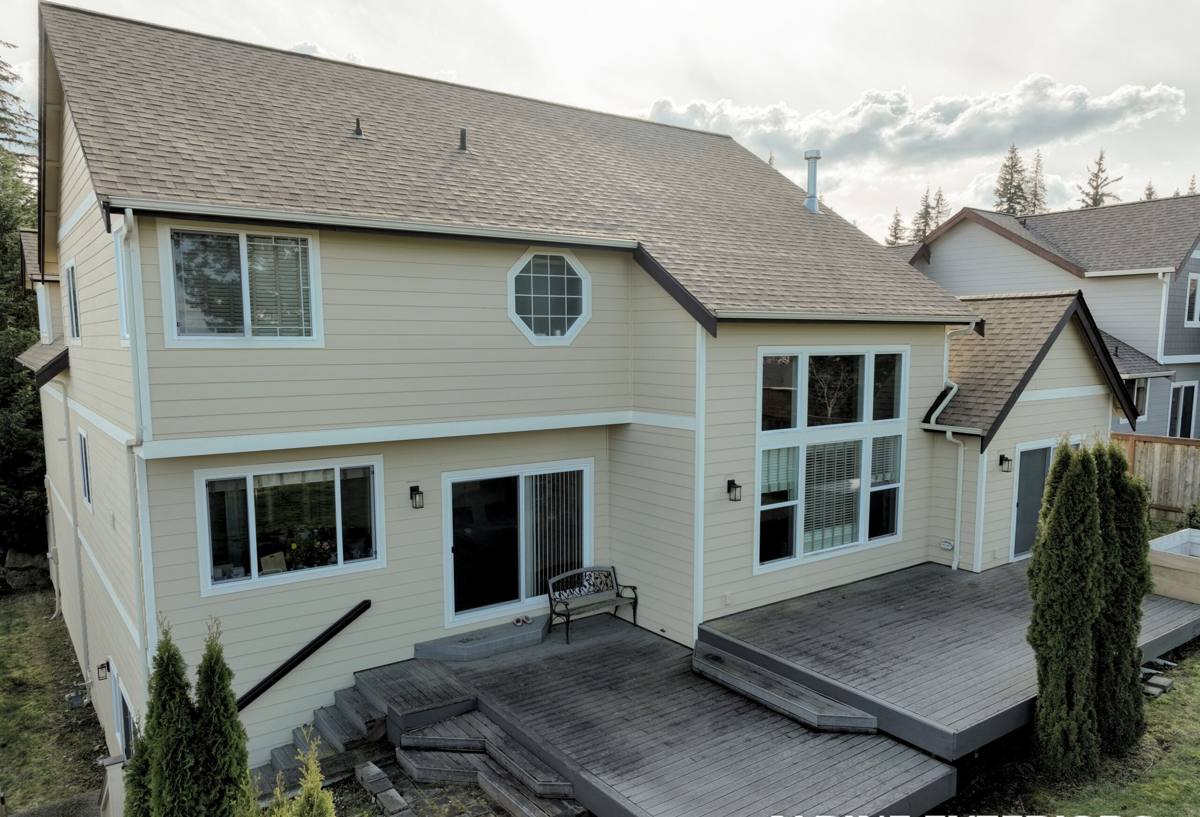
What York's Climate Actually Does to a Deck
Three things drive almost every deck problem we see in this part of Whatcom County, and they compound each other.
Salt Air
Proximity to Chuckanut Bay means a fine layer of salt-laden moisture settles on outdoor surfaces even on dry days. Over years, that accelerates corrosion on any exposed metal fasteners, hinges, and railing hardware. It also interacts with wood grain and some coatings, speeding up surface breakdown. Composite boards themselves don't corrode, but the fasteners and structural hardware holding them still can if the wrong grade is used.
Driving Rain
This isn't gentle drizzle — Whatcom County gets sustained, wind-driven rain that pushes water sideways into gaps, under boards, and around fastener heads instead of just falling straight down and running off. A deck surface that isn't gapped and drained correctly holds water instead of shedding it, and trapped water is the root cause of nearly every rot, mold, and board-warping issue we get called out for.
Extended Moss Season
Cool, damp, and shaded conditions for much of the year create ideal moss and algae growth conditions on any deck surface that doesn't dry out quickly. Moss holds moisture against the board surface, makes footing slick and genuinely dangerous, and on the wrong material can stain permanently. It's less a seasonal nuisance here than a year-round maintenance factor.
None of this means composite decking is a bad fit for York — it's actually a strong fit, because quality composite resists rot and moisture absorption far better than untreated wood. But "composite" isn't one product with one performance level, and the installation details matter as much as the material choice.
Why Composite Makes Sense Here — and Where It Doesn't Solve Everything
Composite decking's core advantage in a climate like this is that the boards themselves don't absorb water the way wood does, so they don't swell, splinter, or rot from moisture exposure the same way. That's a real benefit given how much rain York sees. But composite isn't maintenance-free, and being honest about that upfront is part of doing this job right.
- Composite still needs periodic cleaning to prevent moss, algae, and pollen buildup from staining the surface, especially in shaded or low-airflow areas of the yard.
- The substructure underneath — joists, ledger board, framing — is still typically wood or wood-alternative and needs the same moisture management as any deck, regardless of what's on top.
- Fasteners, flashing, and hardware need to be rated for coastal, high-moisture conditions, or they become the weak point even when the decking itself holds up fine.
- Not all composite products handle moisture and UV the same way — capped composite boards (a protective outer shell around the core) perform meaningfully better in wet, salt-exposed conditions than uncapped or lower-grade composite.
We install composite because it's a genuinely good match for this climate when specified correctly — not because it's a one-size-fits-all upgrade that eliminates maintenance.
What a Correct Installation Involves in a Climate Like This
A composite deck that lasts in York isn't just "boards screwed to a frame." The parts that actually determine how it holds up are mostly invisible once the job is done.
Drainage and Airflow Under the Deck
Board spacing has to account for wood movement and water runoff, and the framing below needs enough clearance and slope for water to actually leave the area instead of pooling. Low-clearance decks or decks built tight against grade are far more prone to trapped moisture, and trapped moisture under a deck is where rot starts even if the surface looks fine.
Ledger Board and Flashing
Where the deck attaches to the house is the single most common failure point on any deck, composite or wood, because it's the hardest spot to keep water out of. Correct flashing detail here is not optional in a driving-rain climate — it's the difference between a deck that stays sound at the house connection for decades and one that develops hidden rot behind the band board within a few years.
Fastener and Hardware Selection
Given the salt air exposure, we spec fasteners and structural connectors rated for coastal or high-corrosion environments, not standard interior-grade hardware. This is a small cost difference at install time and a significant difference in how the deck ages.
Board Selection for Moss and Moisture
Capped composite boards, and profiles designed with better surface drainage and grip texture, hold up better against the moss and algae growth this area sees for much of the year. We'll walk through the realistic differences between board tiers so the choice is based on how the deck will actually perform in York, not just on showroom appearance.
Our Process for a York Composite Deck Project
- On-site assessment. We look at sun exposure, drainage grade, proximity to the water side of the property, existing framing condition if this is a resurface, and how the space is actually used.
- Material walkthrough. We go over composite board tiers, color and finish options, and the honest tradeoffs between them for this specific site — not a generic sales pitch.
- Structural check. If we're building over existing framing, we verify it's sound and correctly spaced before any composite goes down. Composite boards laid over a compromised substructure just hides a problem instead of fixing it.
- Written estimate. Clear scope, materials, and cost — no vague allowances that turn into surprises later.
- Installation. Framing and drainage work first, then ledger and flashing detail, then decking, hardware, and railing.
- Final walkthrough. We go over basic care specific to this material and this climate — what to expect from moss and algae buildup, and simple cleaning steps to keep the surface performing well.
Composite Board Tiers — A Straightforward Comparison
| Factor | Standard Capped Composite | Premium Capped Composite |
|---|---|---|
| Moisture resistance | Good — suitable for this climate with correct install | Better long-term surface protection under sustained rain exposure |
| Moss/algae resistance | Requires regular cleaning | Often includes enhanced surface texture or treatment that sheds growth more easily |
| Fade/UV resistance | Solid, standard warranty coverage | Longer, stronger fade warranty typically included |
| Upfront cost | Lower | Higher |
| Best fit | Budget-conscious projects, covered or partially shaded decks | Full sun/rain exposure, oceanfront-adjacent lots, long-term low-maintenance priority |
Neither tier is the "wrong" choice — it depends on budget, sun exposure, and how much upkeep you want to do. We'll give you a straight recommendation based on your specific property, not just push the higher-margin option.
Maintenance Realities for a York Deck
Setting expectations correctly upfront saves frustration later. A composite deck in this climate should get:
- A rinse or light wash a few times a year to prevent moss, pollen, and algae from taking hold, more often in heavily shaded areas.
- A visual check of railing hardware and fasteners annually, given the accelerated corrosion risk from salt air.
- Prompt clearing of fallen leaves and debris in fall, since trapped organic matter holds moisture against the board surface and speeds up staining.
- An occasional check under the deck for drainage issues, especially after major storm seasons.
This is meaningfully less upkeep than a wood deck in the same location would demand, but "low-maintenance" isn't "no-maintenance," and we'd rather you know that going in.
Why a Local Crew Matters for This Job
A crew that works around Chuckanut and the broader Whatcom County coastline regularly has already seen how different composite products and installation details hold up against this specific combination of salt air, driving rain, and moss. That's not something you get from a general contractor working from a national install manual with no feel for how this particular stretch of coastline behaves. We know which details to prioritize here because we're dealing with the same conditions on every job in this area, not just this one.
Get a Straight Answer on Your York Deck Project
If you're weighing a new composite deck, a rebuild over an aging structure, or just want an honest read on whether your current deck's problems are cosmetic or structural, we're happy to come take a look. We'll give you a clear, no-pressure estimate and a straight answer about what your property actually needs — use the form below to get started.