 Chuckanut Exterior
 What Primed Spruce Siding Actually Is
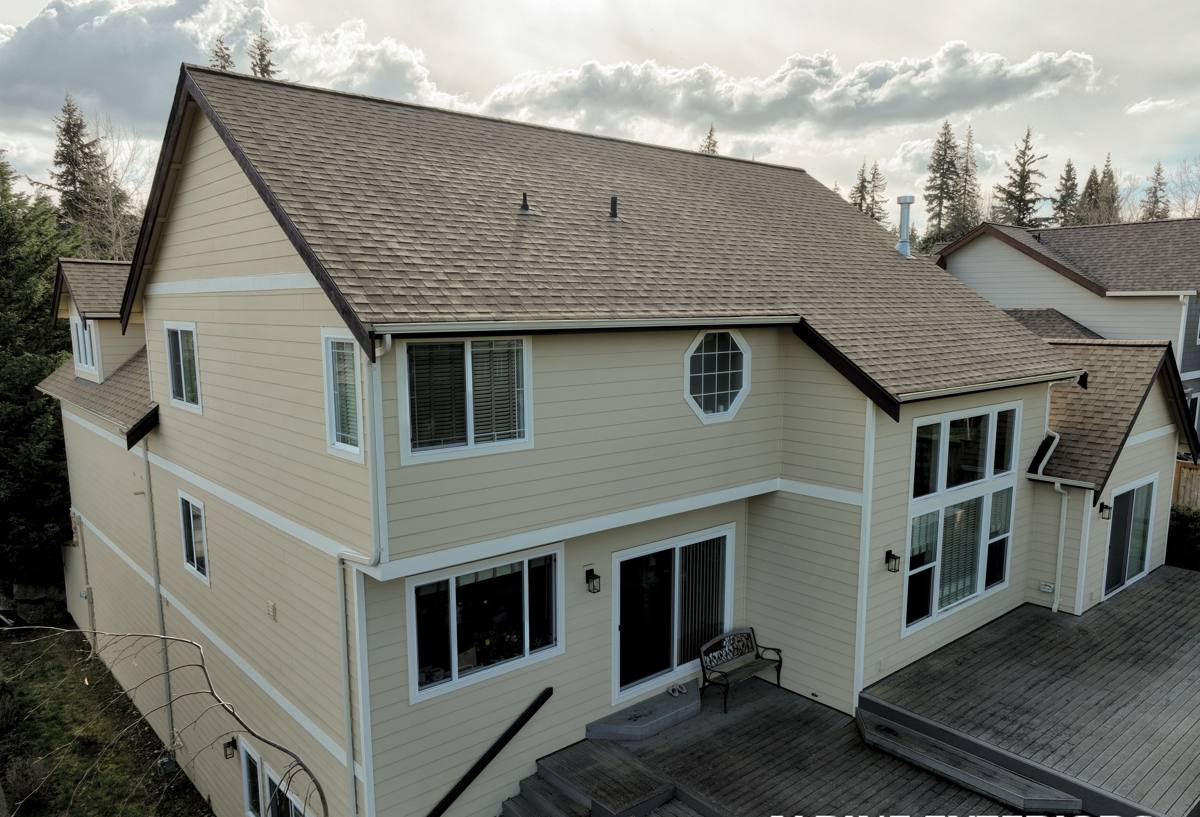
Primed spruce lap siding is a wood product — solid spruce boards milled to a lap profile and coated at the factory (or on site) with a coat of primer before the final paint goes on. It's been a staple in Pacific Northwest construction for decades because it's affordable, it's easy for framing crews to cut and nail, and it gives a house that traditional narrow-lap look a lot of Whatcom County buyers associate with a "real" wood home. There's nothing dishonest about the product. It's genuine solid wood, it takes paint well when it's fresh, and a lot of older homes around Chuckanut and Bellingham still wear it.
Our position isn't that primed spruce is a bad product on paper. It's that after years of servicing exteriors in this specific climate, we stopped installing it — and we think homeowners deserve to know exactly why before they sign a contract with anyone.
Where We Give Primed Spruce Credit
To be fair to the product: solid wood siding has a warmth and a natural grain that manufactured products spend a lot of engineering trying to replicate. It's a renewable material, it's simple to repair in small sections if you catch damage early, and a well-maintained spruce-sided home can look great for a long time. If a homeowner is committed to a strict repaint and inspection schedule and understands the tradeoffs going in, that's an informed choice we respect — we just won't be the crew installing it.
The Local Weather Problem: Salt Air, Driving Rain, and Moss
Salt Air
Chuckanut sits close enough to the water that salt-laden air is a constant, low-grade stressor on exterior materials. Salt air doesn't just corrode metal fasteners and flashing faster — it also holds moisture against surfaces longer than dry inland air does. Wood siding depends on being able to dry out between wet cycles. When the air itself stays slightly damp and salty for long stretches, that drying window shrinks, and paint film starts to fail from underneath before it looks obviously bad on the surface.
Driving Rain
Whatcom County doesn't just get a lot of rain — a good share of it comes in sideways off wind-driven storms rolling in from the Sound. Wind-driven rain gets pushed up and under lap joints and into end-grain cuts in ways that vertical rain never would. Spruce lap siding relies on paint film and caulk at every joint and end cut to keep water out, and those are exactly the points driving rain attacks hardest.
Moss Season
Between the shade from mature trees common on Chuckanut lots and the long stretch of wet, mild months, this area has what amounts to a moss and algae season that runs far longer than most of the country. Moss holds moisture directly against the siding surface for weeks at a time. On fiber cement that's a cosmetic cleaning issue. On wood, sustained contact moisture under a moss mat is exactly the condition that starts soft spots and rot.
Paint and Maintenance: The Real Cost Over Time
The sticker price on primed spruce siding is lower than fiber cement up front. What it doesn't show you is the maintenance schedule that comes with it. Primer is not a finish coat — it's a base layer that's meant to be top-coated with paint within a matter of weeks, and even after that, wood siding in a wet coastal climate typically needs a full repaint cycle well before a factory-finished fiber cement product needs any attention at all.
| Factor | Primed Spruce Siding | James Hardie Fiber Cement |
|---|---|---|
| Finish | Field-applied primer + paint, homeowner maintains | Factory ColorPlus finish, baked on and warrantied |
| Typical repaint interval | Every 5-8 years in this climate | 15+ years before finish attention needed |
| Moisture behavior | Absorbs and swells; needs to dry between wet cycles | Engineered for wet climates; won't rot or swell |
| Moss/algae impact | Trapped moisture can lead to rot underneath | Cosmetic only; surface can be cleaned |
| Fire rating | Combustible | Non-combustible |
| Insect vulnerability | Susceptible to carpenter ants, woodpeckers, rot organisms | Not a food or nesting source |
None of these numbers are a knock on the crews who install spruce — they're just what the material asks of an owner living in a marine climate with this much annual rainfall and salt exposure.
Moisture, Rot, and Insect Exposure
Solid wood siding is a hygroscopic material — it absorbs and releases moisture with the surrounding air. That's fine in a dry climate. In Whatcom County, where the wet season stretches across most of the year, spruce boards spend a lot of time holding more moisture than they'd like to. Once paint film starts to crack or a caulk joint opens up, water gets into the wood fibers directly, and that's the starting point for rot, delamination at the primer bond line, and softening at butt joints and lower courses near grade.
Wood siding is also a food and nesting source for carpenter ants and a target for woodpeckers, both of which are active issues on wooded Chuckanut lots. Fiber cement removes that vulnerability entirely — there's no organic material for insects to exploit.
Installation Sensitivity We're Not Willing to Gamble On
Even when primed spruce siding is installed correctly, it demands a level of field discipline that's easy to shortcut and hard for a homeowner to verify after the fact:
- Every cut end needs to be sealed with primer or end-sealer before installation — an exposed cut end is a direct path for water into the board.
- Back-priming (coating the hidden face of the board before it goes up) is often skipped to save time, leaving the board unprotected from moisture wicking up from behind.
- Fresh primer has a limited window before it needs a top coat — delays between rough-in and final paint leave bare primer exposed to weather it wasn't designed to handle alone.
- Nail placement and caulk joints have to be nearly perfect at every lap and butt seam, since there's no factory-engineered drainage plane behind the board doing extra work.
- Any of these steps done wrong doesn't show up as a problem on day one — it shows up two or three winters later as a soft spot or a paint failure.
We install a lot of siding in this climate, and the failure patterns we've traced back on wood siding jobs almost always lead to one of these steps getting rushed or skipped — often by no fault of the original owner, since it's invisible at the time.
Warranty Reality: What's Actually Backing the Product
Primed spruce siding typically carries a limited manufacturer warranty on the board itself, but the finish — the part actually exposed to salt air and rain — is field-applied, which means the paint warranty (if any) comes from the paint manufacturer or the installing contractor, not the siding maker. That splits your protection across two or three different parties instead of one accountable warranty.
Before committing to any wood siding product, it's worth asking direct questions:
- Is the warranty on the board material, the factory primer, or the field-applied paint — and who backs each piece?
- Does the warranty require documented maintenance (repainting on schedule) to stay valid?
- Is the warranty transferable if you sell the home?
- What specifically voids it — moisture damage, missed maintenance, improper installation?
Why We Install James Hardie Instead
James Hardie fiber cement is engineered specifically for climates like this one. The HZ5 product line is formulated for wet, freeze-prone regions, the ColorPlus finish is baked on at the factory under controlled conditions rather than applied on a job site at the mercy of weather, and the material itself is non-combustible and doesn't feed insects or rot from sustained moisture contact. It still needs to be installed to spec — correct clearances, fastening, and flashing matter on any siding product — but it removes the moisture-absorption problem at the root instead of asking paint film to fight it every year.
The warranty structure is also simpler: one manufacturer standing behind both the substrate and the factory finish, with a transferable limited warranty that doesn't hinge on a homeowner keeping to a strict repaint schedule. That's a meaningfully different risk profile for a house sitting a few miles from saltwater with a moss season that runs most of the year.
Get an Honest Look at Your Home
If you're weighing primed spruce, cedar, or another wood siding against fiber cement for a home in the Chuckanut area, we're glad to walk the exterior with you, point out what your specific site conditions — sun exposure, tree cover, wind direction — are likely to do to each option, and give you a straightforward, no-pressure estimate for a James Hardie installation. There's no obligation, and no pressure to sign anything on the spot.