 Chuckanut Exterior
 Allura Is a Real Fiber Cement Product — Here's the Honest Version
We get asked about Allura siding often enough that it's worth explaining plainly. Allura is a legitimate fiber cement siding manufacturer. It's not vinyl dressed up to look like something else, and it's not a fly-by-night product. Fiber cement as a category — cellulose fiber, sand, and Portland cement pressed into planks and panels — is genuinely good siding material. It doesn't rot, it resists fire far better than wood or vinyl, and it holds paint or factory finish longer than most alternatives. Allura makes that same basic material.
So this isn't a page about a bad product. It's a page about why, after installing siding on homes throughout Whatcom County, we made a business decision to install James Hardie exclusively and not stock, quote, or install Allura, LP SmartSide, Cemplank, vinyl, or wood alternatives. The reasons come down to consistency, climate fit for the Chuckanut area, warranty structure, and what happens ten and twenty years down the road — not marketing.
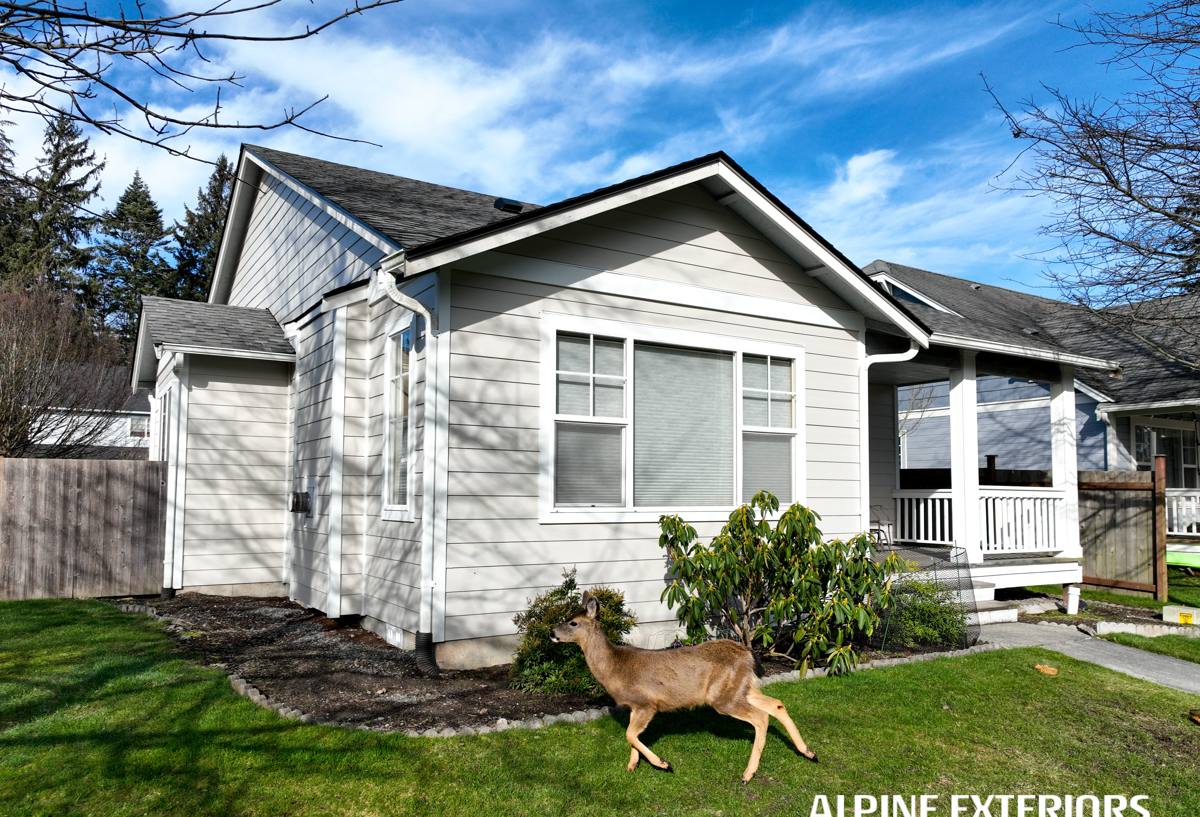
Why Chuckanut's Climate Makes This a Real Decision, Not a Preference
Chuckanut sits right where Samish Bay meets the hills, which means homes here deal with a specific combination of stresses that inland siding jobs don't see. Salt-laden air off the water accelerates corrosion on fasteners, trim, and any exposed metal components. Driving rain off Bellingham Bay and the Sound pushes water sideways into wall assemblies, not just straight down. And the long, damp moss season here — often eight or nine months of consistently wet, shaded conditions — means anything that traps or wicks moisture at the surface becomes a maintenance problem fast.
Fiber cement in general performs well against all three of those stresses compared to wood, vinyl, or engineered wood siding. But not all fiber cement is engineered the same way for the same climates, and that's where the differences between manufacturers start to matter more than the marketing suggests.
What "Climate-Engineered" Actually Means
James Hardie produces regional formulations — HZ5 for the Pacific Northwest's freeze-thaw and moisture cycles specifically — rather than a single national formula. The density, moisture resistance, and flexibility of the board are tuned for the conditions we actually get in Whatcom County: wet winters, cool damp summers, and salt exposure near the water. Allura, like most competitors, produces a more general-purpose fiber cement formulation without that same regional engineering. The base material is still fiber cement and still outperforms wood or vinyl, but it isn't specifically tuned for a marine, high-moss, high-rainfall environment the way Hardie's HZ5 line is.
Factory Finish: The Detail That Shows Up in Year Five, Not Year One
Every fiber cement siding job looks good on install day. The difference between manufacturers shows up years later, and it mostly comes down to how the color coat was applied and cured.
James Hardie's ColorPlus finish is baked on in a controlled factory environment, cured under conditions designed to bond the finish to the substrate and resist UV fade, chipping, and the kind of surface breakdown that damp, mossy conditions accelerate. It carries its own dedicated finish warranty separate from the substrate warranty. Allura also offers factory-finished options, and to be fair, factory finishes generally beat field-applied paint. But the track record and warranty structure behind ColorPlus, specifically for finish durability in wet marine climates like ours, is more established and more heavily tested over more years in the field than Allura's finish program. When we're the ones a homeowner calls back in year eight about a chalking or fading finish, that track record matters to us directly, not just abstractly.
Warranty Structure: Read the Fine Print, Not Just the Headline Number
Almost every fiber cement manufacturer advertises a long warranty — often 30 years or more. The number on the brochure isn't where the real differences live; the differences are in what's covered, whether it's prorated, and whether it transfers cleanly to a new owner if the home sells.
| Factor | James Hardie | Allura |
|---|---|---|
| Substrate warranty length | Non-prorated, long-term coverage on the board itself | Long-term coverage, terms vary by product line |
| Finish warranty | Separate, dedicated ColorPlus finish warranty | Finish coverage tied to specific factory-finish SKUs |
| Transferability | Transfers to subsequent homeowners | Transferability varies by product and documentation |
| Installer network depth in PNW | Large, well-established regional contractor base | Smaller regional presence |
None of that means Allura's warranty is fraudulent or weak on paper. It means that when something goes wrong on a fiber cement job — and over 20-30 years, something eventually needs attention on any siding — we want a manufacturer with a deep, established claims process and a large enough regional installer base that parts, matching profiles, and finish batches are still readily available. Hardie's scale in the Pacific Northwest gives us that. It's a practical, not sentimental, reason to standardize.
Installation Sensitivity: The Part Homeowners Never See
Fiber cement siding, from any manufacturer, is unforgiving of bad installation. Improper fastener placement, wrong clearances, missing flashing details, or gaps at butt joints don't show up as a problem on day one — they show up two or three wet seasons later as water intrusion, cracking at stress points, or a finish that starts failing early because moisture got behind the board.
We install to a single, consistent spec because our crews are trained and re-trained on one set of installation details, one set of flashing and clearance standards, and one manufacturer's fastening schedule. Every additional product line we'd carry means another set of installation nuances our crews have to hold in their heads on a rainy Tuesday in Whatcom County — clearances at grade, kick-out flashing at roof-wall intersections, joint treatment, caulking specs that differ subtly between manufacturers. Standardizing on one system reduces the chance that a detail gets mixed up between jobs. That's not a knock on Allura's installation requirements specifically — it's an argument for any contractor to specialize rather than spread thin across five siding brands.
Cost Factors Worth Understanding Before You Compare Bids
If you're getting quotes and one contractor is proposing Allura at a noticeably lower number than a Hardie quote, it's worth understanding where that gap usually comes from rather than assuming one bid is simply "better priced."
| Cost factor | What drives it |
|---|---|
| Material cost | Allura board and panel pricing typically runs somewhat below Hardie at the distributor level |
| Regional freight/availability | Hardie's larger PNW distribution network can mean fewer delays and better batch matching for repairs |
| Trim and accessory matching | Hardie's trim, soffit, and accessory lines are engineered as one system; mixing brands for trim vs. field can create finish or expansion mismatches |
| Labor | Similar install labor between comparable fiber cement products when done to spec |
| Long-term maintenance | Finish and warranty differences show up as maintenance or repaint costs later, not on the install invoice |
A lower material cost isn't a bad reason to choose a product — it's a legitimate trade-off some homeowners make deliberately. Our position is simply that we'd rather not install a lower-tier system and hope it performs; we'd rather install the system we trust for this specific climate and stand behind it fully.
What We Recommend Instead
We install James Hardie's fiber cement lines exclusively — non-combustible, engineered for Pacific Northwest moisture and freeze-thaw cycles in the HZ5 formulation, finished with ColorPlus factory coating, and backed by a warranty structure with a long regional track record. It's not the cheapest siding material on the market, and we're upfront about that. It's the one we're comfortable putting our name behind on a house that's going to face decades of Chuckanut's salt air, sideways rain, and moss.
A Checklist If You're Comparing Siding Products Yourself
- Ask whether the fiber cement formulation is climate-specific or a single national formula
- Ask if the finish is factory-applied and what the separate finish warranty covers
- Get the warranty document itself, not just the advertised number — check if it's prorated
- Ask if the warranty transfers to a future buyer if you sell the home
- Ask your installer how many other siding brands they install and how often they switch between install specs
- Check whether trim, soffit, and accessories come from the same manufacturer as the field siding
- Ask what happens if a panel needs replacing in ten years — is matching material still readily available regionally
If you're planning a siding project in Chuckanut or anywhere in Whatcom County and want a straight answer about what's right for your home, we're happy to walk the exterior with you and give a free, no-pressure estimate — no obligation either way.