 Chuckanut Exterior
 Vinyl Siding Isn't a Bad Product — It's Just Not the Right Fit Here
We want to start by being fair: vinyl siding is not a scam, and it's not junk. It's one of the most widely installed siding products in the country for good reason — it's inexpensive, it's light, and for a lot of climates it does an adequate job for a while. If someone tells you vinyl siding is worthless, they're overselling their point.
But "works fine in a lot of places" and "works well on a house three miles from Bellingham Bay, under fir trees, in a county that gets driving rain nine months a year" are two different claims. Chuckanut and the surrounding parts of Whatcom County have a specific climate signature — salt-laden marine air, wind-driven rain off the Salish Sea, and long stretches of damp, low-light weather that keep moss and algae active almost year-round. Vinyl siding wasn't engineered around that combination, and after years of installing and repairing siding on homes in this exact stretch of coastline, we made the decision to stop installing it. Here's the honest reasoning, not a sales pitch.
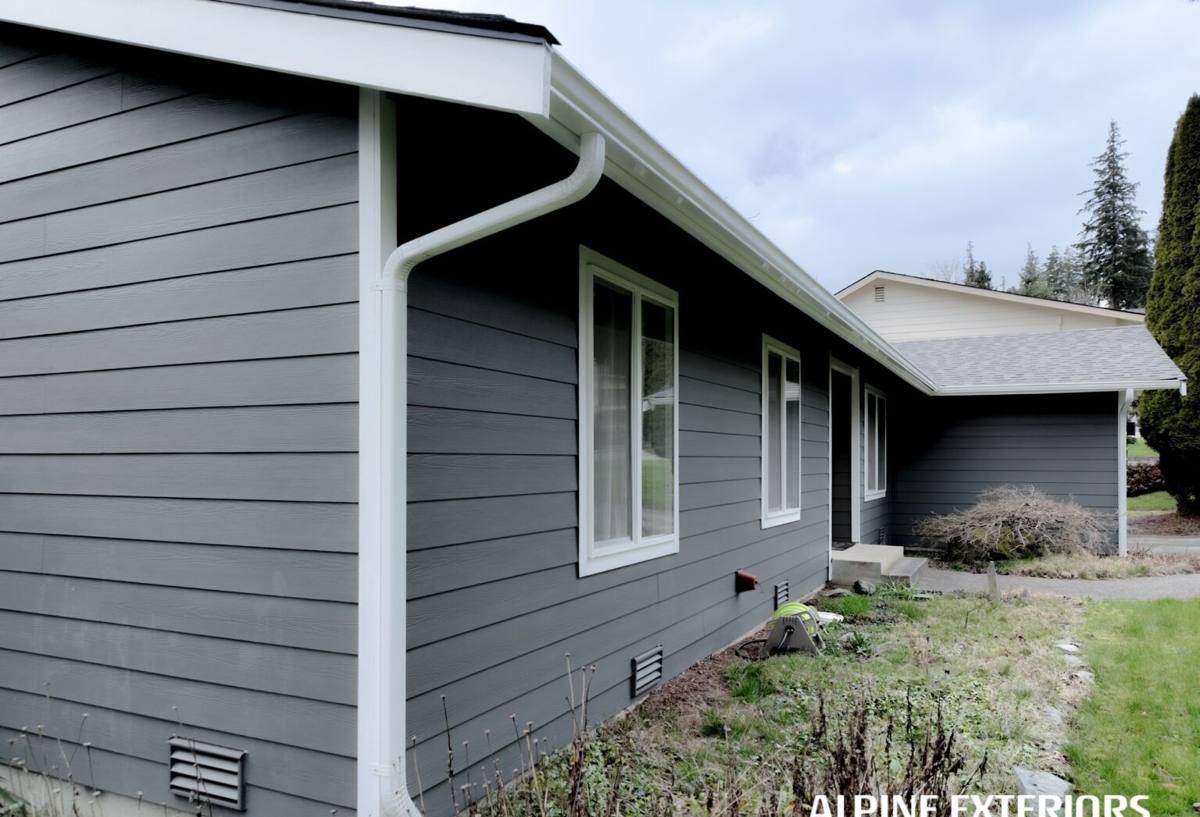
What Vinyl Siding Actually Is
Vinyl siding is an extruded PVC plastic panel, colored all the way through (not painted on the surface), and installed in overlapping horizontal or vertical courses. It's hung — not fastened rigidly — because PVC expands and contracts significantly with temperature swings. That single fact drives almost every trade-off below.
What it gets right
- Low material and labor cost compared to most other siding types
- Lightweight, fast to install on a straightforward wall
- No painting required for the life of the panel
- Reasonable performance in dry, moderate climates with minimal wind exposure
Where It Struggles in a Marine Climate Like Ours
Wind-driven rain finds the seams
Vinyl siding is a lap system, not a sealed water barrier — manufacturers are explicit that it's designed to shed bulk water while relying on the house wrap and flashing behind it to manage anything that gets past the laps. In a climate with occasional heavy, sideways rain coming off the water, that "anything that gets past the laps" is not a rare event. It's a regular one. The siding itself may look fine for years while moisture works its way behind it through seams, corners, and utility penetrations that weren't detailed perfectly the first time.
Wind exposure and fastening tolerance
Because vinyl panels have to hang loose to allow for expansion, they rely on nails driven in the center of the nailing slot, not snug against it. Overdriving a single nail — something that happens constantly on real job sites, even good ones — restricts that movement and sets up buckling, oil-canning (a rippled, wavy look in direct light), or outright panel failure in a windstorm. Homes exposed to open wind lines off the bay see this more than sheltered inland lots. The product's real-world performance depends enormously on installer discipline, on every course, on every house — which is a hard thing to guarantee at vinyl's price point and installation pace.
Moss, algae, and the seams that trap them
Whatcom County's long wet season is exactly what moss and algae need to establish. Vinyl doesn't feed organic growth any more than other siding, but its lap seams, J-channels, and trim pieces create small ledges and shadowed pockets where spores settle and moisture lingers longer than it would on a smoother, better-draining surface. Over a decade of damp winters, those seams are usually where the green streaking shows up first.
Salt air and long-term surface condition
Salt-laden air accelerates the natural chalking and fading that all vinyl experiences over time, and it's harder on the aluminum trim, screws, and flashing components used alongside vinyl systems. None of this is unique to vinyl — salt air is tough on everything — but it's another reason a plastic product engineered for a national average climate isn't the product we'd choose to warranty on a house within sight of the water.
Fire exposure
Vinyl siding is a combustible plastic. It can soften, deform, or ignite at temperatures well below what non-combustible materials tolerate, particularly near attached decks, grills, or in wildfire-adjacent conditions. It's a real factor in Pacific Northwest wildfire seasons, even for homes that aren't in a classic forest interface zone.
Repair and resale reality
Vinyl colors fade unevenly over time, and manufacturers regularly discontinue and replace color lines. If a panel cracks in a windstorm or gets damaged by a falling branch five or ten years in, finding an exact color match is often impossible — you end up with a visibly newer, brighter patch on an older wall. It's a cosmetic issue, but it's a permanent one, and it shows up at resale on a house where buyers are increasingly siding-literate.
Side-by-Side: Vinyl vs. James Hardie Fiber Cement
| Factor | Vinyl Siding | James Hardie Fiber Cement |
|---|---|---|
| Material | Extruded PVC plastic | Cement, sand, and cellulose fiber |
| Combustibility | Combustible | Non-combustible |
| Wind performance | Installation-sensitive; can buckle or blow off if over/under-fastened | Rigid panel, high wind ratings when installed to spec |
| Moisture handling | Relies entirely on house wrap behind the laps | Engineered HZ5 formulation for wet, marine climates |
| Finish | Color runs through the plastic; chalks and fades with UV and salt air | ColorPlus factory-baked finish, resists fading and chipping |
| Moss/algae resistance | Seams and trim trap moisture and organic growth | Denser surface, fewer trap points, holds up better in prolonged damp |
| Repair/color match | Discontinued colors common; patches often visibly mismatched | ColorPlus warranty covers finish; consistent factory color across replacement boards |
| Warranty | Prorated after early years on many product lines | Non-prorated, transferable manufacturer warranty |
Why We Standardized on James Hardie Instead
We don't install LP SmartSide, Cemplank, Allura, primed spruce, cedar, or vinyl. We install James Hardie fiber cement, exclusively, and the reasoning is the same reasoning that ruled out vinyl: this climate rewards materials engineered specifically for it.
Hardie's HZ5 product line is formulated for exactly the kind of freeze-thaw, high-moisture, marine exposure that Whatcom County sees. It's non-combustible, which matters more every wildfire season. The ColorPlus factory finish is baked on under controlled conditions rather than applied as surface paint or run through the material as plastic pigment, and it carries its own finish warranty separate from the substrate warranty. It doesn't buckle with temperature swings the way a loosely-hung plastic panel can, and it holds a paint or factory finish far more evenly over 20-plus years outdoors on the coast.
None of that makes Hardie "no maintenance forever" — it still needs to be installed correctly, caulked and flashed correctly, and it costs more upfront than vinyl. But it's the standard we're willing to put our name and our warranty behind on homes that sit in driving rain and salt air for decades.
What to Check If You Already Have Vinyl Siding
If your home currently has vinyl and it's holding up fine, there's often no urgent reason to replace it early. But it's worth an honest inspection every few years, especially after a hard winter:
- Look at inside corners and J-channels for green or black streaking that keeps returning after cleaning
- Check for panels that look wavy or rippled in low-angle light — a sign of restricted expansion
- Press gently near the bottom courses and around windows for soft or spongy wall sheathing underneath, a sign moisture has been getting behind the panels
- Note any faded or chalky sections next to newer trim — a preview of how hard color-matching a future repair will be
- Ask whether the original installer nailed to manufacturer spec if you're seeing widespread buckling — installation error, not the product itself, is the usual cause
None of these are emergencies on their own, but a pattern of two or three of them is a reasonable signal to start planning a replacement before a storm forces the decision.
Talk to Us Before You Decide
We're not going to tell you vinyl siding is a disaster waiting to happen — for a lot of houses in a lot of places, it's a reasonable, budget-conscious choice. We just won't be the ones installing it, because we've seen how it performs specifically here, on the coast, in Chuckanut's rain and salt air, over the long haul. If you're weighing siding options for a home in the area, we're happy to walk your specific house, point out what we'd actually be concerned about, and give you a straight answer — even if that answer sends you looking at a lower-cost option elsewhere. Reach out for a free, no-pressure estimate and we'll tell you exactly what we'd do and why.