 Chuckanut Exterior
 Why Chuckanut Roofs Wear Differently Than Roofs Inland
A roof in Chuckanut does not age the same way a roof does forty miles east in the Nooksack valley. Being close to Bellingham Bay means your shingles, flashing, and fasteners are living with a steady dose of salt-laden air on top of everything else the Pacific Northwest throws at a roof. Salt air accelerates corrosion on exposed metal — nail heads, flashing, gutter hangers, roof vents — long before the shingles themselves would normally need replacing. That corrosion is often the real reason a roof starts leaking around year fifteen or eighteen, not the shingle material failing on its own.
Layer on top of that Whatcom County's driving rain, which does not fall straight down but gets pushed sideways under eaves and around vents by wind off the water, and a long moss season that can run from October through May in shaded, north-facing roof sections. Each of these factors interacts with the others. Moss holds moisture against the roof deck. Driving rain finds any gap moss growth has lifted at a shingle edge. Salt air weakens the metal that is supposed to keep that water out. None of this means your roof is doomed — it means the decisions you make about materials, ventilation, and maintenance matter more here than they would in a drier, inland climate.
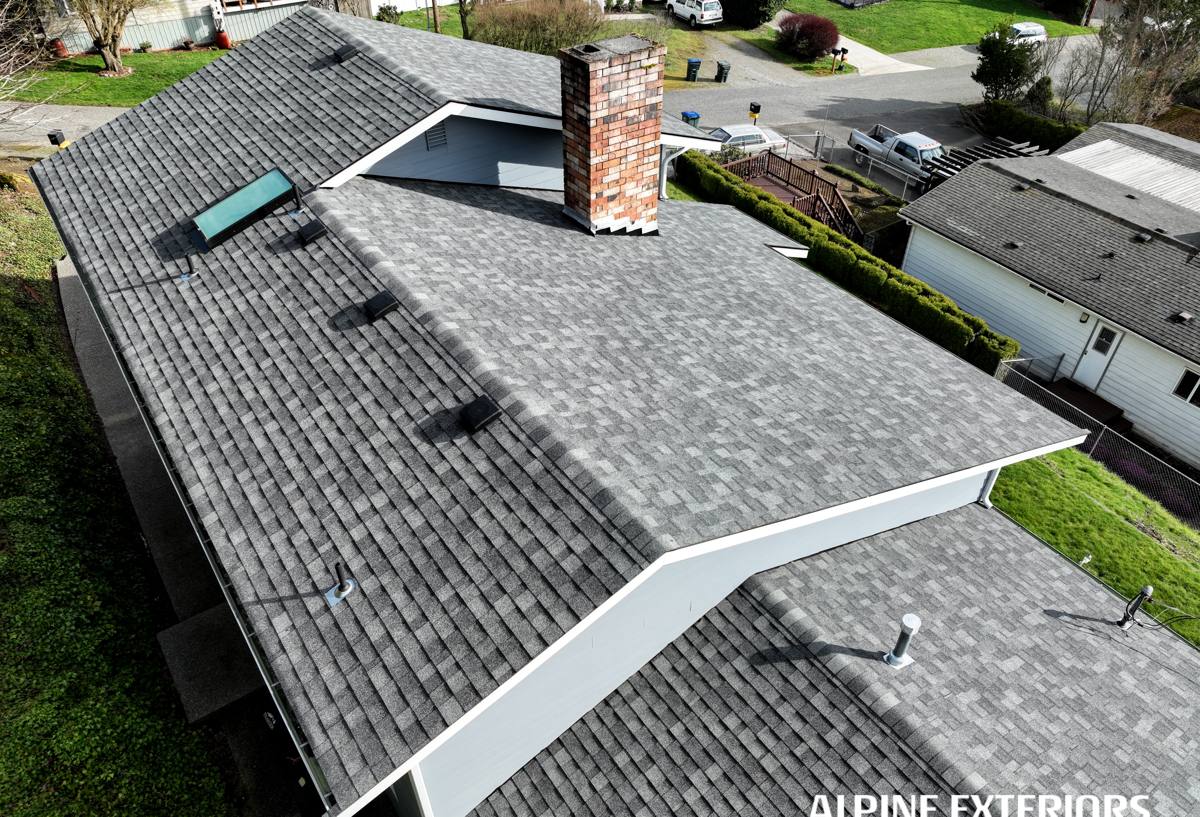
Signs You Need Replacement, Not Another Repair
Most roofs give warning signs well before a full failure. The trouble is that a lot of homeowners patch the same symptom two or three times before realizing the underlying roof is done. Here is what actually indicates you have moved past the repair stage:
- Granules collecting in gutters and downspouts in noticeable amounts, not just a light dusting
- Shingles that are cupping, curling at the edges, or cracking when you look at them from the ground
- Daylight visible through the roof deck from inside the attic
- Soft or spongy spots when walked on, indicating a compromised deck underneath
- Moss or dark streaking covering large sections, especially on north- and west-facing slopes
- Flashing around chimneys, skylights, and roof-to-wall transitions that is rusted, lifted, or was never properly stepped in
- Two or more separate leak repairs in the same roof within the last three years
A single missing shingle or a cracked pipe boot is a repair. A roof showing three or more of the signs above is telling you the underlying materials have reached the end of their useful life, and further patching is just delaying a bigger, more expensive failure.
How Long Should a Chuckanut Roof Actually Last?
Manufacturer ratings assume ideal conditions that rarely exist on a coastal Whatcom County roof. In practice, a standard 3-tab asphalt shingle roof here tends to perform for 15-20 years rather than the 20-25 years quoted on the package. Architectural (dimensional) shingles typically run 22-28 years. Metal roofing, when installed with corrosion-resistant fasteners and proper coating, can push 40-50 years even with salt air exposure. These are ranges, not guarantees — ventilation, moss maintenance, and installation quality move the actual number up or down by a decade in either direction.
Comparing Roofing Materials for This Climate
There is no single "best" roofing material for every home — it depends on your budget, roof pitch, and how much long-term maintenance you want to take on. Here is an honest comparison of the options homeowners in this area typically weigh:
| Material | Typical Lifespan Here | Moss/Moisture Behavior | Relative Cost |
|---|---|---|---|
| 3-Tab Asphalt Shingle | 15-20 years | Prone to moss anchoring in the granule surface; needs regular treatment | Lowest |
| Architectural Shingle | 22-28 years | Thicker profile sheds water better but still needs moss control | Moderate |
| Standing Seam Metal | 40-50 years | Smooth surface resists moss anchoring; sheds driving rain well | Highest upfront |
| Composite/Synthetic Shake | 30-40 years | Good moisture resistance; varies by manufacturer | High |
Metal's higher upfront cost is the main reason more homes here still use architectural shingle rather than metal — but for a roof with heavy tree cover or persistent moss problems, the lower long-term maintenance of metal is worth running the numbers on.
What a Proper Tear-Off and Replacement Actually Involves
A roof replacement is not just removing old shingles and nailing down new ones. In a climate that sees this much sustained moisture, the steps you cannot see matter as much as the finished surface:
- Full tear-off to the deck — layering new shingles over old ones traps moisture and voids most manufacturer warranties
- Deck inspection and repair — any soft, delaminated, or water-stained plywood/OSB gets replaced before anything else goes down
- Ice-and-water shield at vulnerable zones — eaves, valleys, and roof penetrations, which is where driving rain does the most damage
- Synthetic underlayment across the full deck — a second line of defense under the shingles
- New flashing at every chimney, skylight, vent stack, and wall intersection — reusing old flashing is one of the most common causes of early leaks
- Proper nailing pattern and shingle exposure per manufacturer spec, not shortcuts to save time
- Ridge and intake ventilation installed or corrected to keep the attic from trapping moisture
Skipping any one of these steps to hit a lower price is exactly how a roof that should last 25 years starts leaking in year eight.
Ventilation and Moisture: The Step Homeowners Overlook
A roof replacement without a hard look at attic ventilation is an incomplete job, especially here. Poor ventilation traps warm, moist air against the underside of the roof deck, which accelerates deck rot from the inside and creates the exact conditions moss and mildew like on the outside. Balanced ventilation — enough intake at the soffits and enough exhaust at the ridge — keeps air moving through the attic year-round. If your current roof shows sheathing discoloration, mold on rafters, or ice damming in winter, a new roof surface will not fix the underlying problem. The ventilation has to be corrected as part of the same project.
Roof and Siding Timing: Why It Is Worth Coordinating
Because this company works on the full building envelope — siding and roofing both interact with the same moisture and wind exposure — it is worth thinking about your roof and siding as connected systems rather than separate projects done years apart. Flashing at the roofline, drip edges, and the transition where siding meets the roof deck are common leak points regardless of which trade did the work. If your siding is also aging out around the same time as your roof, doing both in a coordinated sequence avoids redoing flashing details twice and gives you one consistent moisture barrier at the most vulnerable transition on the house. It is not necessary to replace both at once, but it is worth asking your contractor to inspect the roof-siding transition whenever either one is being replaced.
What Drives the Cost of a Roof Replacement
Roofing quotes vary widely, and the total is driven by more than just square footage. The main factors:
| Factor | Why It Matters |
|---|---|
| Roof pitch and complexity | Steep or multi-plane roofs take longer and require more safety setup |
| Number of layers being removed | Tear-off labor scales with how many old layers are underneath |
| Deck condition | Rotted sheathing found during tear-off adds material and labor |
| Material choice | Asphalt, metal, and composite carry very different price points |
| Flashing and penetration count | Chimneys, skylights, and multiple vents add detail work |
| Access and staging | Steep lots or limited driveway access affect equipment and disposal costs |
A written estimate should break these out rather than giving a single lump number — that is the only way to compare quotes apples-to-apples.
Choosing a Roofing Contractor in Whatcom County
The roofing trade attracts a fair number of storm-chasing crews that show up after a wind event, do fast work, and are gone before problems surface. A few checks protect you from that:
- Confirm active Washington state contractor registration and general liability insurance — ask to see the certificate, not just take their word for it
- Ask whether they pull a permit for full re-roofs — Whatcom County and most local jurisdictions require one, and a contractor avoiding permits is avoiding inspection
- Get the manufacturer certification level in writing if a manufacturer-backed warranty is part of the quote
- Ask specifically how they handle deck repair pricing — change orders for rotted sheathing should have a stated per-sheet rate up front, not be negotiated mid-project
- Check that the estimate specifies underlayment type, ice-and-water shield locations, and ventilation scope, not just "tear off and replace"
- Get references from jobs at least two to three years old, not just recent ones — that is long enough for early workmanship problems to show up
Permits, Warranty, and Insurance Basics
A full roof replacement in Whatcom County typically requires a building permit, and your contractor should handle that as part of the project rather than leaving it to you. Warranty coverage on a roof usually comes in two separate pieces: a manufacturer's material warranty covering defects in the shingles or metal itself, and a separate workmanship warranty from the installing contractor covering labor errors. Read both — a long manufacturer warranty means little if the contractor's workmanship coverage is only one or two years. If your homeowner's insurance is involved due to storm or wind damage, get your own independent estimate before signing anything with a contractor who also wants to handle the insurance claim on your behalf; that keeps the scope of repair based on what your roof actually needs rather than what the claim allows.
Getting a Straight Answer for Your Roof
Every roof in Chuckanut ages differently depending on tree cover, sun exposure, pitch, and how close it sits to the water. If you are seeing granule loss, moss buildup, or recurring leaks and are not sure whether you are looking at a repair or a full replacement, we are happy to take a look and give you a straightforward read on where your roof actually stands. Reach out for a free, no-pressure estimate — there is no obligation, and you will walk away with a clear picture of your options either way.