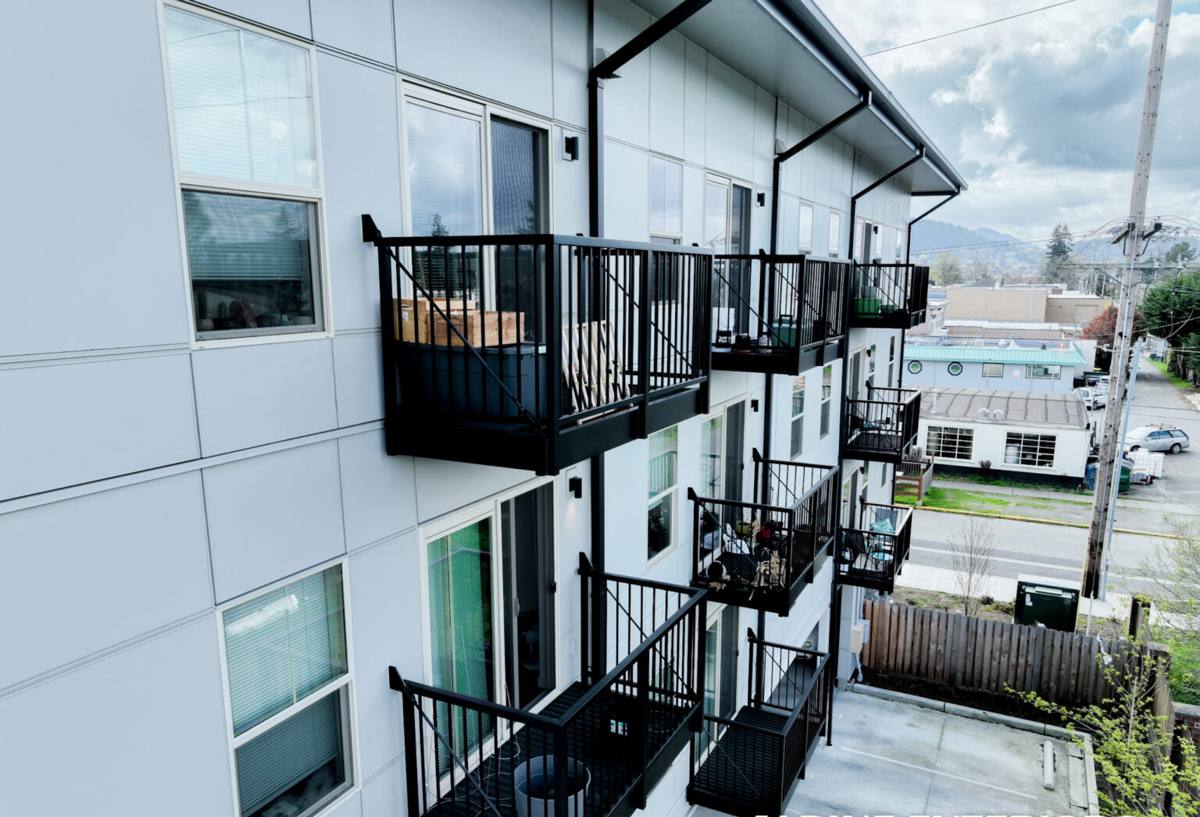
 Chuckanut Exterior
 What LP SmartSide Actually Is
LP SmartSide is an engineered wood siding product made from wood strands and fibers bonded with resins under heat and pressure, then treated with a zinc borate solution to resist fungal decay and insects, and finished with a primer coat at the factory. It comes in lap siding, panel siding, and trim profiles, and it has been on the market for decades under different ownership and formulations. It is a real, code-approved product, not a knockoff — plenty of homes around Whatcom County wear it today.
The core material is different from the fiber cement products we install. LP SmartSide is wood-based, so its performance depends heavily on keeping water out of the strand board itself. That distinction matters a lot in a place like Chuckanut, where the siding on a house faces salt-laden air off the bay, long stretches of driving rain, and a moss season that can run most of the year.
What LP SmartSide Gets Right
We are not going to pretend this is a bad product to make a point. It has real strengths, and homeowners deserve an honest accounting of them before we explain why we don't install it.
- It is noticeably lighter than fiber cement, which can make it faster and less physically demanding to install on some crews.
- It cuts and nails more like traditional wood, which some carpenters find easier to work with than fiber cement.
- It resists cracking from impact reasonably well, since the wood-strand structure has some flex to it.
- It is often priced below premium fiber cement siding, which matters on tight budgets.
- The factory primer gives it a head start on paint adhesion compared to raw wood siding.
If a homeowner asked us to name honest reasons a product like this gets specified, those are the real ones. The trouble starts once you look at how it performs over ten, twenty, and thirty years in this specific climate.
The Trade-Offs That Matter in Chuckanut's Climate
Moisture and a Wood-Based Substrate
Zinc borate treatment protects the wood strands from rot and insects as long as the coating on the surface stays intact and water is not allowed to sit against or soak into the material. The moment a cut end, a nail hole, a scratch, or a failed caulk joint lets water in repeatedly, that treatment is working against a much harder problem than it was designed for. Whatcom County gets a lot of slow, sustained rain rather than short heavy downpours — the kind of weather that gives water time to find every gap in a building envelope.
Edge and Cut-End Sealing
Every cut end, joint, and fastener penetration on an engineered wood product needs to be field-sealed according to the manufacturer's instructions, every time, by every crew member, for the life of the installation. Miss one butt joint behind a downspout or under an eave with no overhang, and that is where swelling and delamination typically start. This is a maintenance-dependent system, not a set-it-and-forget-it one.
Salt Air and Coastal Exposure
Chuckanut sits close enough to salt water that homes here deal with airborne salt settling on exterior surfaces year-round. Salt is hygroscopic — it pulls moisture out of the air and holds it against whatever surface it lands on. On a painted wood-based product, that means the paint film and caulking are working overtime near the coast, and any breach in that film gives salt-laden moisture a direct path to the substrate.
Moss and Prolonged Dampness
Whatcom County's long moss season is not just a roof problem. Moss and algae growth on north-facing walls, under trees, and in shaded side yards holds moisture against the siding surface for extended periods. On fiber cement that moisture mostly just sits there until it evaporates. On a wood-based product, prolonged surface dampness is exactly the condition that stresses the material and its coatings the most.
Installation Sensitivity Is the Real Story
LP SmartSide's manufacturer publishes detailed installation requirements — clearances above grade and roof lines, specific caulking and priming steps at every cut, fastener spacing, and gap tolerances for expansion. Warranty coverage is generally tied to following those instructions precisely. That is not unusual for a manufacturer, but it does mean the finished product's real-world durability rests almost entirely on installer discipline, on a job site, in Pacific Northwest weather, over the multi-day span of a siding project.
Fiber cement has installation requirements too, but the material itself is not moisture-reactive the way wood strand is — a small installation miss on Hardie siding does not have the same downstream consequence as a small installation miss on an engineered wood product. That gap between "installed correctly" and "installed adequately" is where we have seen the biggest difference in how a siding job actually holds up ten years later.
The Maintenance Burden Over Time
Every exterior siding product needs some upkeep. The honest comparison is about how much, how often, and how unforgiving the consequences are of falling behind.
| Factor | LP SmartSide (engineered wood) | James Hardie (fiber cement) |
|---|---|---|
| Base material | Wood strands, resin-bonded, zinc borate treated | Cement, sand, and cellulose fiber |
| Combustibility | Combustible (wood-based) | Non-combustible |
| Repaint cycle | Typically every 5-8 years, sooner near salt air | ColorPlus factory finish rated well beyond 15 years before repaint is typically needed |
| Cut-end and joint sealing | Required at every cut, ongoing maintenance item | Recommended at joints, less moisture-critical if missed |
| Behavior with prolonged moisture/moss contact | Can swell, delaminate, or support decay if coating fails | Does not rot or absorb moisture into the core material |
| Typical upfront cost | Generally lower | Generally higher |
That repaint and recaulk cycle is the part homeowners underestimate when they compare sticker prices. A siding product that needs attention every five to eight years, with real consequences for skipping a cycle, has a different lifetime cost than one that does not.
What Deferred Maintenance Looks Like
We have seen the pattern often enough on inspections and estimates around Whatcom County: a home gets engineered wood siding installed and painted well, looks great for the first several years, then a repaint gets pushed back a season or two because of cost or scheduling. By the time it happens, moisture has already gotten behind the coating at a few joints, and the fix is no longer "repaint" — it's localized replacement of swollen or soft boards before the new paint goes on. None of that is a manufacturing defect. It is the predictable outcome of a moisture-sensitive material meeting a maintenance schedule that slipped.
Why We Standardized on James Hardie Instead
We made a deliberate decision to install only James Hardie fiber cement siding, and it comes down to matching the material to what this region actually does to a house over decades, not just the first few years.
- Non-combustible core — fiber cement does not contribute fuel to a fire the way wood-based products do, which matters more every year in Washington.
- ColorPlus factory finish — a baked-on, warranted finish applied under controlled conditions, not a field-applied paint job dependent on weather and crew technique.
- Climate-engineered HZ product lines — Hardie manufactures HZ5 formulations specifically for regions with prolonged moisture exposure, which fits Whatcom County's rain and moss season directly.
- A strong, transferable warranty — coverage that is designed around the product's actual failure modes, which are far more limited than a wood-based product's.
- Proven longevity when installed to spec — because the core material itself is not the weak point, correct installation delivers a much longer, lower-maintenance service life.
This is not a claim that engineered wood siding is defective. It is a professional judgment, made after years of installing and inspecting siding in this specific coastal, wet, moss-prone climate, that fiber cement is the better long-term match for homes here — and it is the only product we are willing to put our installation warranty behind.
Making the Right Call for Your Home
If you already have LP SmartSide or another engineered wood siding on your home, none of this means you have a problem — it means you have a maintenance schedule to stay ahead of. If you are choosing a siding product for a new install or a full replacement, here is what we would ask any contractor, regardless of what they sell:
- What is the manufacturer's required repaint and recaulk interval, and what happens to the warranty if it's missed?
- How does this product handle prolonged surface moisture from moss, shade, or coastal air?
- Is the finish factory-applied and warranted, or field-applied and dependent on the installer?
- Is the product rated or engineered for this specific climate, or is it a general-purpose version?
- What does the manufacturer's warranty actually cover, and is it transferable if you sell the home?
Those five questions will tell you more about a product's real-world fit for Chuckanut than any brochure will.
If you're weighing siding options for a home in Chuckanut or elsewhere in Whatcom County, we're happy to walk your property, look at your sun and moisture exposure, and give you a straight answer about what will actually hold up here. Reach out for a free, no-pressure estimate — there's no obligation, just an honest look at your home.