 Chuckanut Exterior
 Decks in South Hill Take More Punishment Than People Expect
Homeowners in the South Hill area of Chuckanut often assume a deck is a deck — build it once, hose it off twice a year, done. The reality here is different. Whatcom County's marine climate puts three specific stresses on outdoor structures: salt-laden air drifting off nearby water, long stretches of driving, wind-blown rain rather than gentle straight-down showers, and a moss and algae season that can run eight or nine months out of the year in shaded, north-facing yards. A deck built with generic, big-box assumptions will show its age in three to five years around here. A deck built for this specific climate can go two to three times longer before it needs real intervention.
This page is about one thing: building or replacing a deck for a South Hill property, done right, the first time.
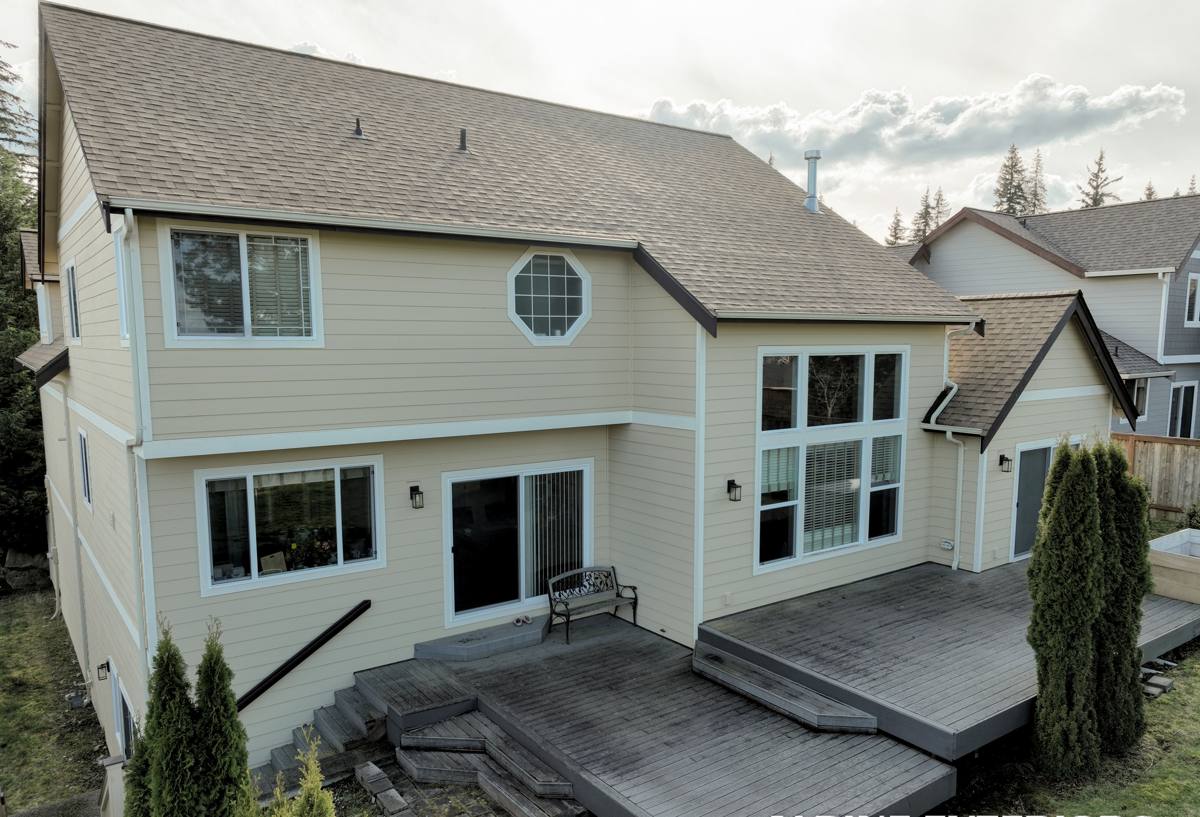
What South Hill's Climate Actually Does to a Deck
Salt Air
Salt in the air accelerates corrosion on anything metal — fasteners, joist hangers, post bases, railing brackets. Standard zinc-coated hardware can start showing rust bloom within a couple of seasons in areas with regular salt exposure, and once a fastener starts corroding, it weakens exactly where you can't see it: buried in the wood.
Driving Rain
Rain that comes in sideways doesn't just fall on a deck's surface — it gets driven into ledger board connections, under railing posts, and into any gap where end grain is exposed. Water that would simply run off a flat deck in a calmer climate gets forced into joints and seams here, which is why flashing and sealing details matter more in Chuckanut than they would in a drier, calmer region.
Moss and Algae
Shaded decks, north-facing decks, and decks under tree cover stay damp far longer after a rain event than sun-exposed surfaces. That extended dampness is exactly what moss and algae need to establish. Beyond looking bad, moss holds moisture against the decking surface around the clock, which speeds up rot in wood and can make composite and even some capped products slippery and stained if they're not built and finished with drainage in mind.
What a Correctly Built Deck for This Area Involves
A deck that's actually built for South Hill's conditions isn't about upgrading everything to the most expensive option — it's about getting a handful of details right that generic construction often skips.
- Stainless or heavy hot-dip galvanized fasteners and hardware at every structural connection, not just at the visible surface
- Proper ledger flashing where the deck attaches to the house, so driving rain can't work its way behind the band board
- Joist tape or a comparable protective barrier on top of framing lumber to stop standing water from soaking into end grain and top faces
- Footings set to the correct frost and bearing depth for the soil conditions on the lot, not just poured to a standard minimum
- Decking gaps and airflow beneath the structure sized to let the deck actually dry out between rain events instead of trapping moisture
- Railing post connections detailed to shed water rather than cup it against the post base
None of this is exotic. It's standard good practice — but it's the difference between a deck that ages gracefully in a wet marine climate and one that starts needing repairs while it's still technically "new."
Choosing a Decking Material for South Hill Conditions
There's no single right answer here — it depends on budget, how much maintenance you want to do, and how much shade and moss exposure your specific yard gets. Here's how the common options actually compare in this climate:
| Material | Upfront Cost | Maintenance in Wet Climate | Moss/Algae Resistance | Typical Lifespan Here |
|---|---|---|---|---|
| Pressure-treated wood | Lowest | Needs regular cleaning, re-staining, and moss removal | Low — moss establishes quickly if not maintained | 10-15 years with upkeep |
| Cedar | Moderate | Needs periodic sealing to hold its color and resist moisture | Moderate — naturally rot-resistant but still needs cleaning | 15-20 years with upkeep |
| Traditional composite | Higher | Low — occasional washing | Moderate — can still stain in deep shade without airflow | 20-25 years |
| Capped composite / PVC | Highest | Lowest — rinse as needed | Best — capped surface resists staining and moisture absorption | 25-30+ years |
For sunny, open decks with good airflow, wood remains a perfectly reasonable choice if you're willing to keep up with staining and occasional moss treatment. For shaded, north-facing, or tree-covered lots — which describes a fair number of South Hill properties — capped composite earns its higher upfront cost back in avoided maintenance and slower moss buildup. We'll walk your specific site conditions with you rather than pushing one material as a default.
A Note on Product Selection
We install a narrower range of decking brands and fastening systems than some big regional builders, and that's intentional. We've found that certain composite formulations and fastener coatings hold up poorly to the combination of salt air and constant moisture cycling — not because they're bad products everywhere, but because this specific climate exposes their weak points faster than drier regions do. We'd rather recommend fewer options we trust in this climate than a long list that includes products we know will disappoint a homeowner five years in.
Framing and Structural Considerations Specific to This Area
The framing underneath a deck matters as much as the decking on top — arguably more, since it's harder and more expensive to fix later. In Chuckanut's wet climate, we pay particular attention to:
- Ledger attachment and flashing — the single most common source of hidden rot on older decks we're asked to repair
- Post base connections — kept off grade and away from standing water, with hardware rated for wet, salt-exposed conditions
- Beam and joist sizing — matched to actual span and load requirements rather than the minimum that happens to pass inspection
- Under-deck drainage — grading and gravel placement so water moves away from footings instead of pooling under the structure
Whatcom County permitting requirements apply to most new deck construction and many significant deck rebuilds, particularly where structural changes, height above grade, or attachment to the home are involved. We handle the permitting conversation as part of the process rather than leaving it for the homeowner to sort out.
How Our Deck Building Process Works
- On-site assessment. We look at sun exposure, shade patterns, drainage, existing structure (if any), and how the space will actually be used.
- Design and material conversation. We walk through decking and framing material options honestly, including cost, maintenance, and expected lifespan for your specific site conditions.
- Written estimate. Clear scope, materials, and pricing before anything is signed.
- Permitting. We handle the paperwork for projects that require it.
- Demolition (if replacing an existing deck). Old structure removed and hauled off; we'll flag anything concerning we find underneath, like hidden rot or undersized framing.
- Framing and structural work. Footings, posts, beams, joists, and ledger flashing installed to hold up in this climate, not just to pass a minimum inspection.
- Decking, railing, and finish work. Installed with the drainage and airflow details that keep moss and moisture from taking over.
- Final walkthrough. We go over care and maintenance specific to the material you chose before we consider the job done.
Living With a Deck in a Long Moss Season
Even a well-built deck needs some homeowner cooperation in this climate. A few habits go a long way toward protecting the investment:
- Sweep debris and leaf litter off the deck regularly, especially in fall — trapped organic matter holds moisture and feeds moss
- Trim back overhanging branches where practical to let more light and airflow reach shaded sections
- Rinse or lightly scrub visible moss growth before it has a chance to establish and stain the surface
- Check railing posts and stair stringers once a year for soft spots, especially where they meet the ground or a concrete footing
- Re-seal or re-stain wood decking on the schedule recommended for the specific product, not just "when it looks dry"
None of this is heavy labor — it's the difference between a deck that stays sound for decades and one that quietly deteriorates because small problems went unnoticed.
Why Hire a Crew That Already Works South Hill
A contractor who mostly builds in drier inland areas will often default to standard framing and fastener specs that are genuinely fine for those conditions — and undersized for a marine climate like this one. Working regularly in and around Chuckanut and Whatcom County means we've seen how decks actually fail here: which fastener coatings hold up, which decking materials handle shade and moss well, and where driving rain finds its way into a structure that looks fine on paper. That local pattern recognition is hard to substitute with a generic spec sheet, and it's the main reason we recommend hiring a crew with real, current experience building decks specifically in this area rather than one working from a one-size-fits-all playbook.
If you're planning a new deck or replacing one that's showing its age, we're happy to take a look and put together a straightforward, no-pressure estimate. There's a form below — tell us a bit about your property and what you're picturing, and we'll go from there.