 Chuckanut Exterior
 Why South Hill Decks Wear Out Faster Than People Expect
South Hill sits close enough to the water and the tree cover that a deck here takes a different kind of beating than a deck in a drier inland town. Salt-laden air moves through the area and slowly works on fasteners, railings, and any metal hardware that isn't rated for it. Driving rain off the Sound doesn't just fall straight down — it gets pushed sideways under railings and into board gaps, which means drainage and airflow underneath the deck matter as much as the decking material itself. And then there's moss season, which in this part of Whatcom County isn't really a season at all — it's most of the year. Shaded decks, north-facing decks, and anything under fir or cedar canopy stay damp long enough for moss and algae to take hold on almost any surface that doesn't shed water well.
None of this means a deck in South Hill is doomed. It means the material choice and the install details have to account for constant moisture, not occasional moisture. That's the standard we build to.
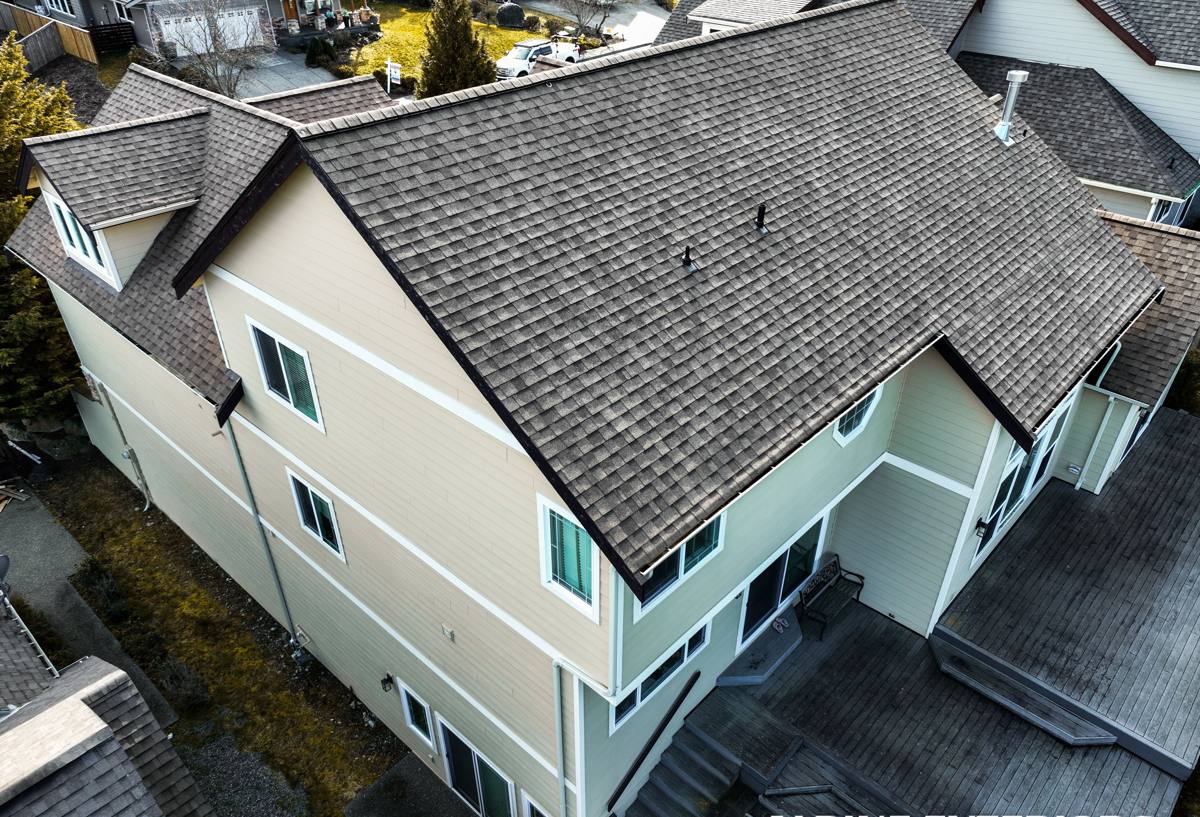
Where Composite Fits for This Kind of Climate
Wood decking can absolutely work in Chuckanut, but it demands a maintenance schedule most homeowners don't actually keep up with — stripping, brightening, and re-sealing on a yearly or every-other-year basis to keep moisture out of the fibers. Skip a year or two and a wood deck in a damp, shaded South Hill yard will start graying, splintering, and holding moss faster than the same deck would in a drier climate.
Composite decking was built to solve exactly that problem: a material that doesn't absorb water the way wood does, doesn't need annual sealing, and resists rot at the board level. That's a real advantage here. It's not a maintenance-free material — nothing outdoors in this climate is — but the maintenance shifts from "protect the wood from moisture" to "keep the surface clean so moss and algae don't get a foothold." That's a much easier job to stay on top of.
Where Composite Still Has Trade-offs
We tell homeowners the honest version of this up front. Composite boards run warmer in direct sun than some wood species, though that matters less on shaded South Hill lots than it would on an open, south-facing deck. Composite is also less forgiving of a bad substructure — because the board itself won't visibly warn you the way wet, softening wood does, moisture problems underneath a composite deck can go unnoticed longer if the substructure wasn't built right in the first place. That puts more weight on getting the framing and drainage correct at install, which is where a lot of composite deck problems actually originate.
What a Correct Composite Deck Install Actually Involves
Composite decking is more installation-sensitive than most homeowners realize. The board itself is only part of the system — the framing, fasteners, and drainage underneath it determine whether the deck performs for twenty-plus years or starts showing problems in five.
Substructure and Moisture Management
In a climate that stays damp as much as South Hill's does, the framing underneath the boards needs to be treated as the first line of defense, not an afterthought. That means joist tape or another moisture barrier on top of the framing, proper flashing where the deck ties into the house, and enough slope and clearance underneath for water to actually drain and air to actually move. A deck built tight to the ground with no airflow will stay damp longer after every rain, and in a moss-prone area that's the difference between a clean deck and a green one within a couple of seasons.
Joist Spacing and Fastening
Composite manufacturers publish specific joist spacing requirements, and they're tighter in wet, high-load-cycle climates than the bare minimum some installers default to. Hidden fastener clips need to be the type rated for the specific board profile being used — mixing hardware isn't a shortcut, it's how boards start to squeak, shift, or gap over time. We follow manufacturer spacing and fastening specs as the floor, not the ceiling.
Railings, Stairs, and Code
Railing posts and stair stringers see the most stress and the most weather exposure on any deck, and they're where salt air does the most damage to unprotected metal hardware. We use fasteners and brackets rated for corrosive, coastal-adjacent conditions rather than standard interior-grade hardware, and we build railings and stairs to current code for guard height, baluster spacing, and stair rise/run — not just to whatever the previous structure happened to have.
Composite vs. Other Decking Materials for This Area
There isn't one universally "right" decking material — there's a right material for a given yard, budget, and maintenance appetite. Here's how the common options actually compare for a damp, shaded, salt-air-adjacent lot like the ones common in South Hill.
| Material | Moisture Behavior | Maintenance | Typical Lifespan |
|---|---|---|---|
| Pressure-treated wood | Absorbs water; prone to splintering and rot if not sealed regularly | Annual or biannual cleaning and sealing | 10-15 years with upkeep |
| Uncapped composite | Resists rot but the surface can absorb moisture and stain more than capped boards | Regular cleaning; more prone to mold/mildew on the surface | 15-20 years |
| Capped composite | Outer shell sheds water and resists staining; core is protected from moisture intrusion | Periodic surface cleaning | 25+ years, often with longer manufacturer warranties |
For most South Hill homes dealing with shade, moss, and salt air, capped composite is the material we recommend most often — the protective shell is specifically what holds up best against the surface staining and algae growth that damp, shaded decks are prone to. Uncapped composite is a lower-cost option that still outperforms wood on rot resistance, but it will need more regular surface cleaning to stay ahead of mildew.
Keeping a Composite Deck Clean Through Moss Season
Composite decking's biggest advantage in this climate is that it doesn't rot the way wood does — but it can still grow moss, algae, and mildew on the surface if it's not cleaned periodically, especially in shaded spots. The good news is that cleaning a composite deck is a lot simpler and less time-sensitive than maintaining a wood deck.
- Sweep debris (needles, leaves, seed pods) off the deck regularly so damp organic material doesn't sit on the boards
- Wash the surface with mild soap and water a couple of times a year, more often in consistently shaded areas
- Avoid pressure washing at close range or high PSI directly into board grooves — it can drive water into fastener channels
- Check that gaps between boards stay clear so water keeps draining instead of pooling
- Rinse railings and hardware occasionally to knock salt residue off metal components
- Trim back overhanging branches where possible to cut down on shade and debris buildup
None of this is a major time commitment — it's the kind of upkeep that takes an afternoon a couple of times a year rather than a full re-sealing project every season.
How We Approach a South Hill Composite Deck Project
We keep the process straightforward because deck projects don't need to be complicated to be done right.
- On-site assessment: We look at drainage, sun/shade exposure, existing framing (if any), and how the deck ties into the house before recommending a board type or structure.
- Plan and material selection: We walk through board options, hardware, railing style, and layout based on what the site actually needs — not a one-size-fits-all package.
- Permitting: Deck projects in Whatcom County typically require a permit depending on size and height; we handle that process rather than leaving it on the homeowner.
- Build: Framing and moisture barrier first, then decking, railings, and stairs, built to manufacturer spec and current code.
- Final walkthrough: We go over the finished deck together, including basic care so the maintenance stays simple going forward.
Why It Matters to Hire a Crew That Already Works This Area
A composite deck built to a generic spec sheet, without accounting for South Hill's specific mix of shade, moisture, and salt exposure, can look fine for the first year or two and then start showing problems — hardware corrosion, surface algae, or a substructure that never had the chance to drain properly. A crew that works this part of Whatcom County regularly already knows which details matter here: where flashing tends to get skipped, which hardware holds up against salt air, and how much slope and airflow a substructure actually needs in a climate that stays wet more months than it's dry. That local knowledge doesn't show up on a spec sheet — it shows up in how the deck performs five and ten years out.
Cost Factors to Expect
Every deck project is different, but a few factors consistently drive the price up or down more than homeowners expect.
| Factor | Effect on Cost |
|---|---|
| Board tier (uncapped vs. capped composite) | Capped boards cost more upfront but reduce long-term maintenance and staining |
| Substructure condition | Replacing or upgrading an existing frame adds cost but is often necessary for composite's longer expected lifespan |
| Railing style and material | Composite or metal railing systems cost more than basic wood but need less upkeep |
| Deck height and stairs | Elevated decks and multi-run stairs add framing, code requirements, and labor |
| Site access | Tight or sloped lots can increase labor time for material handling |
We give straight, itemized numbers during the estimate rather than a vague range, so homeowners can see exactly what's driving the cost before committing to anything.
If you're weighing composite decking for a South Hill property, we're glad to take a look and walk through what your specific yard, shade pattern, and existing structure actually need. Use the form below for a free, no-pressure estimate — there's no obligation, just a straight assessment of what's involved.