 Chuckanut Exterior
 Why Sedro-Woolley Homes Need Siding Built for This Climate
Sedro-Woolley sits in a part of Washington where the weather doesn't let up for months at a time. Homes here deal with a combination most siding products were never designed to handle well: salt-carrying air moving in off the water, driving rain that hits walls sideways instead of straight down, and a moss season that can stretch from late fall through spring. Individually, each of those is manageable. Together, over years, they're what separates a siding job that looks good for two decades from one that starts failing at year eight.
Salt air is corrosive to fasteners and finishes, and it accelerates the breakdown of anything that relies on a surface-applied coating rather than a factory-cured finish. Driving rain doesn't just wet a wall — it drives moisture up under laps, into seams, and behind trim if those details weren't built correctly the first time. And moss doesn't just grow on roofs. Given a shaded north wall, a slow-draining grade, or a siding product with any organic content, moss and mildew will take hold and stay there for months, holding moisture against the wall the entire time.
This is the environment we design every Sedro-Woolley siding job around. It's also why we only install James Hardie fiber cement — not because it's the trendiest option, but because it's the one product line we've found holds up to this specific combination of conditions without turning into an annual maintenance chore.
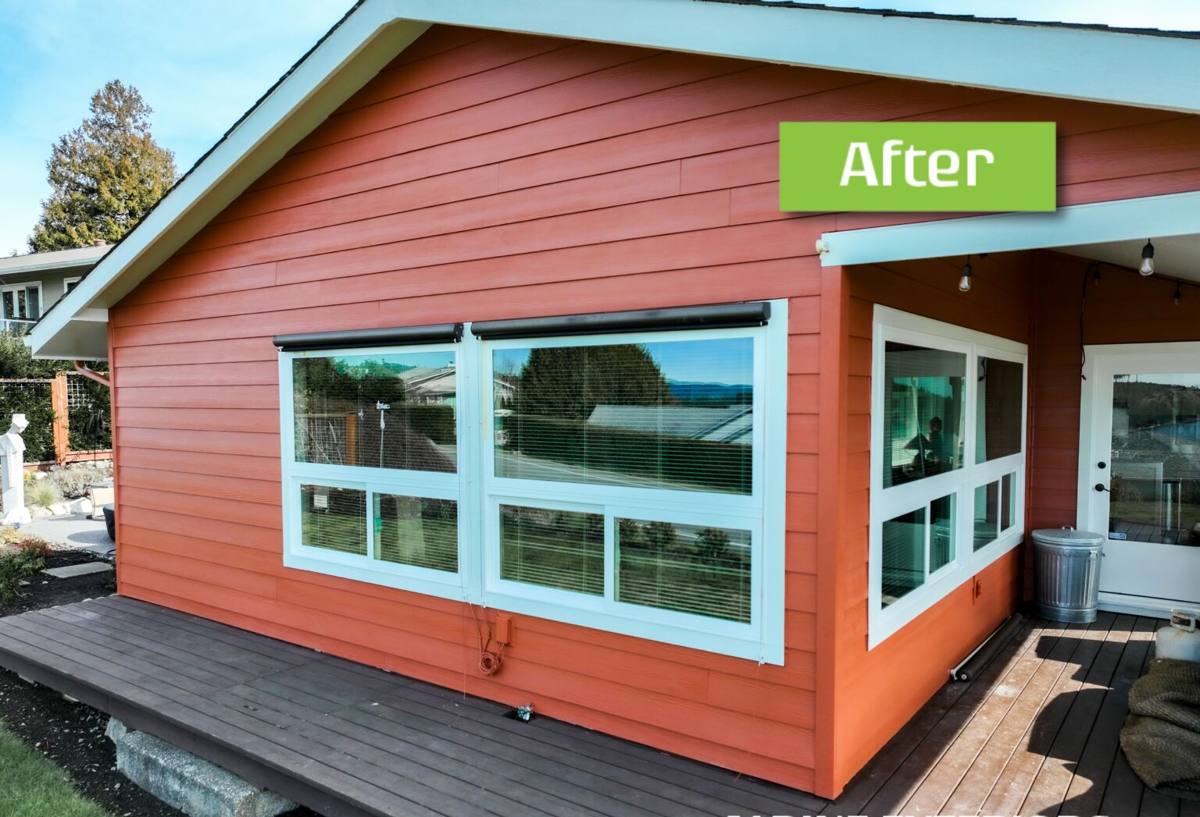
What "Correct" Siding Actually Means Here
A siding job can look right on install day and still be wrong. The problems that show up in this climate are almost always installation problems, not just product problems — moisture doesn't fail a wall through the face of the siding, it fails a wall through the gaps installers left at the edges. On a Sedro-Woolley home, a correct install means paying real attention to:
- Water-resistive barrier and flashing details at every window, door, and penetration — not just where it's easy
- Proper starter strip and clearance at the foundation line, so splash-back and standing moisture don't sit against the bottom course
- Correct fastener placement and spacing per the manufacturer's install spec, not a generic "close enough"
- Butt joints and laps sealed and shingled the right direction relative to prevailing wind and rain
- Ventilation gaps maintained behind the siding so any moisture that does get in can actually dry out
- Trim and corner details that shed water outward instead of channeling it into the wall assembly
None of this is exotic. It's just detail work that takes longer and requires a crew that's done it enough times on homes facing the same weather to know where the water actually wants to go.
Where Moss Season Changes the Calculus
A long moss season means north- and west-facing walls, walls under tree cover, and walls near downspouts stay damp far longer than a homeowner might expect. Any siding product with organic material in it — wood, wood-based composites, or products with a paper-faced substrate — gives moss and mildew something to feed on. Fiber cement doesn't. That single difference matters more in Sedro-Woolley than it would in a drier part of the state, because here those damp walls aren't a once-a-year event, they're a months-long condition.
Why We Only Install James Hardie
We get asked fairly often why we don't offer vinyl, LP SmartSide, cedar, primed spruce, or fiber cement alternatives like Cemplank or Allura. It's not a marketing position — it's a standard we set after weighing what each option actually does over time in this climate.
Vinyl
Vinyl is inexpensive and easy to install, but it's a thin material that expands and contracts with temperature swings, and its seams and J-channels give wind-driven rain more opportunities to get behind the wall. It also doesn't hold up structurally to the kind of storm-driven debris impact this region sees.
Wood-based and engineered wood siding (LP SmartSide, cedar, primed spruce)
Wood and wood-based products can look excellent when new, but they're organic materials in a climate that stays wet for a long stretch of the year. That combination means an ongoing maintenance commitment — recoating, caulking, watching for edge swelling — that most homeowners don't want to sign up for indefinitely. Cedar in particular needs regular refinishing to keep weather resistance intact; skip a cycle or two and it starts absorbing moisture it can't shed fast enough.
Other fiber cement brands (Cemplank, Allura)
These are legitimate fiber cement products and share Hardie's basic moisture and fire resistance advantages. Where we see the difference is in factory finish consistency, the depth of climate-specific product engineering, and warranty structure. James Hardie's ColorPlus factory finish and its HZ5 product line (engineered specifically for wetter, harsher climates) gave us more confidence installing at scale across every home we take on, rather than mixing standards project to project.
The James Hardie System We Install
James Hardie fiber cement is a mix of cement, sand, and cellulose fiber, cured to be dense, non-combustible, and dimensionally stable — it doesn't expand and contract the way wood or vinyl does, and it doesn't feed moss or insects because there's nothing organic in it for them to use. For Sedro-Woolley specifically, we spec the HZ5 climate line, which is engineered for regions with significant moisture exposure rather than the drier-climate HZ10 line used in other parts of the country.
ColorPlus factory-applied finish is a meaningful part of why we trust this system in a wet climate: the color and protective coating are baked on at the factory under controlled conditions, rather than field-applied paint that depends on weather, temperature, and crew technique on install day. That factory finish is also what backs the strongest part of the warranty — coverage that follows the product, not just workmanship.
Common Hardie Profiles for This Style of Home
| Profile | Look | Where It Fits Well |
|---|---|---|
| Lap siding (HZ5) | Traditional horizontal board look | Most full-wall re-sides; broad style compatibility |
| Board and batten (Artisan or HZ5) | Vertical, farmhouse-style | Gable accents, shop buildings, modern-farmhouse remodels |
| Shingle-style panels | Textured, traditional shingle look | Accent gables, dormers, mixed-material facades |
| Trim boards | Smooth or woodgrain finish | Corners, window/door casing, fascia pairing |
Our Process for a Sedro-Woolley Re-Side
Every job starts the same way: an honest look at what's actually happening on the home, not just what the current siding looks like from the driveway.
- Walk-through and moisture check. We look at grading, downspout discharge, shaded wall areas, and any current siding for signs of trapped moisture or soft spots before quoting anything.
- Tear-off and sheathing inspection. Once the old siding is off, we check the sheathing and water-resistive barrier underneath. This is where hidden problems from a prior install usually surface, and it's better to find them now than after the new siding goes on.
- Flashing and barrier correction. Any window, door, or penetration flashing that isn't right gets corrected before a single piece of Hardie goes up. This step gets skipped more often than homeowners realize, and it's the single biggest predictor of a callback five years later.
- Install to manufacturer spec. Fastener pattern, clearances, lap direction, and joint treatment follow James Hardie's published installation requirements — the same requirements that back the product warranty.
- Final detail and walkthrough. Trim, caulking, and touch-up happen last, followed by a walkthrough so the homeowner knows what they're looking at and what (if anything) needs attention down the road.
What Drives Cost on a Job Like This
Every Sedro-Woolley home is different, and we won't quote a number without seeing the house, but these are the factors that actually move the price:
| Factor | Why It Matters |
|---|---|
| Sheathing/barrier condition | Hidden moisture damage found during tear-off adds repair scope before new siding can go on |
| Home complexity | Dormers, multiple gables, and cut-up wall planes take more labor per square foot than simple rectangular walls |
| Profile selection | Lap siding, board-and-batten, and shingle-style panels have different material and labor costs |
| Trim scope | Full trim replacement alongside siding costs more than siding alone but avoids mismatched old/new materials |
| Access and site conditions | Slope, landscaping, and setback affect scaffolding and staging time |
What to Ask Before Hiring Anyone for This Job
Because so much of siding performance depends on installation quality rather than the product box it came in, the contractor matters as much as the material. Before hiring anyone for a re-side in this area, it's worth asking:
- Are you a certified James Hardie installer, and can you explain the HZ5 vs. HZ10 climate distinction without hesitation?
- What's your process for checking sheathing and flashing once the old siding is off?
- How do you handle moss- or mildew-affected walls found during tear-off?
- Is the manufacturer's product warranty separate from your workmanship warranty, and what does each actually cover?
- Can you walk me through fastener spacing and clearance requirements for this specific profile?
A contractor who's worked this specific stretch of Washington regularly should be able to answer all of these without reaching for a brochure — the answers should be routine, because the conditions here are routine for them.
Why Local Experience Matters More Than It Seems
A crew that mostly installs siding in a drier, milder climate will still know how to hang a board straight. What they won't have is the built-in instinct for where water actually collects on a home exposed to salt air and driving rain — which walls need extra flashing attention, which grading conditions turn into standing moisture, which north-facing corners need to be treated differently than the sun-facing side of the same house. That instinct only comes from doing this work, on homes like this, in this weather, repeatedly. It's the difference between a technically correct install and one that's actually built for where it sits.
If you're weighing a siding replacement or noticing moss, soft spots, or failing caulk lines on your Sedro-Woolley home, we're happy to take a look and give you a straightforward, no-pressure estimate — no obligation, just an honest read on what your home actually needs.