 Chuckanut Exterior
 Roofing Built for the Mount Vernon Climate
A roof in the Mount Vernon area doesn't fail the way a roof does in a dry inland climate. Out here, the damage is slow and cumulative: salt-laden air off the water works into fasteners and flashing, driving rain finds every gap in a lapped seam, and a long, wet moss season keeps shingles damp for months at a stretch instead of drying out between storms. None of these things show up as a dramatic failure on day one. They show up five, ten, or fifteen years in, as soft decking, rusted flashing, or shingles that have lost their granules and their grip.
When we replace a roof in Mount Vernon, we're not just matching what's already up there — we're building a roof system that's supposed to hold up to this specific combination of moisture, wind-driven rain, and organic growth. That distinction matters more here than in most parts of the country, and it's the reason a roof replacement done right in this climate looks a little different from a generic tear-off-and-reshingle job.
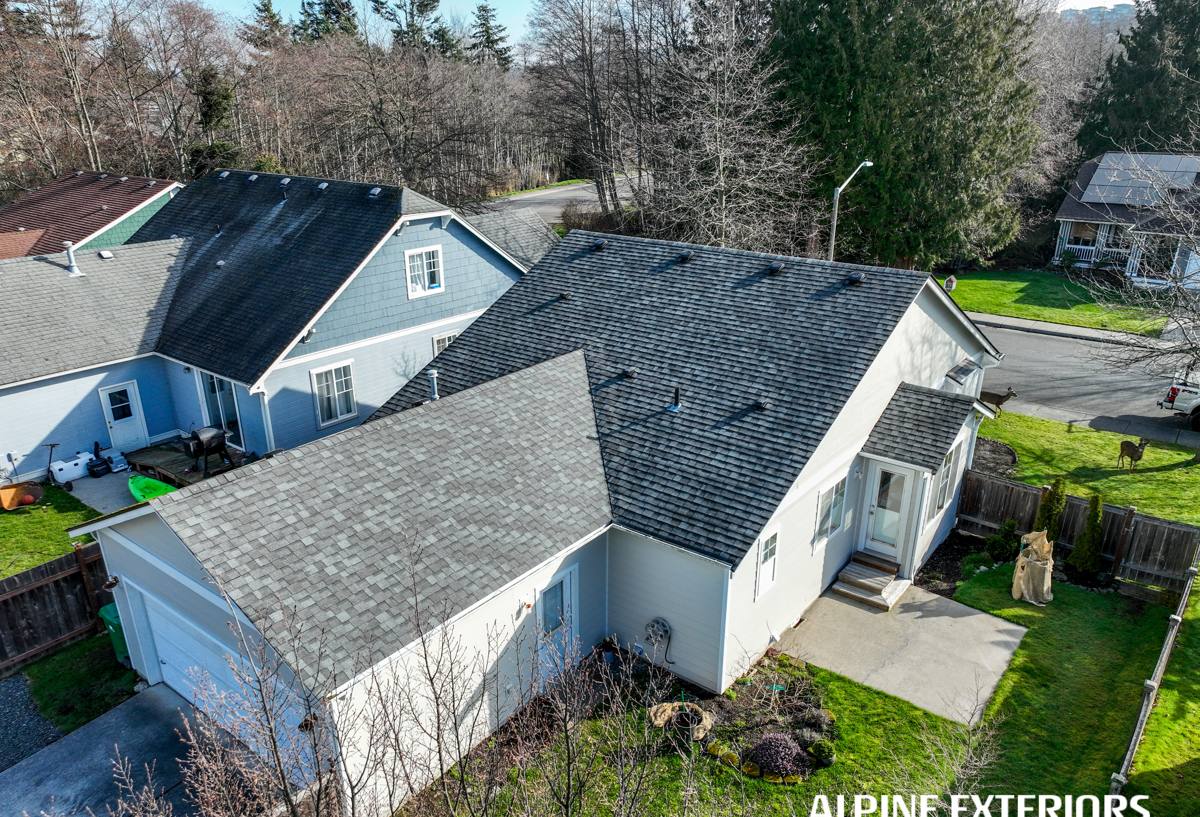
Signs a Mount Vernon Roof Needs Replacement, Not Another Repair
Most homeowners call us after noticing one obvious problem — a leak, a stain on a ceiling, a section of missing shingles after a windstorm. But the real question is always whether that visible issue is isolated or a symptom of a roof that's reached the end of its useful life. A few signs tend to point toward full replacement rather than a patch:
- Granule loss heavy enough that you can see bare, shiny patches on multiple slopes, not just one weathered section
- Moss or algae staining that keeps coming back within a season or two of cleaning, even after treatment
- Shingles that are cupping, curling, or cracking across the field of the roof rather than in one localized spot
- Soft or spongy decking felt underfoot during inspection, which usually means moisture has already reached the plywood
- Flashing around chimneys, skylights, or valleys that's visibly rusted, lifted, or was never properly step-flashed to begin with
- A roof that's simply at or past the manufacturer's rated lifespan for this climate, regardless of how it looks from the ground
If only one of these applies and the roof is otherwise young, a repair is often the honest answer, and we'll tell you that. Replacement makes sense when the underlying materials — decking, underlayment, flashing system — have aged out together, because patching one component on a failing system just delays the next call.
What a Correct Roof Replacement Involves Here
Tear-Off and Deck Inspection
We don't roof over an existing layer. A full tear-off is the only way to actually see the decking, and in a climate that pushes moisture into a roof system for months at a time, that inspection step is not optional. Any soft, delaminated, or water-stained plywood gets replaced before anything new goes down — building over a compromised deck just locks the problem in for the next owner to find.
Underlayment That Matches the Rainfall, Not the Minimum Code
Code minimums are a floor, not a target. In an area that gets sustained, driving rain, we lean toward synthetic underlayment with taped or sealed seams, and self-adhered ice-and-water membrane at the vulnerable points — eaves, valleys, and around every roof penetration — rather than treating that membrane as an upgrade reserved for snow country. Wind-driven rain doesn't care about slope the way gravity-fed water does, and the underlayment is what protects the deck if wind ever pushes moisture back up under the shingle laps.
Flashing Done as Metalwork, Not an Afterthought
Most roof leaks that aren't storm damage trace back to flashing, not the field shingles. Chimneys, skylights, sidewall intersections, and valleys all need properly formed, corrosion-resistant flashing, step-flashed and integrated with the underlayment — not just caulked over old metal. Salt air accelerates corrosion on lower-grade or older galvanized flashing, so we pay particular attention to metal quality and fastener choice on homes closer to open water.
Ventilation That Actually Balances
A roof replacement is the right time to correct ventilation, and it's frequently overlooked. Balanced intake at the eaves and exhaust at the ridge keeps the attic space closer to outdoor temperature and humidity, which slows both moss growth from below and condensation-driven rot in the decking. A new roof installed over unbalanced or blocked ventilation will show the same moisture problems as the old one, just on a delay.
Material Options for This Climate
There's no single "best" roofing material — the right choice depends on budget, roof pitch, how long you plan to stay in the home, and how much maintenance you're willing to do. Here's how the common options compare for a wet, moss-prone, coastal-influenced climate like this one:
| Material | Moisture & Moss Behavior | Typical Lifespan Here | Maintenance Load |
|---|---|---|---|
| Architectural asphalt shingle | Good when algae-resistant granules are specified; needs periodic moss removal | 20-30 years | Low to moderate |
| Standard 3-tab asphalt shingle | Sheds moss less effectively; more prone to curling with sustained moisture | 15-20 years | Moderate |
| Metal panel roofing | Sheds water and moss well due to smooth surface and slope; coastal-grade fasteners matter | 40-plus years | Low |
| Wood shake | Naturally more moisture-sensitive; requires disciplined maintenance to prevent rot in this climate | Highly maintenance-dependent | High |
Most Mount Vernon homes we work on end up on a good-quality architectural asphalt shingle with algae-resistant granules, because it balances upfront cost with genuinely solid performance against local moss and moisture when it's installed with the right underlayment and ventilation behind it. Metal is a strong option for homeowners planning to stay long-term or dealing with a low-slope section where shingles perform poorly. We'll walk through the honest trade-offs for your roof rather than pushing whatever's easiest to install.
Our Process for a Mount Vernon Roof Replacement
- On-site inspection. We walk the roof, check the attic from inside where accessible, and look at flashing, ventilation, and decking condition — not just the shingle surface.
- Written scope and estimate. You get a clear breakdown of what's being replaced, what materials are specified, and why, before any work starts.
- Tear-off and deck repair. Old roofing comes off completely, decking is inspected board by board, and anything compromised is replaced.
- Underlayment and flashing installation. Membrane and synthetic underlayment go down first, followed by properly formed and step-flashed metalwork at every penetration.
- Roofing material installation. Shingles, panels, or shakes are installed to manufacturer spec, with attention to nailing pattern and exposure — details that directly affect wind and moisture resistance.
- Ventilation check and final walkthrough. We confirm intake and exhaust are balanced, clean up the site, and walk the finished roof with you.
Cost Factors for Mount Vernon Homeowners
We don't publish flat pricing because roof cost depends on real variables specific to your home, but these are the factors that move the number most:
| Factor | Why It Matters |
|---|---|
| Roof size and number of planes | More squares and more cut lines mean more material and labor |
| Pitch and accessibility | Steep or hard-to-access roofs require more safety setup and time |
| Existing deck condition | Rot or soft decking found during tear-off adds material and labor to replace it properly |
| Number of penetrations | Chimneys, skylights, and vents each need individual flashing work |
| Material choice | Asphalt, metal, and wood shake carry different material and labor costs |
| Layers to remove | Tearing off multiple existing layers takes more labor than a single layer |
We'll give you a specific, written number after seeing the roof in person — broad estimates without an inspection tend to be wrong in one direction or the other, and we'd rather be accurate than fast.
Why a Crew That Already Works in Mount Vernon Matters
Roofing crews that don't work this specific climate regularly tend to default to whatever spec works fine in a drier region — lighter underlayment, standard flashing details, ventilation sized for less sustained moisture. That's not incompetence, it's just a mismatch. A crew that works Mount Vernon and the surrounding area routinely sees what actually fails here over time: which flashing details hold up to salt exposure, which underlayment choices keep decking dry through a wet winter, and which ventilation mistakes show up as moss and mold five years later.
There's also a practical side to hiring local. Materials, permitting, and scheduling all move faster when a crew already knows the area, and warranty follow-up is a lot more straightforward when the company that installed your roof is a short drive away rather than a call center. We treat every Mount Vernon roof as one we'll likely be asked to service again down the road, which shapes how we build it the first time.
What to Check Before You Hire Anyone for a Roof Replacement
Whether you go with us or another contractor, a few basics protect you regardless of who does the work:
- Confirm the contractor is licensed and insured in Washington, and ask to see current documentation rather than taking it on faith
- Get the scope of work in writing, including specific underlayment and flashing details, not just "new roof, same as before"
- Ask what happens if soft or damaged decking is found during tear-off, and how that's priced
- Confirm whether ventilation will be assessed and corrected as part of the job, not just the shingles replaced
- Ask about manufacturer warranty requirements — many shingle warranties require specific underlayment or certified installation to stay valid
- Get more than one estimate if the price feels unusually low; roofing is one trade where the cheapest bid often means shortcuts in materials or decking replacement
If your roof is showing its age or you just want an honest read on how many years it has left, we're glad to come take a look. The estimate is free, there's no pressure attached to it, and you'll get a straight answer about whether you need a full replacement or something less — just fill out the form below to get started.