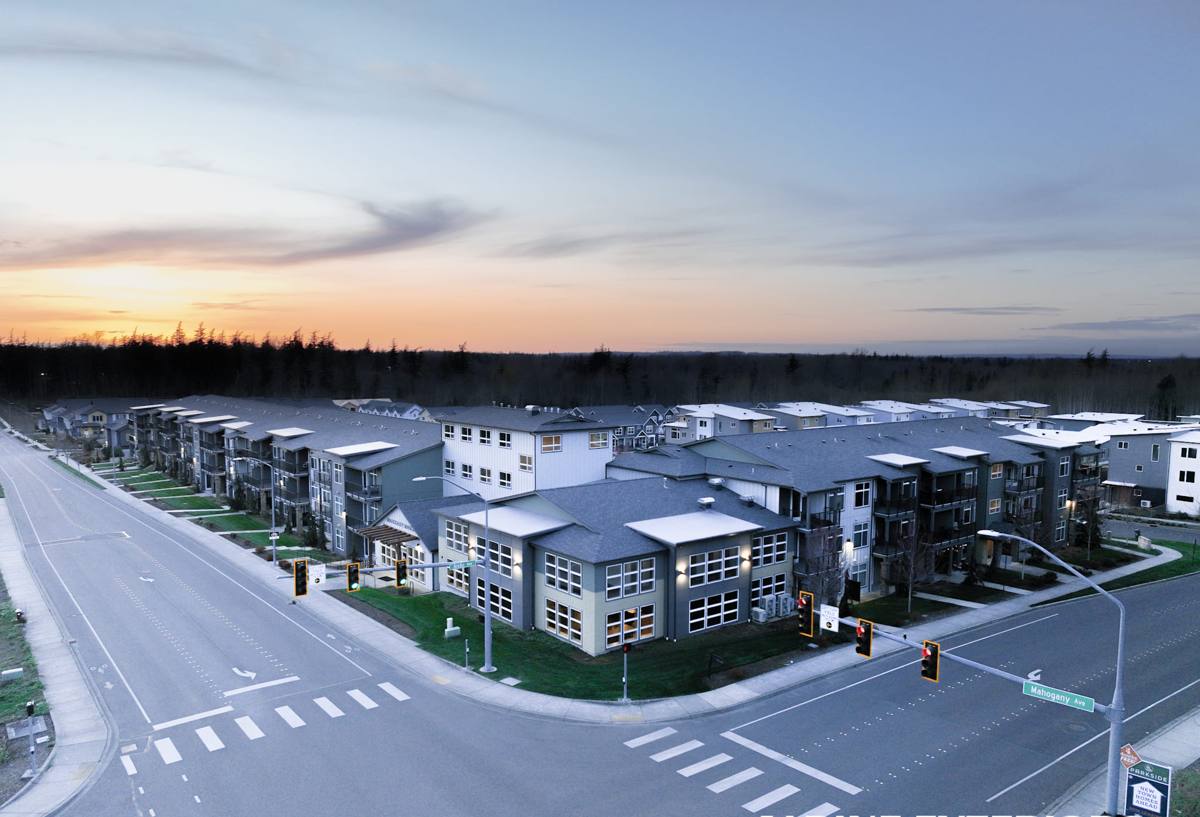
 Chuckanut Exterior
 Happy Valley's Climate Is Hard on Siding
Homes in Happy Valley sit in one of the tougher climates in Whatcom County for exterior materials. The combination of salt-laden air off the water, wind-driven rain that hits certain elevations hard during winter storms, and a moss season that can run half the year or longer puts constant pressure on whatever is covering your walls. Most siding failures we see in this neighborhood aren't sudden — they're the slow result of moisture finding a way in, or a surface that couldn't hold up to years of damp, shaded exposure.
Salt air is corrosive to exposed metal fasteners and trim, and it accelerates the breakdown of paint films and lower-grade composite products. Driving rain doesn't just wet a wall — it drives water sideways and upward under laps, trim, and penetrations if those details weren't built correctly the first time. And moss doesn't stay on the roof. It colonizes shaded siding, north-facing walls, and anywhere air doesn't move well, holding moisture against the surface long after a storm has passed. Any siding product installed here has to be evaluated against all three of these conditions at once, not just one of them.
Why We Only Install James Hardie Fiber Cement Here
We standardized on James Hardie fiber cement siding for every job we take on, including in Happy Valley, because it's engineered specifically for climates like this one. Hardie's HZ5 product line is formulated for the Pacific Northwest's wet, marine-influenced weather — it's not a generic siding product with a coastal climate treated as an afterthought. Fiber cement itself is made from cement, sand, and cellulose fibers, which means it doesn't rot, doesn't feed moss and mildew the way wood-based products can, and doesn't swell or delaminate when it takes on moisture the way some engineered wood products do.
The ColorPlus factory finish, when specified, is baked on in a controlled environment rather than field-applied, which matters directly for salt air exposure — factory-cured finishes hold up better against the kind of chalking and fading that ocean-adjacent air causes to job-site-painted surfaces over time. Hardie siding is also non-combustible, which is a real consideration during dry spells even in a generally wet region. We won't install LP SmartSide, vinyl, Cemplank, Allura, primed spruce, or cedar on a home, not because those products have no merit anywhere, but because we've made a professional judgment that Hardie's moisture behavior, finish durability, and long-term performance in this specific climate are worth the trade-offs — and we'd rather stand behind one product system we know inside and out than juggle installation methods across several.
What Sets Fiber Cement Apart in a Wet, Salty Climate
- Won't rot or support fungal growth the way wood and some wood-composite sidings can
- Dimensionally stable — doesn't swell, warp, or cup with repeated wet-dry cycling
- Factory ColorPlus finish resists the fading and chalking that salt air accelerates on field-painted surfaces
- Non-combustible core material
- Backed by a strong transferable manufacturer warranty when installed to Hardie's published specifications
What a Correct Installation Involves
The material is only half the equation. A lot of the siding problems we get called out to inspect in this area trace back to installation shortcuts, not product failure. Hardie publishes detailed installation requirements, and skipping them is how you end up with moisture intrusion behind siding that looks fine from the curb.
Moisture Management Comes First
Before a single piece of siding goes up, the wall needs a properly lapped weather-resistant barrier, correctly integrated flashing at every window, door, and roofline intersection, and a plan for how bulk water that gets behind the cladding will drain back out. In a neighborhood that takes driving rain on certain elevations, these details aren't optional extras — they're what actually keeps water out of the wall assembly over the next several decades.
Fastening, Clearances, and Cut Edges
Hardie specifies exact fastener types, spacing, and placement for each product line, and those specs change depending on exposure and wind conditions. Siding also needs proper clearance from grade, roof lines, and decks so it isn't sitting in standing water or splash-back. Any factory edge that gets field-cut needs to be sealed or primed per Hardie's guidance before installation — skip that step and you've created a spot where the material can absorb moisture at exactly the seams most exposed to wind-driven rain.
Joints, Caulking, and Trim Details
Butt joints, trim transitions, and penetrations (hose bibs, vents, light fixtures) are where most real-world leaks start. Correct installation means using the right sealants at the right joints — and knowing which joints shouldn't be caulked at all because they're designed to drain.
Signs Your Current Siding Is Already Losing the Fight
If your home in Happy Valley has any of the following, it's worth having someone take a real look before small problems become structural ones:
- Persistent moss or dark streaking on north- or shade-facing walls that comes back soon after cleaning
- Paint that's peeling, bubbling, or chalking heavily, especially on lower or more exposed elevations
- Soft or spongy spots when you press on the siding near the bottom courses or trim
- Visible gaps, cupping, or warping in boards or panels
- Staining or discoloration below windows, at corners, or around penetrations — a common sign water is tracking behind the material
- Fasteners that are rusting, backing out, or leaving streak marks
Our Process for Happy Valley Homeowners
- On-site assessment. We look at your home's specific exposure — which walls take the worst of the driving rain, where moss and shade are a factor, and what condition the current siding and underlying sheathing are actually in.
- Honest scope discussion. Some homes need a full re-side; others have isolated problem areas. We tell you which situation you're in and why, in plain terms.
- Detailed proposal. This covers the Hardie product line and profile that fits the home, the water management plan for your specific elevations, and a clear cost breakdown.
- Installation to Hardie's published specifications. Weather barrier, flashing, fastening, clearances, and joint treatment are done to spec, not shortcut — because in this climate, the details are what determine whether the job lasts.
- Final walkthrough. We go over the completed work with you before calling the job done.
Comparing Siding Options for This Climate
| Material | Moisture Behavior | Maintenance | Typical Lifespan |
|---|---|---|---|
| James Hardie fiber cement | Dimensionally stable, engineered moisture resistance, non-combustible | Low — factory finish holds up well, occasional washing | Multiple decades with correct install and upkeep |
| Vinyl | Doesn't rot but can warp, crack, or fade; seams can allow water behind panels | Low, but color fades and isn't repaintable in most cases | Variable, shorter in harsh coastal exposure |
| Engineered wood (e.g. LP SmartSide) | Wood-based core is more moisture-sensitive; edge sealing is critical | Moderate — finish and edge maintenance matter | Depends heavily on installation and moisture exposure |
| Cedar | Natural material, moisture and pest susceptible without diligent upkeep | High — regular refinishing and sealing needed | Shorter without consistent maintenance |
This table reflects general product characteristics, not a claim that every product in these categories fails — it's why, after weighing these trade-offs for a climate like this one, we made fiber cement our standard.
What Affects the Cost of a Hardie Siding Job
| Factor | Why It Matters |
|---|---|
| Home size and wall complexity | More corners, dormers, and trim details mean more labor and material |
| Tear-off vs. new construction | Removing old siding and repairing sheathing underneath adds time and sometimes surprises |
| Product line and profile | Lap, panel, and shingle-style Hardie products differ in material and labor cost |
| Finish choice | Factory ColorPlus finish versus field-primed-and-painted affects both cost and long-term durability |
| Site access | Steep lots, limited driveway access, or tall walls can affect scaffolding and labor time |
We won't quote a job without seeing the home — anyone offering a firm number over the phone for a full re-side is skipping steps that matter.
Why Local Experience in Happy Valley Matters
A crew that works regularly in this part of Whatcom County knows which elevations in a given neighborhood typically take the worst of the driving rain, how much shade and moss pressure a given lot layout tends to create, and how salt air factors into material and fastener choices over the life of the job. That's not something you get from a general contractor who does one siding job a year in a completely different climate. It shows up in the flashing details, the fastener choices, and the water management plan — the parts of the job that aren't visible once the siding is up, but are exactly what determines whether it holds up through the next twenty winters.
If you're weighing a siding replacement or want an honest read on the condition of what's on your home now, we're happy to take a look. Reach out for a free, no-pressure estimate — there's a form below to get started.