 Chuckanut Exterior
 Metal Roofing Built for Larrabee's Weather, Not a Catalog Photo
Larrabee sits close enough to the water that homes here take on a different kind of weather punishment than roofs a few miles inland in Bellingham or Ferndale. You get salt-laden air drifting up off the bay, driving rain that comes in sideways off the Chuckanut foothills, and a moss season that seems to start earlier and last longer every year. A roof that's rated fine for a dry climate spec sheet can still struggle here if it isn't matched to these specific conditions. When we talk about metal roofing for Larrabee, we're talking about a system chosen and installed with this exact combination of salt, rain, and shade in mind — not a generic install dropped onto a coastal Whatcom County lot and hoped for the best.
This page is about one service in one area: metal roofing on homes in and around Larrabee. We're not going to give you a broad overview of every roofing option under the sun. We're going to walk through what the local climate actually does to a roof, what a correctly installed metal system looks like in response, and how we approach the work when we're out on one of these properties.
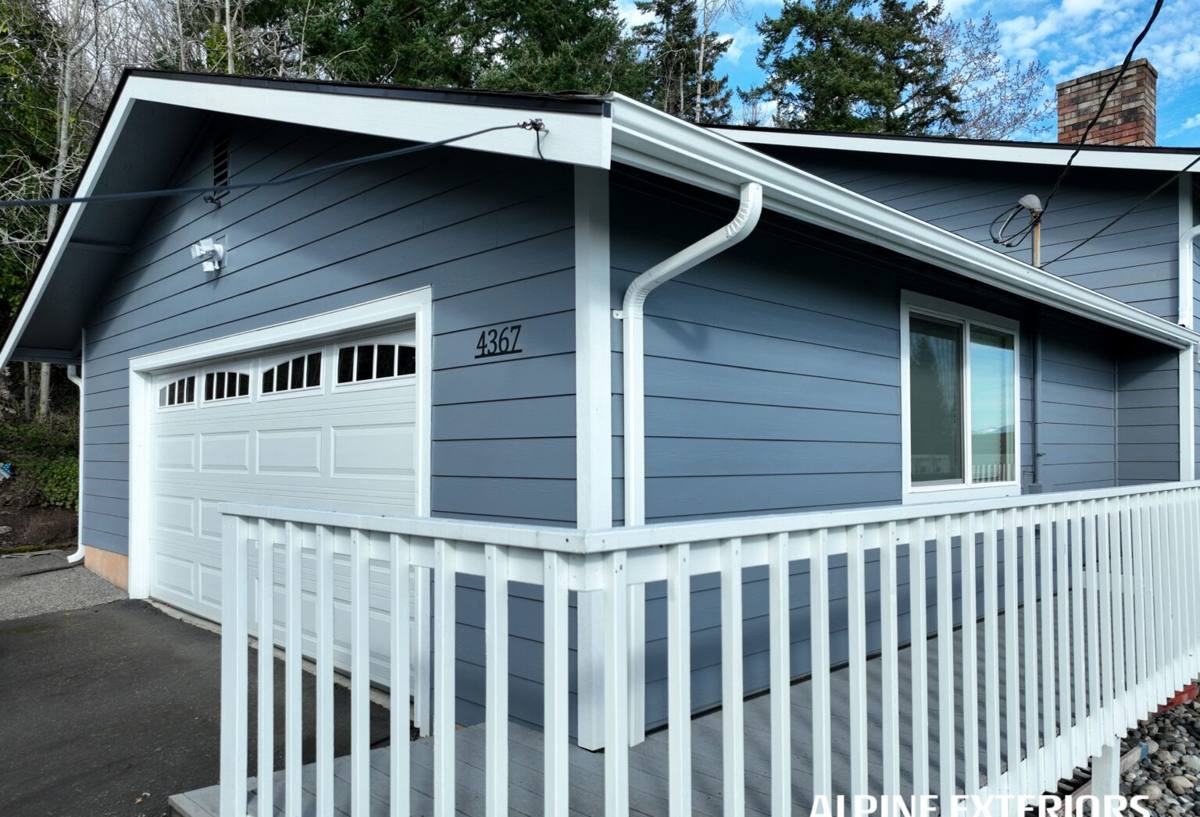
What Chuckanut's Climate Actually Does to a Roof
Salt Air and Slow Corrosion
Proximity to Samish Bay and the greater Puget Sound means airborne salt is a constant, low-level presence on building materials in this area. It's not dramatic — you won't see damage overnight — but it's persistent. Salt accelerates corrosion on any exposed metal that isn't properly coated or isn't the right alloy for a marine-influenced environment. Fasteners, flashing, and cut edges are usually the first places this shows up, which is why detailing at those points matters more here than it would on a roof twenty miles inland.
Driving Rain and Wind-Driven Water
Chuckanut Drive and the terrain around it funnel wind in ways that push rain sideways rather than letting it fall straight down. That matters for a roof because wind-driven rain finds its way under laps, around penetrations, and into any seam that wasn't sealed or fastened correctly. Whatcom County gets its share of straight-down rain too, but it's the sideways, wind-pressured events that expose weak points in a roofing system faster than anything else.
Moss, Shade, and Moisture That Doesn't Leave
Larrabee's tree cover is part of what makes the area desirable to live in, but it also means many roofs sit in partial shade for a good part of the day. Shade plus regular moisture is exactly what moss wants. On traditional roofing materials, moss holds water against the surface and works its way under laps and shingle edges over time. Metal roofing doesn't give moss the same foothold, but it isn't automatically moss-proof either — debris still needs to be kept off it, and panel design still matters for how well water and organic material shed rather than collect.
Why Metal Roofing Fits This Environment
We install and recommend metal roofing on homes near Larrabee for practical reasons tied directly to the conditions above, not because it's trendy:
- Steep water shedding on standing seam and most panel profiles gives moss and moisture less time sitting on the surface
- Solid panel runs have far fewer horizontal laps than shingles or shakes, which means fewer places for wind-driven rain to work its way in
- Correctly coated steel and aluminum resist salt-air corrosion far better than untreated or poorly coated metals
- A well-installed metal roof has a long service life, which matters on a coastal property where re-roofing access and staging can be more involved
- Metal sheds snow and ice cleanly, which is worth factoring in given the elevation changes around the Chuckanut foothills
None of this means metal roofing is maintenance-free or that every metal product performs the same. The material choice and the installation detailing both have to be right, or you're just trading one set of problems for another.
Choosing a Metal Roofing System for a Larrabee Property
Not every metal roofing product is a good match for a marine-influenced, moss-prone site. We walk homeowners through the trade-offs honestly rather than pushing whatever is easiest to install.
| System | Corrosion Resistance | Water Shedding | Typical Fit for Larrabee |
|---|---|---|---|
| Standing seam steel or aluminum | Very good, with correct coating and fastener spec | Excellent — concealed fasteners, continuous panel runs | Strong default choice near the water and under tree cover |
| Exposed-fastener metal panels | Good, but fastener gaskets are a maintenance point | Good, though laps and screws need periodic checking | Workable on secondary structures or lower-budget projects |
| Stone-coated steel | Very good on the coated steel itself | Good, mimics shake or tile profiles | Reasonable where a homeowner wants a traditional look with metal's durability |
| Uncoated or mill-finish metal | Poor in salt air without additional treatment | Fine mechanically, but corrosion risk is real | Not something we recommend this close to the water |
For most Larrabee homes, standing seam in a marine-grade coated steel or aluminum is our default recommendation. It has the fewest long-term maintenance points and holds up best against the combination of salt and driving rain this area sees. That said, budget, roof pitch, and the look a homeowner wants all factor into the final decision — we'll talk through the real trade-offs rather than steering everyone to the same product.
What a Correct Metal Roof Installation Involves
Underlayment and Moisture Barrier
A high-temperature, self-adhering synthetic underlayment goes down first. In a climate with this much sustained moisture, the underlayment is doing real work as a backup line of defense — it's not just a formality between the deck and the panels.
Fastening and Panel Attachment
Fastener type and spacing have to match the panel manufacturer's spec and the local wind exposure. On a site with regular wind-driven rain, under-fastening or using the wrong fastener coating is one of the most common causes of premature failure. We use fasteners rated for the coastal environment, not general-purpose hardware.
Flashing at Valleys, Walls, and Penetrations
Most metal roof leaks trace back to flashing details, not the panels themselves. Valleys, chimney and skylight penetrations, and wall-to-roof transitions all need properly formed and lapped flashing to handle wind-driven rain rather than relying on sealant alone. Sealant helps, but it's not a substitute for correct metal-to-metal detailing.
Ventilation
Metal roofing performs best over a properly ventilated deck. Trapped moisture underneath a roof — common on shaded, tree-covered lots — can cause deck problems even when the roof surface itself is doing its job. We check attic and roof ventilation as part of any metal roofing project rather than treating it as a separate issue.
Edge and Trim Detailing
Drip edges, rake trim, and ridge caps are where a lot of corners get cut on lower-quality installs. In a salt-air environment, these edge pieces need the same coating quality as the field panels — a mismatched or lower-grade trim piece will corrode faster than the roof around it and stand out as an obvious weak point.
How Our Process Works on a Larrabee Project
The steps themselves aren't unusual, but the details we check at each one are shaped by this specific location:
- On-site assessment — we look at existing roof condition, deck condition, tree cover and shading, and how exposed the property is to wind and salt air off the water
- System recommendation — we walk through panel and coating options against the homeowner's budget, honestly noting where a cheaper option trades away long-term corrosion resistance
- Written estimate — scope, materials, and timeline laid out plainly, no vague allowances
- Tear-off and deck inspection — we check for any moisture damage from moss or trapped water before new material goes down, since covering up a wet deck defeats the purpose of a new roof
- Underlayment, panel installation, and flashing — done to manufacturer spec and matched to the wind and moisture conditions on that specific lot
- Final walkthrough — we go over the finished roof and basic care with the homeowner before we consider the job done
Living With a Metal Roof in a Moss-Prone, Salt-Air Area
A correctly installed metal roof needs far less attention than shingles or shakes in this climate, but "far less" isn't "none." A short annual routine goes a long way toward protecting the investment:
- Clear debris — needles, leaves, small branches — from valleys and gutters, especially on shaded portions of the roof
- Look for any moss or algae buildup at low-slope sections or areas that stay shaded longer through the day
- Check that gutters and downspouts are draining freely, since standing water near the eaves is where corrosion problems tend to start
- Have flashing and sealant points checked periodically rather than waiting for an active leak to show up inside the house
- Avoid pressure washing metal panels directly — debris removal should be gentle, since aggressive cleaning can damage factory coatings
None of this requires a specialist visit every few months. It's the kind of light upkeep most homeowners can build into a seasonal routine, with a periodic professional check-in for the parts that are hard to see from the ground.
Why Local Experience Matters for This Kind of Job
Metal roofing done wrong doesn't usually fail on day one — it fails two, five, or ten years in, at the exact stress points a coastal, moss-prone climate is designed to find: an under-spec fastener, a flashing detail that worked fine in a drier climate but not here, a coating that wasn't rated for salt exposure. A crew that regularly works properties in and around Larrabee and the broader Chuckanut area has already seen where those failures tend to start on this terrain, and builds the install to avoid them from the beginning rather than learning it the hard way on your roof.
Whatcom County has plenty of microclimates within a short drive of each other, and a roofing approach that's appropriate for a dry, inland lot isn't automatically appropriate for a shaded, water-exposed one like many properties around Larrabee. Choosing a contractor who treats those as genuinely different jobs — not just a line item on the same estimate template — is one of the more practical things a homeowner can do to protect a metal roofing investment here.
Get a Straightforward Estimate
If you're weighing metal roofing for a home near Larrabee, we're glad to come take a look, walk the roof, and give you an honest read on condition, options, and cost — no pressure, no hard sell. Use the form below to request a free estimate.