 Chuckanut Exterior
 Metal Roofing Built for Lake Samish, Not Just Sold to Lake Samish
Lake Samish sits tucked into forested terrain along the Chuckanut corridor, and that setting is exactly what makes roofing here different from a typical subdivision job in flatter parts of Whatcom County. Homes around the lake live under heavy tree canopy, deal with prolonged damp seasons, and take on wind-driven rain that finds every weak seam in a roof system. A roof that performs fine on a wide-open lot ten miles away can fail early here simply because the conditions are harsher. This page is about one thing specifically: metal roofing for Lake Samish homes, what the local climate demands from it, and what a correctly installed system actually involves.
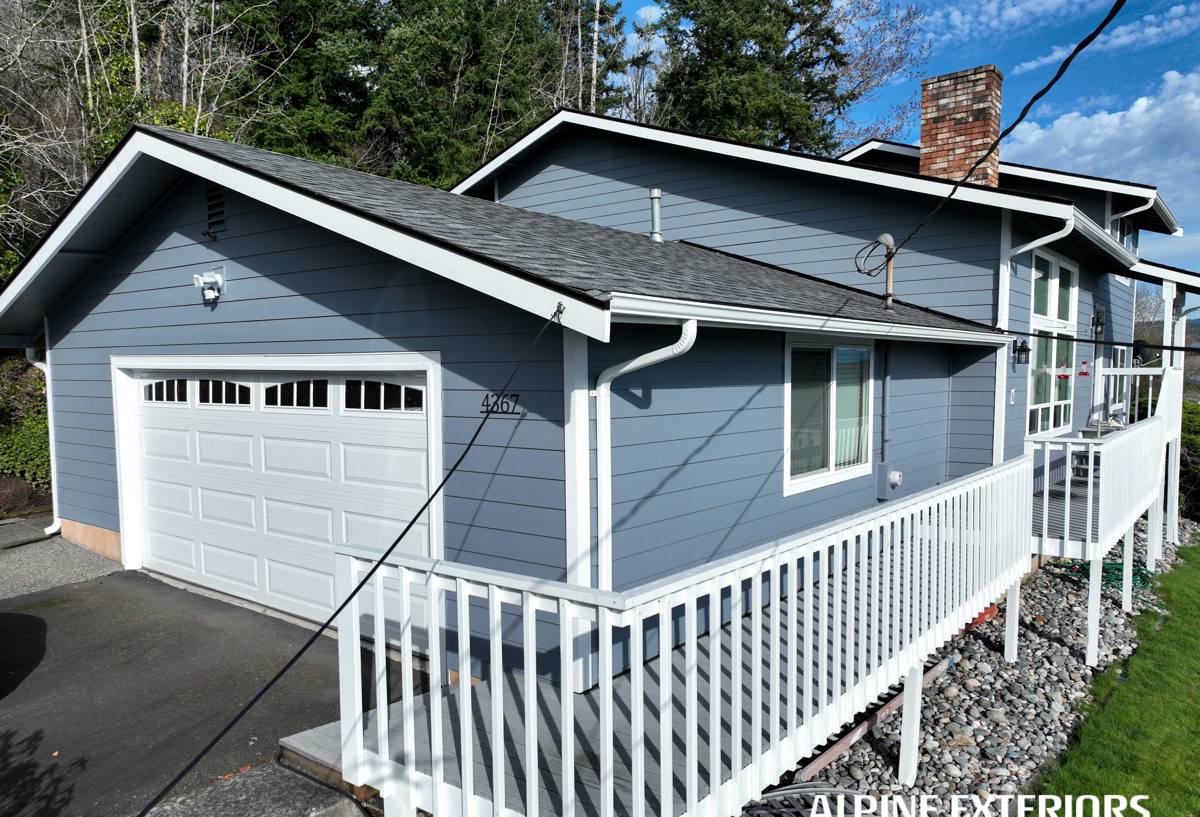
What the Lake Samish Climate Does to a Roof
Whatcom County's proximity to the water means homes throughout this region, including the Chuckanut and Lake Samish area, deal with salt-laden air, long stretches of driving rain, and a moss season that can run most of the year in shaded spots. Add in the tree cover that surrounds much of the lake, and you get a set of conditions that wears roofing down faster than drier, more open parts of the state.
Moss and Organic Debris
Heavy tree canopy means needles, leaves, and seed debris collect in valleys and behind chimneys or dormers. That debris holds moisture against the roof surface, and moisture plus shade is exactly what moss needs to establish. On asphalt shingles, moss roots work into the mat and lift granules, shortening the roof's life. On a properly installed metal roof, there's no organic mat for moss to root into, and the slick surface sheds debris far more readily.
Wind-Driven Rain
Rain around Lake Samish rarely falls straight down. Wind pushes it sideways and up under laps, fascia, and flashing details that weren't built to handle it. This is a workmanship issue as much as a material issue — the roofing material matters less than how the seams, underlayment, and flashings are actually put together.
Salt Air and Corrosion
Being close to the Sound, this part of Whatcom County carries salt in the air more than inland communities do. Salt air accelerates corrosion on unprotected metal, on fasteners, and on flashing. That doesn't rule metal roofing out — it means the fastener type, coating, and flashing metal have to be chosen correctly for a marine-influenced environment, not treated as an afterthought.
Why Metal Roofing Fits This Terrain
Metal roofing isn't the right fit for every home or every budget, and we'll say so honestly if that's the case. But for the specific conditions around Lake Samish, it solves several problems at once:
- Sheds moss, needles, and debris instead of trapping them against the roof surface
- Handles sustained wind-driven rain well when seams and laps are installed correctly
- Holds up to decades of freeze-thaw and wet-dry cycling without the granule loss that shortens shingle life
- Performs well under the steep, shaded rooflines common on lake-adjacent lots
- Reduces how often a homeowner needs to get on the roof for moss treatment or debris clearing
The trade-off is upfront cost and installation sensitivity. Metal roofing rewards a crew that does it correctly and punishes one that doesn't — a poorly detailed metal roof can leak worse than a poorly detailed shingle roof, because water finds the one seam that wasn't handled right and moves fast once it's in.
Metal Roofing Options for Lake Samish Homes
Not all metal roofing is the same product wearing a different name. The systems differ in how they're fastened, how they handle expansion and contraction, and how they age in a wet, tree-covered environment like this one.
| System | How It's Fastened | Best Fit For | Trade-Offs |
|---|---|---|---|
| Standing seam | Concealed clips, no exposed fasteners | Steep or shaded lake-view rooflines where long-term watertightness matters most | Higher material and labor cost; requires an experienced installer |
| Exposed-fastener panel | Screws driven through the panel face | Outbuildings, shops, or budget-conscious main roofs | Fasteners and washers age faster in salt air and need periodic inspection |
| Stone-coated steel | Interlocking panels with a granulated coating | Homeowners who want a shingle or shake appearance with metal's durability | More installation detail work around penetrations; higher material cost |
For most homes directly on or near Lake Samish, where shade, debris, and driving rain are the main concerns, we lean toward standing seam because it has the fewest long-term points of failure. We'll walk through the honest trade-offs for your specific roofline rather than push one system across the board.
What a Correct Metal Roofing Installation Actually Involves
The panel itself is the least important variable in whether a metal roof performs. Most metal roof failures we get called out to inspect trace back to installation shortcuts, not the material.
Underlayment
In a wet, shaded environment, the underlayment underneath the panels is doing real work, not just serving as a backup. We use synthetic or self-adhered underlayment rated for the exposure the roof will actually see, with extra protection at eaves and valleys where wind-driven rain concentrates.
Flashing and Penetrations
Chimneys, skylights, plumbing vents, and dormers are where nearly every roof leak actually starts. Flashing has to be formed and layered correctly with the panel system, not caulked as a substitute for proper detailing. Caulk fails; correctly lapped metal doesn't.
Fasteners and Metal Compatibility
In a salt-air environment, mixing incompatible metals accelerates corrosion through galvanic reaction. We match fastener and flashing metal to the panel system so components age together instead of one corroding faster and compromising the rest.
Ventilation
Metal roofs need a ventilated deck to prevent condensation from forming underneath the panels, especially on shaded, moisture-heavy lots like many around the lake. Skipping proper ridge and intake ventilation is one of the most common corners cut on cheap metal roof jobs, and it shows up years later as deck rot that isn't visible from the ground.
Our Process for a Lake Samish Metal Roof
- On-site inspection — we look at the existing roof deck, tree exposure, drainage paths, and any current moss or moisture damage before recommending a system.
- Honest scope and options — you get a clear explanation of which panel system fits your roofline and budget, with the trade-offs stated plainly.
- Tear-off and deck assessment — we remove the old roofing and check the deck for rot or soft spots, which are common under long-standing moss growth.
- Underlayment and flashing installation — done to the standard the local climate actually requires, not the minimum code allows.
- Panel installation — fastened and seamed with attention to thermal movement, since metal expands and contracts more than shingles across our seasonal swings.
- Final walkthrough — we go over the finished roof with you, including what maintenance it will and won't need going forward.
Maintenance in a Moss-Prone, Wooded Area
One of the real advantages of metal roofing around Lake Samish is how little ongoing maintenance it needs compared to shingles under the same tree cover. That doesn't mean zero maintenance — it means different maintenance.
- Clear needles and leaf debris from valleys and behind chimneys a couple of times a year, more often on heavily treed lots
- Keep gutters and downspouts clear so water isn't backing up under eave flashing
- Trim back overhanging branches that keep sections of the roof in constant shade and moisture
- Have flashing and sealant points checked periodically, since these are the components most likely to need attention over time, not the panels themselves
- Watch for any streaking or discoloration at fastener heads, an early sign worth addressing before it spreads
Cost Factors to Understand Before You Budget
Metal roofing costs more upfront than asphalt shingles, and the final number depends on more than just square footage. Rather than quote a number that won't mean much without seeing your roof, here's what actually moves the price:
| Factor | Why It Matters |
|---|---|
| Roof complexity | Valleys, dormers, and multiple roof planes require more flashing and labor time than a simple gable roof |
| Panel system chosen | Standing seam runs higher than exposed-fastener panel, reflecting the concealed-fastener labor and material |
| Deck condition | Rot or soft decking found during tear-off adds repair work before panels can go on |
| Access and pitch | Steep or hard-to-access rooflines near the lake take longer and require more safety setup |
| Tree exposure | Heavier debris load may call for additional flashing detail at valleys and penetrations |
We'll give you a real number based on your actual roof after an inspection — not a ballpark pulled from a national average that has nothing to do with a shaded, sloped lot on Lake Samish.
Why Hiring a Crew That Already Works Lake Samish Matters
A roofing crew that mostly works flat, open subdivisions doesn't necessarily know how to detail a roof for heavy tree debris, sustained shade, and wind-driven rain off the water. Working this specific part of Whatcom County regularly means we already know which details tend to fail first on lake-area homes, how local permitting and inspection typically go, and how to sequence a job around the wetter stretches of the year so the deck isn't sitting exposed longer than it should be. That local familiarity shows up in fewer callbacks, not in a sales pitch.
Get a Free, No-Pressure Estimate
If you're weighing a metal roof for a home on or near Lake Samish, we're happy to take a look, walk you through what your specific roofline needs, and give you a straight answer — including if metal roofing isn't the right fit for your budget or timeline. Use the form below to request a free estimate, no pressure either way.