 Chuckanut Exterior
 Siding That Has to Work Against the Water, Not Just Near It
Homes in the Larrabee area sit close to the water along the Chuckanut shoreline, and that proximity shapes almost everything about how siding ages here. Salt-laden air off the bay works differently on a house than inland weather does — it settles into seams, clings to fasteners, and speeds up the breakdown of anything that isn't built to shed moisture fast. Add in Whatcom County's long wet season and the shade from the timber that covers most lots along Chuckanut Drive, and you get a climate that punishes siding choices made for drier, sunnier parts of the state.
This page is specifically about James Hardie fiber cement siding installed on homes in Larrabee — not a general overview of siding options, and not a generic Hardie brochure. It's what we've learned putting this product on homes in exactly this kind of environment, and what a correct installation has to account for here that it wouldn't have to in, say, a dry inland subdivision.
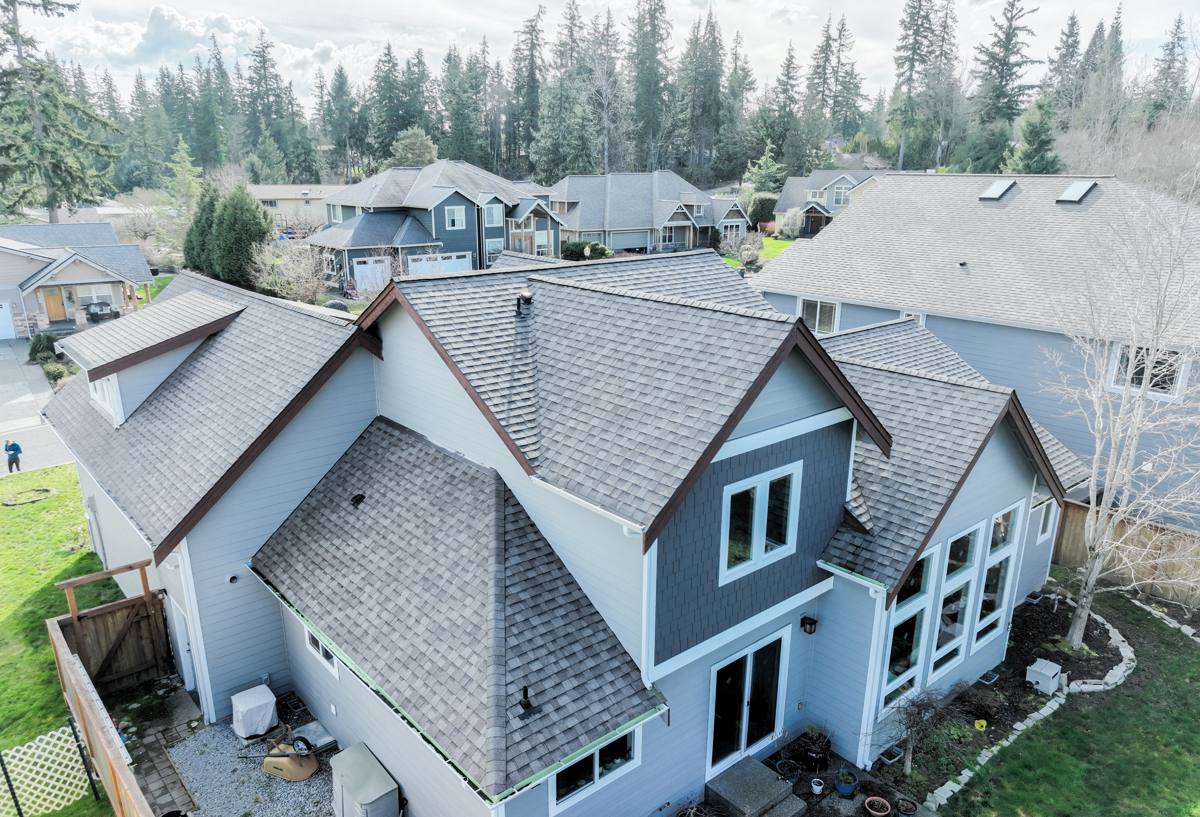
What Salt Air, Driving Rain, and Moss Actually Do to a House
Each of these three conditions attacks siding in a different way, and a Larrabee home usually deals with all three at once.
Salt Air
Airborne salt is corrosive to exposed metal — fasteners, flashing, trim edges — and it accelerates the breakdown of paint film on wood-based products. Over years, a house facing the water will show wear on its siding and trim well before a similar house a few miles inland does, simply because the air itself is more aggressive.
Driving Rain
Wind-driven rain off the bay doesn't just fall on a house, it pushes sideways into laps, corners, and penetrations. Siding that relies on caulk and paint alone to stay watertight will eventually let moisture past the face material. What matters more than the face material itself is what's happening behind it — the water-resistive barrier, the flashing details, and the drainage gap that lets any moisture that does get in find its way back out.
Moss and Prolonged Dampness
Heavy tree cover and a long damp season mean north- and west-facing walls in particular stay shaded and wet for extended stretches. That's exactly the environment moss and mildew need to establish themselves. On porous or absorbent siding materials, sustained dampness works its way into the material itself over time, not just the surface.
Why We Standardize on James Hardie for Homes Like These
We install James Hardie fiber cement exclusively — we don't offer vinyl, LP SmartSide, or cedar as alternatives. In a climate like Larrabee's, that's not a marketing position, it's a practical one. Fiber cement is non-combustible, dimensionally stable in wet-dry cycling, and doesn't feed moss and mildew the way organic or wood-based siding materials can. It holds a factory finish under UV and salt exposure far longer than field-applied paint holds up on wood siding, which matters a great deal in a spot where repainting means scaffolding a shaded, damp wall.
HZ5 — Built for This Specific Climate
James Hardie engineers its siding into region-specific HZ (HardieZone) formulations, and homes in Western Washington fall into the HZ5 zone — the version engineered for wetter, harsher climates rather than the HZ10 formulation used in drier, hotter regions of the country. HZ5 product is formulated to resist moisture intrusion and freeze-thaw stress better than the standard version, which is exactly the profile a Chuckanut-area home needs. Using the correct zone-rated product isn't optional on our jobs — it's the baseline.
ColorPlus Finish in a Shaded, Damp Environment
James Hardie's ColorPlus factory finish is baked on and warrantied against fading and peeling, which matters more on a shaded, salt-exposed wall than almost anywhere else. Field-painted siding depends on surface prep and weather conditions at the time of painting — both harder to control on a job site with Larrabee's rain patterns. A factory-cured finish removes that variable entirely and holds its color and seal far longer under sustained damp and low-light conditions.
What a Correct Installation Involves Here
The siding material is only part of the equation. Most premature siding failures we see in this area trace back to installation shortcuts, not the product itself.
Water Management Behind the Siding
Every wall gets a code-compliant water-resistive barrier, and every penetration — windows, doors, vents, hose bibs — gets flashed so that water is directed out and down, never trapped behind the cladding. Given how much wind-driven rain this location sees, we treat flashing details as the part of the job that actually determines whether the wall stays dry, not an afterthought once the siding is up.
Drainage Gap and Rainscreen Considerations
A drainage plane behind the siding lets any moisture that does get past the face material drain and dry instead of sitting against the sheathing. On a shaded, damp lot, that ventilation gap is what keeps a wall from staying wet long enough to grow mold or invite rot in the framing behind it.
Fastening and Clearances
Fasteners are corrosion-resistant and set to manufacturer spec — under-driven or over-driven nails are a common cause of cracking and water entry over time. We also hold the ground clearance and roof-line clearances James Hardie specifies, because tight clearances near grade or under eaves are where sustained dampness and splash-back do the most damage.
Caulking and Joint Treatment
Butt joints, trim intersections, and penetrations get sealed with a high-quality, paintable sealant rated for the exposure — and we don't rely on caulk to do a flashing detail's job. Caulk is a second line of defense here, not the primary one.
| Factor | James Hardie Fiber Cement | Vinyl / LP SmartSide / Cedar |
|---|---|---|
| Moisture absorption | Cement-based, does not absorb and swell | Wood-based products can absorb moisture and are vulnerable to rot; vinyl can trap moisture behind it |
| Moss and mildew resistance | Inorganic surface resists organic growth | Organic wood surfaces are more hospitable to moss and mildew in shaded, damp areas |
| Finish durability in salt air | Factory ColorPlus finish, warrantied against peeling/fading | Field-applied paint or factory laminate wears faster under salt exposure and UV |
| Fire resistance | Non-combustible | Combustible (wood-based products); vinyl can deform/melt under heat |
| Long-term maintenance | Periodic washing, minimal repainting | More frequent repainting, caulking, or panel replacement typically needed |
Our Process on a Larrabee Job
- Walkthrough and assessment — we look at exposure direction, tree cover, drainage around the foundation, and the condition of the existing wall assembly before quoting anything.
- Tear-off and sheathing check — old siding comes off and we inspect the sheathing underneath for any moisture damage that needs to be addressed before new siding goes up.
- Water-resistive barrier and flashing — barrier installed, all penetrations flashed, drainage gap established.
- Hardie panel or plank installation — HZ5-rated product installed to manufacturer fastening and clearance specs.
- Trim, caulking, and final detailing — joints sealed, touch-up finish applied where factory-cut edges are exposed.
- Final walkthrough — we go over the finished work with you before calling the job done.
Signs Your Current Siding Is Already Losing the Fight
- Dark green or black streaking on shaded walls, especially north- and west-facing sides
- Soft or spongy spots when you press on the siding, particularly near the ground or under windows
- Paint that's peeling or bubbling rather than just fading
- Visible gaps or separation at butt joints and corner trim
- Persistent musty smell near exterior walls inside the house
- Warping, cupping, or bowing panels, especially on wood-based siding
Any one of these on its own isn't necessarily an emergency, but in a climate like Larrabee's they tend to compound quickly once moisture finds a way in.
Living With Moss Season: What Maintenance Actually Looks Like
James Hardie siding isn't maintenance-free, but the maintenance is manageable. A periodic gentle wash (low-pressure, not a pressure washer aimed directly at seams) keeps moss and organic buildup from establishing on the surface. Keeping nearby vegetation trimmed back improves airflow and sun exposure on the worst-affected walls. Because the ColorPlus finish is factory-applied, you're generally not looking at repainting on the same cycle you would with field-painted wood siding — but it's still worth a visual check each fall, before the wet season sets in, for any caulking that's shrunk or pulled away from a joint.
Why a Crew That Already Works Larrabee Matters
Siding installation instructions read the same everywhere, but the judgment calls on a given wall don't. Knowing which elevations on a Larrabee lot take the worst of the wind-driven rain, how much clearance a wall needs given the tree cover and shade pattern, and where salt air does the most damage to fasteners and flashing over time — that's the kind of thing you learn by working houses in this specific stretch of Whatcom County, not from a spec sheet. A crew that's done this work along Chuckanut Drive and the surrounding shoreline isn't guessing at how the local conditions will treat a wall five or ten years out — they've already seen it.
If you're weighing a siding replacement or repair on a Larrabee home, we're happy to walk the property, look at what your walls are actually dealing with, and give you a straight assessment — no pressure, no upsell. Request a free estimate using the form below and we'll get back to you.