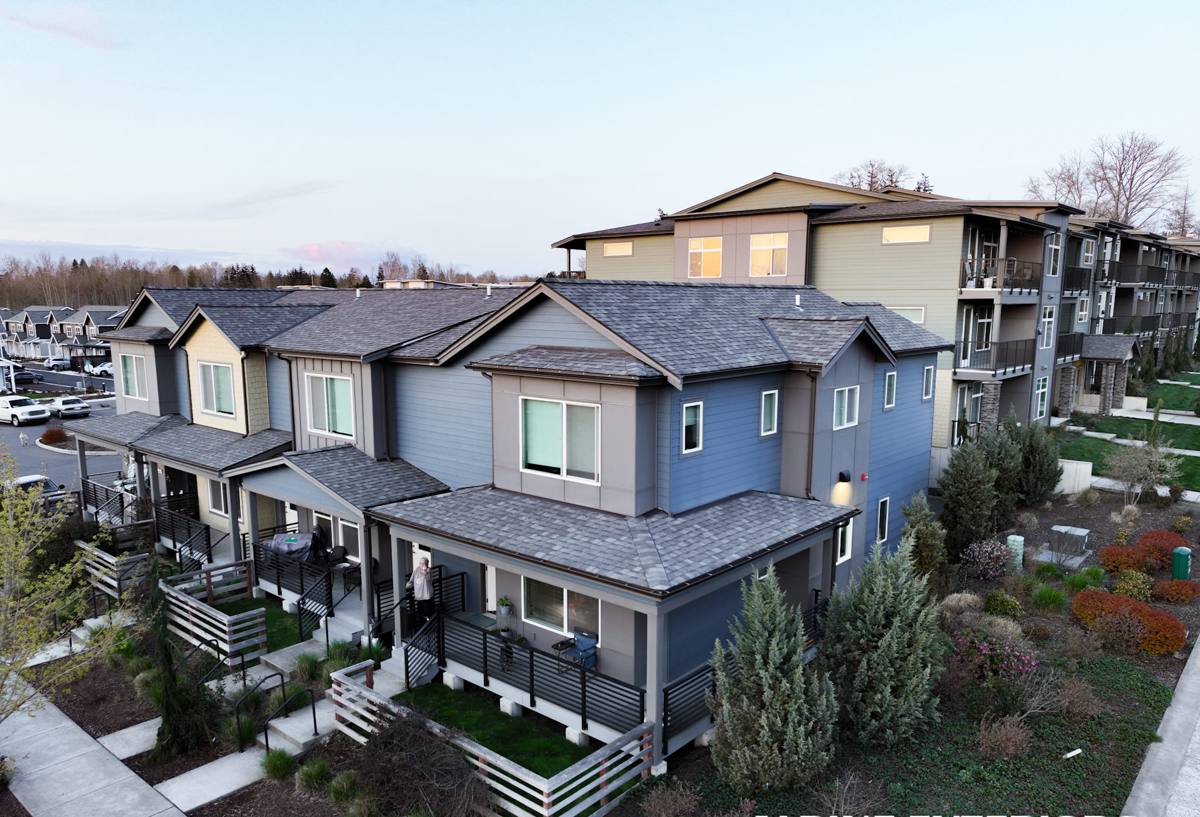
 Chuckanut Exterior
 Building New at Lake Samish: What the Climate Actually Demands
Lake Samish sits in a forested pocket of Whatcom County where tree cover, lake humidity, and the long, wet stretch of a Pacific Northwest winter combine into conditions that are tougher on a building envelope than most homeowners expect. Driving rain off passing fronts hits window openings sideways, not straight down, which means flashing details matter more here than in drier parts of the state. Shaded, tree-lined lots around the lake stay damp longer after storms, and that extended dampness feeds a moss and algae season that can run most of the year on north- and west-facing walls. Add in the broader Salish Sea region's salt-tinged air moving inland on winter storms, and you have an environment where a window installed even slightly wrong on day one becomes a maintenance headache within a few winters, not a few decades.
New construction gives you the best possible chance to get this right, because the window opening is being built specifically around the window rather than the window being fitted into an opening that already exists. That's the opportunity — and the risk, if the crew doing the framing and flashing doesn't understand what a Lake Samish site throws at a house.
New-Construction Installation Is a Different Job Than Replacement
People sometimes assume "installing a window" is the same task whether the house is new or twenty years old. It isn't. Replacement work fits a window into an existing rough opening and has to make peace with whatever flashing, sheathing, or framing is already there. New construction lets us build the opening, the water-resistive barrier (WRB), and the flashing sequence in the correct order from scratch, with the window's nailing fin doing what it was engineered to do.
That's a real advantage on a Lake Samish lot. It means we're not working around old, saturated framing or guessing at what's behind an existing wall — we're setting the window into a fresh assembly designed to shed water from the top down, the way it's supposed to work.
Why the Sequence Matters More Here Than in a Dry Climate
In a low-rainfall climate, a minor gap in the water-resistive barrier lap or a skipped bead of sealant might never cause a problem. Around Lake Samish, with driving rain hitting the walls repeatedly through a long wet season, any weak point in that sequence eventually finds water. New construction is where we control that sequence completely, so it's also where the standard has to be highest.
What a Correct New-Construction Window Install Involves
A properly installed window is really a small system of layered, overlapping materials designed so water always drains outward and downward, never inward or upward. On every new-construction opening we build, that system includes:
- A sloped sill pan at the rough opening that directs any water that gets past the window back outside, not into the wall cavity
- Water-resistive barrier integrated with the window flange in the correct shingle-lap order — sides first, then head flashing lapped over the top
- Head flashing sized and positioned to break the path of driving rain before it reaches the window-to-wall joint
- Backer rod and a compatible, paintable sealant at the exterior joint — sized correctly, not just smeared on
- Proper fastening through the nailing fin per the manufacturer's schedule, without over-driving or missing structural framing
- Interior air-sealing at the rough opening, which matters for condensation control as much as for energy use
Skip or rush any one of these steps and the window can still look fine from the driveway for a year or two. The failures we're called out to fix on other builds are almost never the glass — they're a missed flashing lap or a sealant joint that was never really watertight to begin with.
Choosing the Right Window for a Lake Samish Build
Frame material and glazing package both affect how a window handles a damp, shaded, moss-prone site over time. There's no single "best" choice for every home — it depends on your elevations, budget, and how much exterior maintenance you want to take on — but here's how the common options compare for this specific climate:
| Frame Material | Moisture Handling | Maintenance in a Mossy, Shaded Climate | Relative Cost |
|---|---|---|---|
| Vinyl | Good — won't rot or corrode; seams need proper welding | Low — occasional wash to keep sills clear of moss and debris | Lower |
| Fiberglass | Excellent — very stable in wet/dry cycling, minimal expansion | Low — durable finish resists staining and moss growth | Mid to higher |
| Wood-clad (exterior clad, wood interior) | Good if detailing is correct — cladding protects wood core | Moderate — cladding needs the same care as vinyl/fiberglass; any cladding breach exposes wood | Higher |
| Aluminum | Fair — prone to condensation without thermal breaks; can corrode near salt-tinged air | Higher — thermal break seals and finish need periodic inspection | Mid |
For most Lake Samish new builds we lean toward vinyl or fiberglass on the exterior because both shrug off the damp, shaded conditions around the lake with the least ongoing care. Wood-clad is a fine choice too, especially where the design calls for it, as long as the cladding and flashing details are done correctly — a wood-clad window with a compromised seal is one of the few window problems that's genuinely expensive to fix later.
Glazing and Energy Code Considerations
Washington's energy code sets minimum performance requirements for new-construction windows, and those minimums are tighter than what many older Lake Samish homes were built to. New construction gives you the chance to meet or beat code without the compromises replacement work sometimes requires. Two numbers matter most:
- U-factor — measures how well the window resists heat loss. Lower is better, and it directly affects winter heating costs and comfort near the glass on cold nights.
- Condensation resistance — relevant everywhere in Whatcom County's humid winters, but especially on shaded, forest-adjacent lots around the lake where indoor humidity and cooler glass surfaces are both common.
We spec glazing packages (typically dual-pane low-E with argon fill, sometimes triple-pane on especially exposed elevations) to meet code and match how each wall of the house is actually exposed — a north-facing wall under tree cover has different needs than a south-facing wall that gets more sun and drying time.
Site Conditions Unique to a Lake Samish Build
Working around the lake comes with practical realities that don't apply on a typical in-town lot. Tree cover means walls dry more slowly after rain, so we pay closer attention to sequencing — we don't want a rough opening sitting exposed through a wet stretch of weather any longer than necessary. Many lots have steep or soft ground near the water, which affects staging and material access, and tree protection is often a real consideration during framing and window delivery, not just a permit checkbox.
We also see more moss and algae pressure on north- and west-facing walls immediately around the lake than on more open, sun-exposed lots elsewhere in the county. That doesn't change how a window is installed, but it does factor into which sill and trim materials we recommend and how we detail the joint between window and siding so moisture doesn't get trapped and feed growth right at the frame edge.
Our Process, From Rough Opening to Final Trim
On a new-construction job, we coordinate directly with your framer or general contractor so window openings are built to the correct rough dimensions the first time — resizing an opening after the fact is avoidable waste. From there, our sequence is:
- Verify rough openings against approved window schedule and manufacturer specs
- Install sloped sill pans and integrate WRB in correct shingle-lap order
- Set windows plumb, level, and square, checking reveal and shim placement
- Fasten per manufacturer schedule and apply head flashing over the WRB lap
- Seal exterior joints with backer rod and compatible sealant
- Air-seal interior rough opening before insulation and drywall close it in
- Final walk-through of operation, hardware, and weatherproofing before trim
Every step gets checked before the next crew — siding, insulation, drywall — covers it up, because a flashing mistake found after the walls are closed in is far more expensive to fix than one caught at the window stage.
A Quick Checklist Before Your Windows Go In
Whether you're the homeowner or working with a general contractor on your Lake Samish build, these are worth confirming before window installation begins:
- Rough openings match the approved window schedule, with no field resizing needed
- WRB is installed and lapped correctly before window crews arrive
- Sill pan flashing is specified for every opening, not just the most exposed elevations
- Glazing package meets current Washington energy code for your climate zone
- Frame material and finish are appropriate for shaded, moisture-prone elevations
- Sealant and flashing warranty terms are documented, not just verbal assurances
- A final weatherproofing check happens before siding and trim close in the opening
Why a Crew That Already Works Lake Samish Matters
A window that's engineered correctly can still fail if it's installed by a crew unfamiliar with how driving rain, shade, and prolonged dampness behave on a specific site. We've built and detailed openings on lots around the lake, and we know which elevations tend to hold moisture longest, which details matter most under tree cover, and how to sequence a new-construction install so it isn't sitting exposed through a stretch of Whatcom County weather. That local pattern recognition doesn't show up on a spec sheet, but it's a big part of why a window installed right the first time stays right for decades instead of needing attention in year three.
If you're planning a new build near Lake Samish and want windows detailed correctly from the rough opening on, we're happy to walk the plans with you and provide a free, no-pressure estimate — just fill out the form below.