 Chuckanut Exterior
 Composite Decking Built for Fairhaven's Waterfront Climate
Fairhaven sits close to Bellingham Bay, with Chuckanut Bay just south of it, which means homes here take on more than the average Whatcom County weather. Salt-laden air off the water, driving rain that comes in sideways during winter storms, and heavy shade from fir and maple along the Chuckanut hillside all work against an outdoor deck. Wood decking in this environment usually means yearly staining and sealing just to keep ahead of it. Composite decking, installed correctly, is built to handle that exact combination of moisture and organic growth — but only if the substructure, fasteners, and drainage details are done right. That's the part that separates a deck that looks good for two years from one that still looks good in fifteen. This page covers what that actually takes on a Fairhaven property, not just what a composite deck is in general.
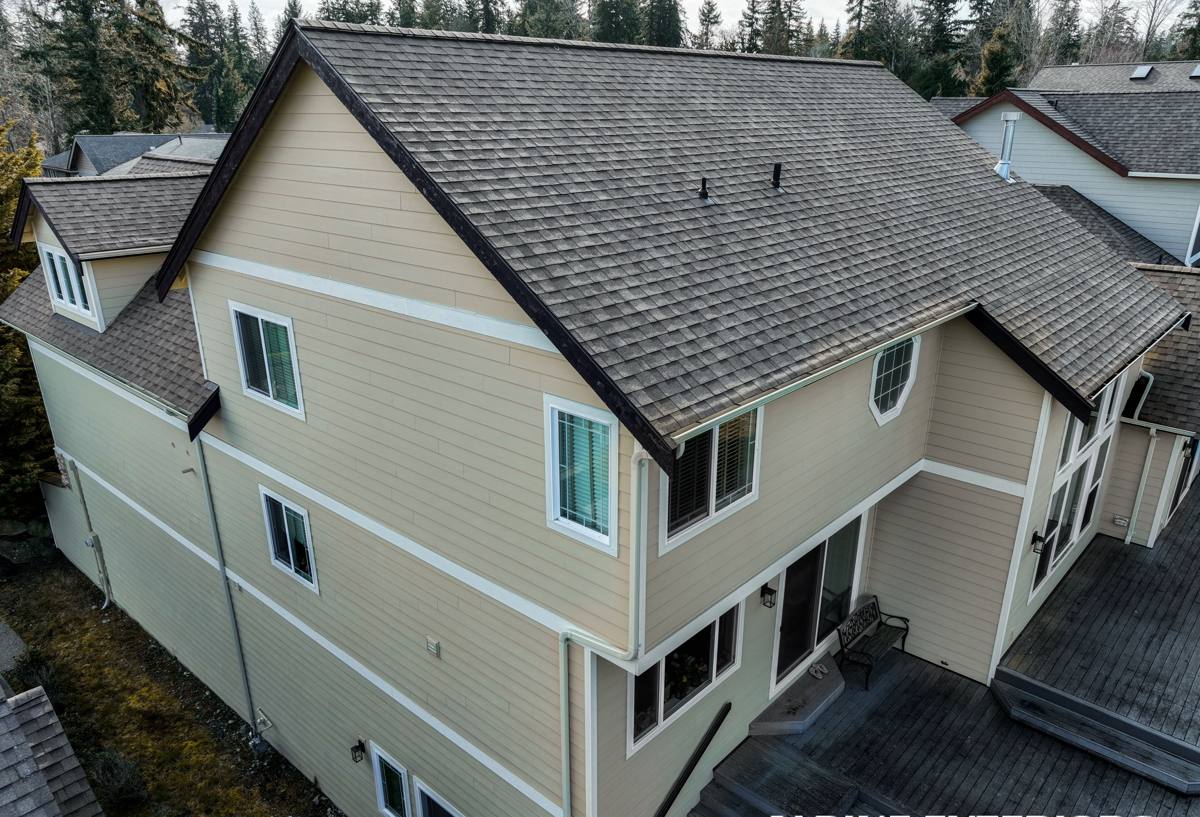
What Fairhaven's Weather Actually Does to a Deck
Before we talk about the product, it helps to understand what it's up against. Three things drive most of the deck problems we see in this part of Whatcom County:
- Salt air. Airborne salt off the bay corrodes exposed metal — fasteners, brackets, railing hardware — faster than it would inland. On lighter-colored boards, corroding hardware can also cause rust streaking at every screw or bracket point.
- Driving rain. Wind-driven rain during winter storms doesn't just fall straight down — it gets pushed sideways into railing posts, ledger connections, and stair stringers. Composite boards themselves shrug off moisture, but the wood framing underneath them doesn't, unless it's protected.
- A long moss season. Shaded, tree-lined lots — common in and around Fairhaven — stay damp for months at a time. Moss and algae take hold on any surface that doesn't shed water and dry out between rains, and a poorly ventilated deck surface is exactly the kind of surface they like.
What a Correct Composite Deck Installation Involves
Composite decking has a reputation for being low-maintenance, and it is — but that reputation depends entirely on what's happening below the board surface. A deck built without attention to the details below will still grow moss, still trap moisture, and still fail early, regardless of how good the boards themselves are.
Substructure and Framing
The joists and beams under a composite deck still need to be pressure-treated or otherwise rated for ground or weather exposure, spaced correctly for the board span, and sloped slightly away from the house so water doesn't pool. In a climate this wet, we run joist tape over the top of every joist before boards go down — a thin step that keeps standing water out of exposed end grain and fastener holes, which is where rot actually starts.
Fasteners and Hardware
Standard galvanized hardware degrades faster this close to saltwater. We use stainless steel or coastal-rated coated fasteners throughout, including at railing posts and stair stringers where hardware sees the most direct weather. Hidden fastener clip systems, when matched correctly to the board's groove profile, cut down on surface penetration points and give water fewer places to get in — but the clips have to be the right ones for the specific board, not a generic substitute.
Flashing and Ledger Attachment
Where a deck ties into the house, proper flashing over the ledger board keeps wind-driven rain from working its way behind the siding — a common failure point on older homes in this area where a ledger was simply bolted on without flashing. We treat this connection as one of the most important parts of the job, since a leak here can cause damage to the house itself, not just the deck.
Ventilation Underneath the Deck
A deck that sits low to the ground, or backs up against a hillside lot the way many Fairhaven properties do, needs enough clearance and cross-ventilation underneath to let moisture escape. Without it, damp air gets trapped below the boards, which slows drying after every rain and gives mold and mildew a place to establish even when the board surface above looks fine. On tight-clearance builds we look at venting options and support layout specifically to keep air moving underneath, not just meeting the minimum height off grade.
Composite vs. Other Decking Materials for a Coastal Whatcom County Lot
Homeowners in Fairhaven usually compare composite against pressure-treated wood or PVC. Here's how they stack up against the specific conditions this area produces:
| Factor | Capped Composite | Pressure-Treated Wood | PVC / Vinyl |
|---|---|---|---|
| Moisture & rot resistance | High — capped shell resists water absorption | Moderate — needs sealing to maintain resistance | High — fully synthetic |
| Salt air performance | Good, with corrosion-rated hardware | Fair — hardware and grain are both exposed | Good |
| Moss & algae resistance | Good with proper board profile and gapping | Poor in shaded, damp spots without upkeep | Good |
| Ongoing maintenance | Occasional wash-down | Annual staining/sealing | Occasional wash-down |
| Typical feel underfoot | Wood-like, wide color/texture range | Natural wood grain | Can feel more plastic-like |
| Upfront cost | Mid to higher | Lower | Higher |
For most Fairhaven lots — especially ones with shade or direct water exposure — capped composite gives the best balance of low upkeep and long-term durability without the constant sealing schedule wood requires. We install manufacturer lines from established composite makers such as Trex, TimberTech, and Fiberon, which offer capped profiles and warranty coverage suited to this kind of climate. The right choice still depends on the specific lot, budget, and how much upkeep a homeowner actually wants to take on — we'll walk through the honest trade-offs during the estimate rather than push one product for every job.
Choosing Board Color and Profile for a Shaded, Damp Lot
Color and surface texture matter more here than they would on a dry, sunny lot. Darker boards show less rust streaking from hardware but can highlight algae film more readily; lighter boards hide moss dust between cleanings but show hardware corrosion sooner if lower-grade fasteners were used. Grooved or scalloped-underside profiles help boards dry faster between rains than solid, flat-backed boards, which matters most on shaded sections that never get direct sun to speed up drying. We factor in how much shade a specific area of the deck gets — not just the yard as a whole — when recommending a profile and color combination.
Our Composite Decking Process
Every deck we build in Fairhaven follows the same sequence, adjusted for the specific lot and its sun, shade, and drainage:
- On-site assessment. We look at sun and shade exposure, existing drainage patterns, the condition of any current structure, and talk through board color and railing options that suit both the home and the surrounding tree cover.
- Removal and prep. Old decking comes off and we check the framing underneath for rot, which is common near ledger boards and stair stringers on older decks that have been fighting moisture for years.
- Framing and flashing correction. Any substructure issues get fixed here, and joists get joist tape and corrosion-rated hardware before a single board goes down.
- Board installation. Boards go in with correct gapping for expansion, contraction, and airflow underneath — gapping that's too tight traps moisture and invites moss.
- Railing, stairs, and trim. Matched or compatible rail systems go in with the same corrosion-rated hardware used throughout the deck.
- Final walkthrough. We check fastening, drainage, and edge details together, and go over a maintenance schedule suited to the specific site — a sunny, open lot needs less attention than a shaded one under tree cover.
Maintenance in a Wet, Shaded Climate
Composite decking cuts down on maintenance dramatically compared to wood, but "low-maintenance" isn't "no-maintenance" — especially in a climate that stays damp as long as this one does. A short seasonal routine keeps a composite deck looking and draining the way it should:
- Rinse off salt film and pollen a couple of times a year — more often on lots that face the water directly.
- Sweep leaves and needle debris off promptly, especially in fall; trapped organic matter holds moisture against the board surface and feeds moss growth.
- Check hidden fastener clips and railing hardware once a year for early corrosion, particularly on lots closer to the shoreline.
- Keep gutters and downspouts clear so roof runoff isn't sheeting across the deck surface.
- Clean algae or moss film with a mild soap and soft-bristle brush, or a cleaner made for composite surfaces; a wide fan-tip pressure washer works too, kept at moderate pressure and a safe distance.
- Trim back overhanging branches where practical to let more sun and airflow reach shaded sections of the deck.
Why Hire a Crew That Already Works Fairhaven
A lot of what makes a composite deck last here isn't in the manufacturer's install manual — it's local knowledge. Which lots stay damp longest into spring, which streets take the worst of the wind off the bay, how the tree canopy along the Chuckanut hillside changes sun exposure and drainage from one yard to the next. A crew that already works this area brings that judgment to your project instead of learning it on your deck.
Sloped and hillside lots, which aren't unusual in and around Chuckanut and Fairhaven, also change how a deck gets supported — footing depth and placement need to account for grade and drainage in a way a flat-lot build doesn't. We also know the local permitting and inspection process, so structural work gets handled correctly the first time instead of flagged and redone later.
If you're planning a new composite deck or replacing an aging one in Fairhaven, we're glad to walk the site with you and put together a straightforward, no-pressure estimate. The form below is the easiest way to get that conversation started.