 Chuckanut Exterior
 Siding Repair in Bow: Built Around What This Climate Actually Does to a Wall
Bow sits close enough to the water that homes here take a different kind of weathering than siding fifteen or twenty miles inland. Salt-laden air off the bay works on fasteners, trim, and any exposed seam. Driving rain off Chuckanut and the surrounding hills doesn't just fall straight down — it hits siding at an angle, again and again, and finds every gap a straight-down rain would never reach. And Whatcom County's long, damp shoulder seasons give moss and algae months at a time to get established on north-facing and shaded walls. None of that is unusual for this part of Washington. But it does mean a siding repair that would hold up fine somewhere drier can fail here in a fraction of the time — and it's why repair work in Bow has to be diagnosed and done differently than a generic patch job.
This page is specifically about siding repair for homes in and around Bow — not a full replacement, not a general overview of siding in general. If your siding has a damaged section, a moisture problem, moss buildup, or aging trouble spots and you're trying to figure out whether it can be fixed and what a proper fix actually involves, this is written for that decision.
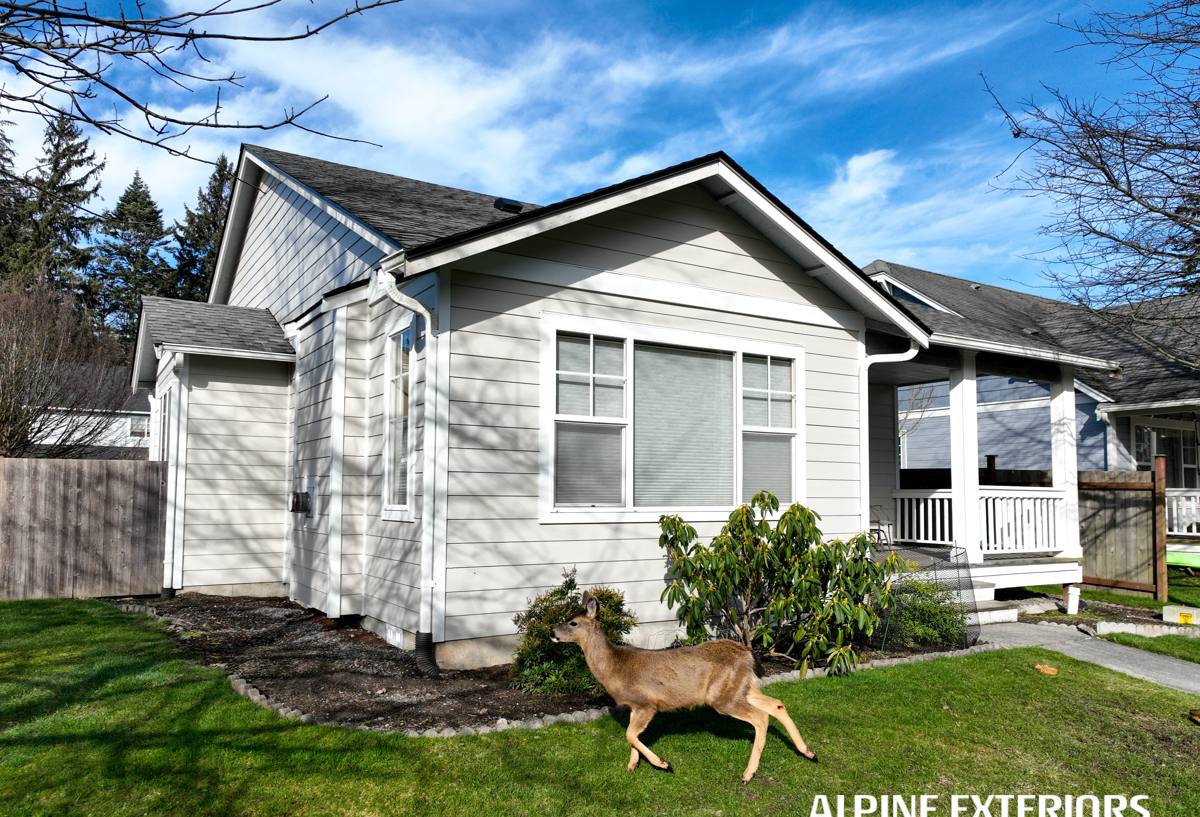
Why Bow Siding Wears Differently Than Siding Further Inland
Three regional factors show up in almost every repair call we get in this area, and they compound each other:
Salt Air and Corrosion
Airborne salt accelerates corrosion on any exposed metal — nail heads, flashing, trim fasteners, hose bibs, and light fixtures mounted through the siding. Once a fastener starts to corrode, it loses its grip and the siding around it starts to move. Small movement lets water in behind the panel, which is where real damage starts.
Wind-Driven, Angled Rain
Straight-down rain is easy for siding to shed. Wind-driven rain off the water pushes moisture sideways and upward into laps, seams, corner boards, and anywhere trim meets siding. Repairs that only address the visible surface — a bead of caulk, a patch, a coat of paint — without correcting how water moves at that spot tend to fail again within a season or two.
Extended Moss and Algae Season
Bow's tree cover and marine-influenced humidity keep shaded and north-facing walls damp for a large part of the year. Moss and algae aren't just cosmetic — they hold moisture directly against the siding surface, which is exactly the condition that leads to rot in wood-based products and finish breakdown in others. A repair on a wall with an active moss problem needs to address the moisture source, not just the stained panel.
Common Repair Issues We See on Bow Homes
| Issue | What's Usually Happening | Why It Matters Here |
|---|---|---|
| Soft or swollen siding sections | Moisture has gotten behind the panel, usually through a failed seam or fastener | Driving rain finds these entry points faster than in drier climates |
| Moss and algae staining | Prolonged dampness on shaded or north-facing walls | Long wet season means it returns quickly if the moisture source isn't fixed |
| Nail pops or loose panels | Corroding fasteners or wood movement behind the siding | Salt air speeds up fastener corrosion |
| Cracked or split panels | Impact damage, freeze-thaw stress, or material fatigue | Cracks are a direct path for wind-driven rain |
| Caulk or paint failure at trim and corners | Old sealant drying out, shrinking, or never being the right product for the joint | These joints take the brunt of angled rain |
| Discoloration or chalking finish | UV and moisture cycling breaking down an aging paint or coating | More pronounced on walls exposed to sun and salt spray |
What a Correct Siding Repair Actually Involves
A repair that just replaces the damaged-looking piece and moves on is a cosmetic fix, not a real one. Here's what separates a repair that lasts from one you'll be calling someone back out for in a year:
Diagnosing the Cause, Not Just the Symptom
Before anything gets replaced, we look at why that section failed. Was it a flashing detail, a caulking joint that opened up, a fastener issue, or something behind the wall like a downspout dumping water against that section? Replacing the visible panel without fixing the underlying cause just buys time before the same spot fails again.
Checking What's Behind the Siding
Damaged or soft siding is often a sign that moisture has already reached the sheathing or framing behind it. A proper repair opens up the area enough to check for rot, staining, or trapped moisture — and addresses what's found there, not just what's visible from the street.
Matching Material and Finish
Patch repairs stand out badly when the material, texture, or paint doesn't match. On homes with older or discontinued siding products, matching can be difficult or impossible, which is one of the honest trade-offs we'll walk you through rather than promising a seamless patch we can't deliver.
Getting the Details Right — Not Just the Panel
Flashing, house wrap, seam laps, and caulking joints all have to be installed in the correct order and orientation so water sheds down and out, never in. This is the part of a repair that's invisible once it's finished, and it's also the part that determines whether the fix holds up through a wet Whatcom County winter.
Repair or Replace? An Honest Look at the Decision
Not every damaged section needs a full re-side, and we're not going to tell you it does. But there's a point where patch repairs stop making financial sense. Here's how we think about it:
| Factor | Leans Toward Repair | Leans Toward Replacement |
|---|---|---|
| Extent of damage | Isolated to one or two sections | Spread across multiple walls or elevations |
| Underlying moisture | Localized, source identified and fixable | Widespread rot or long-term water intrusion behind the siding |
| Age and condition of remaining siding | Siding is mid-life and sound elsewhere | Siding is near end of service life or failing in several spots |
| Material availability | Matching material and finish are available | Product is discontinued or won't match visually |
| Cost over time | Repair cost is modest relative to remaining siding life | Repeated repairs are adding up toward replacement cost anyway |
When a home's existing siding is old wood, vinyl, or a product with a history of moisture problems, and the damage is spreading rather than isolated, we'll say so directly. In those cases, patching one section while the rest of the wall is on the same trajectory usually isn't the best use of your money — and that's when we'll talk about James Hardie fiber cement as the long-term fix rather than another round of repairs.
Repairing Existing James Hardie Siding vs. Other Materials
We install James Hardie fiber cement exclusively for full siding jobs, and that shapes how we approach repair work too. If a Bow home already has Hardie siding, repairs are usually the most straightforward kind we do: the material doesn't swell, rot, or feed moss the way wood-based products can, so a repair is typically a matter of replacing a physically damaged plank, correcting a flashing or caulking detail, and matching the factory ColorPlus finish — which holds its color well enough that older sections and new ones read consistently.
Repairs on other materials are a different conversation. Vinyl can be brittle and difficult to source in an exact matching color once it's faded. Older wood or engineered wood products are the ones most likely to have moisture damage extending beyond the visibly bad section, because those materials are more vulnerable to the kind of prolonged dampness Bow gets for a good part of the year. We'll still repair what's repairable on any material — we're not going to tell you your vinyl or wood siding needs to come off if a solid patch will genuinely hold. But when a homeowner is facing the second or third repair on the same wall, we think it's fair to lay out why fiber cement holds up differently in this climate, so that decision is an informed one, not a sales pitch.
Our Repair Process
- On-site inspection. We look at the damaged area and the surrounding siding, not just the spot you called about — a lot of the time there's a related issue nearby that hasn't shown itself yet.
- Diagnosis. We identify the actual cause: moisture intrusion, fastener failure, impact damage, or a flashing/sealant issue, and check what's happening behind the siding where needed.
- Honest recommendation. We tell you plainly whether a repair will hold, what it involves, and if the damage points toward a bigger problem, we say so — along with the reasoning, not just an upsell.
- The repair itself. Damaged material comes out, the substrate is checked and addressed if needed, flashing and water management details are corrected, and new material goes in matched as closely as possible.
- Finish and cleanup. Caulking, touch-up, and a check that the repaired area sheds water the way the rest of the wall does.
Why It Matters to Hire a Crew That Already Works in Bow
Siding repair looks straightforward from the outside, but the correct fix depends heavily on understanding how water actually moves across a wall in this specific area — the direction storms typically come from, how much shade a given elevation gets, and how moss tends to establish itself locally. A crew that works across Chuckanut and the surrounding Whatcom County communities regularly sees the same failure patterns repeat on similar homes, which means less guesswork diagnosing your specific issue and a repair that's built for what this coastline actually throws at a house, not a generic textbook fix. Local also means being reachable if a repair needs a follow-up look after the next heavy rain — not a one-time visit from a crew that's moved on to the next city.
Keeping a Repair From Becoming a Repeat Repair
Once a repair is done, a little attention keeps it — and the rest of your siding — from heading down the same path again:
- Rinse moss and algae off shaded or north-facing walls before it establishes a thick mat, rather than after.
- Keep gutters and downspouts clear so water isn't discharging directly against a wall section.
- Trim back vegetation that keeps siding shaded and damp longer than it needs to be.
- Do a visual check after major windstorms for loose panels, popped fasteners, or fresh cracks.
- Re-caulk trim and corner joints before the existing sealant fully fails, not after water's already gotten behind it.
- Address small issues — a loose corner, a hairline crack — while they're still small repairs.
Get an Honest Look at Your Siding
If you're dealing with a damaged section, a moisture spot, or siding that just isn't holding up the way it used to, we're glad to come take a look and tell you straight what's going on and what it'll take to fix it right. There's no pressure and no obligation — just a clear read on your options. Fill out the form below for a free estimate.