 Chuckanut Exterior
 Building a new home in the Bellingham area gives you one advantage you don't get with a remodel: the chance to get window installation right the first time, before siding, trim, and insulation cover up the details that actually determine whether those windows perform for the next 30 years. New-construction window work is a different trade skill than replacement window work, and in a climate that mixes salt air off Bellingham Bay, driving wind-driven rain, and a long moss season, the difference between a correctly flashed window and a "close enough" one shows up as a repair bill five to ten years down the road.
New-Construction Windows vs. Replacement Windows
These are two different jobs, even though both end with a window in a wall. New-construction installation happens with the wall open to the studs — the window gets set into a bare rough opening, tied into the weather-resistive barrier (WRB) and flashing system, and secured with a nailing flange before siding and trim go on. Replacement (retrofit) installation works around existing siding and trim, usually reusing the old frame or working within it.
New construction gives us full access to build a proper drainage plane around every window — something you can't fully redo once siding is installed. That access is an opportunity, but it also means there's no room for shortcuts, because any flashing mistake gets sealed inside the wall assembly for the life of the house.
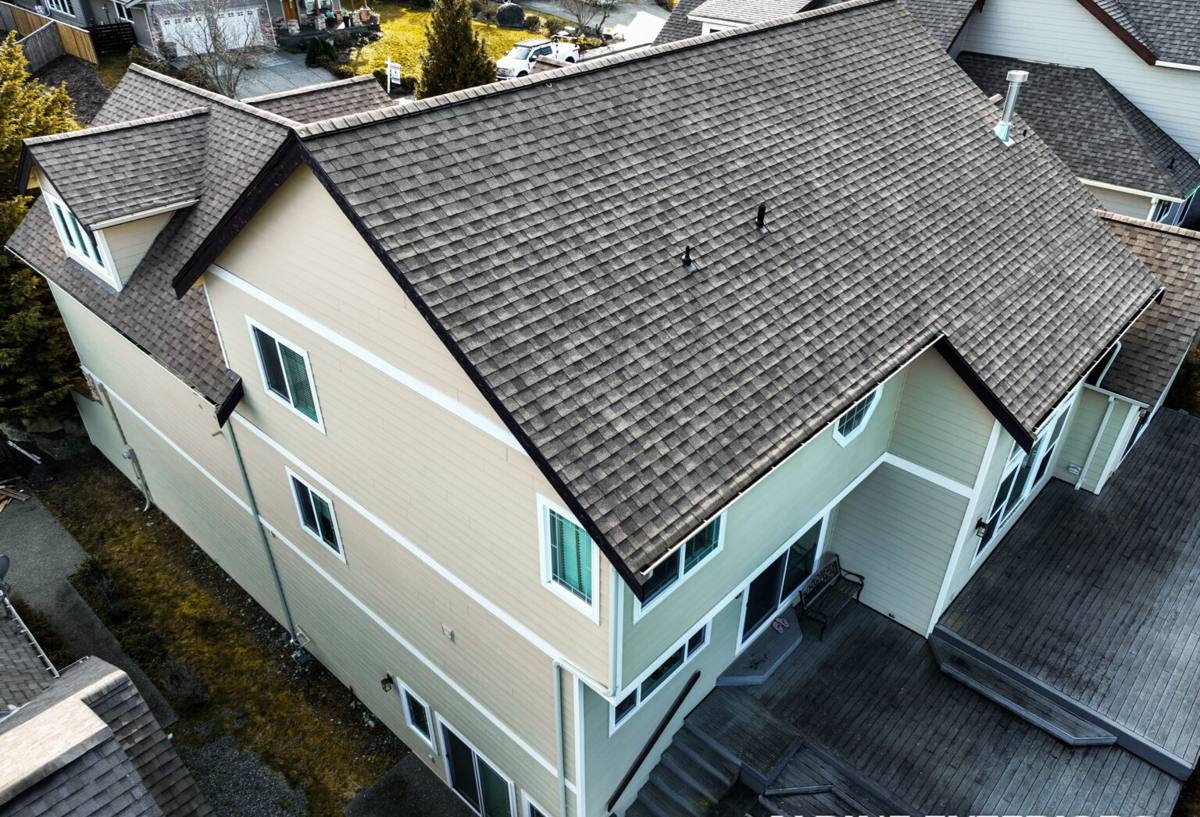
Why Bellingham's Climate Raises the Stakes
Salt Air and Corrosion
Homes closer to Bellingham Bay and the surrounding shoreline deal with airborne salt that accelerates corrosion on window hardware, fasteners, and unprotected metal flashing. We spec corrosion-resistant fasteners and flashing metals for these properties rather than treating every job the same regardless of proximity to the water.
Driving, Wind-Driven Rain
Whatcom County doesn't just get rain — it gets rain pushed sideways by wind off the Sound, which puts real pressure on window flashing and sealant joints that a calmer climate would never test. A window that's "basically sealed" in a dry climate can leak here within a year or two if the sill pan, head flashing, and jamb integration aren't built correctly.
Moss and Sustained Moisture
The long moss season here means surfaces that stay damp longer, get less direct sun exposure under eaves and in shaded elevations, and hold moisture against wood trim and sills longer than in drier regions. That sustained dampness is exactly the condition that turns a small flashing gap into rot, so trim details and drainage gaps matter more here than in most parts of the country.
What a Correct Installation Actually Involves
A properly installed new-construction window is a system, not a single product. Every layer has to work with the ones around it:
- A sloped sill pan flashing under the window that directs any water that gets past the frame back outside the wall, not into the framing
- Self-adhered flashing tape integrated with the WRB in the correct shingle-lap order (bottom to top, so water always sheds outward and downward)
- Head flashing that extends beyond the jamb flashing and directs water away from the window head
- Backer rod and low-expansion sealant at the interior and exterior gaps — never spray foam alone as a water barrier
- Proper shimming so the frame stays square and doesn't rack, which is what keeps sashes operating smoothly for years
- Fasteners and flashing rated for the exposure — more corrosion resistance for near-shoreline properties
Skip any one of those steps and the window may look fine and even test dry on a calm day — the problems show up during the first real wind-driven storm, and by then the evidence is inside the wall where you can't see it.
Meeting Washington's Energy Code
New construction in Whatcom County has to meet Washington State Energy Code requirements for window performance, which are stricter than a lot of homeowners expect. That means paying attention to two numbers on every window's label:
| Rating | What It Measures | Why It Matters Here |
|---|---|---|
| U-Factor | How well the window resists heat loss (lower is better) | Keeps heating bills reasonable through our long, wet, cool winters |
| SHGC (Solar Heat Gain Coefficient) | How much solar heat passes through the glass | Balances winter warmth against summer overheating on sun-exposed elevations |
We select window performance packages that meet or exceed code for your specific plans and orientation, and we can walk you or your builder through what the energy code checklist actually requires before the windows are ordered — it's much cheaper to fix a spec on paper than to swap out installed windows later.
Choosing Window Materials for This Climate
| Frame Material | Strengths | Trade-Offs Here |
|---|---|---|
| Vinyl | Cost-effective, low maintenance, good energy performance | Can expand/contract with temperature swings; quality varies a lot by manufacturer |
| Fiberglass | Very stable dimensionally, strong, holds paint well, low maintenance | Higher upfront cost than vinyl |
| Wood / Wood-Clad | Classic appearance, good insulator | Exterior wood needs consistent maintenance to resist rot in our wet, mossy conditions — cladding helps but sightlines and end grain still need attention |
| Aluminum | Slim sightlines, strong, modern look | Conducts heat and cold unless thermally broken; needs a quality thermal break spec for this climate |
We don't push one product line for every job. The right call depends on your home's design, budget, and how much exterior maintenance you want to take on. What we won't do is install a window system whose warranty or moisture behavior we can't stand behind in this specific climate — that's a standard we hold regardless of what's cheapest to order.
Our New-Construction Window Process
- Plan review — we review window schedules and rough opening dimensions against your building plans before anything is ordered, catching sizing or spec issues while they're still easy to fix
- Coordination with your builder or GC — we work on the framing crew's timeline so windows go in at the right stage, not rushed ahead of a dry WRB or delayed past the point where siding crews are waiting
- Rough opening prep — verifying openings are square, plumb, and correctly sized before any flashing goes on
- Sill pan and flashing installation — built in the correct shingle-lap sequence for this climate's wind-driven rain
- Window setting and shimming — squared, plumb, and fastened per manufacturer specs to protect the warranty
- Insulation and interior/exterior sealing — low-expansion foam and sealant at the gap, never foam alone as the water barrier
- Final inspection — checking operation, seals, and flashing laps before the wall gets closed up behind siding and interior finish
Working With Your Builder
On new construction, window installation sits in the middle of the schedule — after framing and WRB, before siding and interior trim. Delays or miscommunication at that handoff point are one of the most common causes of water problems in new homes, because a rushed crew working around someone else's timeline is more likely to skip a flashing step. We coordinate directly with general contractors and framing crews around Bellingham so the window stage happens in the right order, at the right time, without holding up the rest of the build.
What Drives Cost on a New-Construction Window Job
| Factor | Why It Matters |
|---|---|
| Number and size of openings | More and larger windows mean more flashing detail work and material |
| Frame material | Vinyl, fiberglass, wood-clad, and aluminum carry different material costs |
| Performance package | Higher-performance glass packages for energy code compliance cost more but lower long-term utility bills |
| Site exposure | Near-shoreline or high-wind-exposure homes need upgraded flashing and fastener specs |
| Access and building stage | Windows installed on schedule with easy access cost less than jobs requiring rework after the fact |
We give straightforward, itemized estimates so you know what you're paying for — not a single lump number that hides whether you're getting real flashing detail or the bare minimum.
Why Local Experience on Bellingham Homes Matters
A crew that installs windows across a range of climates might do fine work in general, but a crew that regularly works Bellingham and the surrounding Whatcom County area has already seen how this specific combination of salt air, wind-driven rain, and moss-season dampness plays out on real houses over time. We know which elevations tend to take the worst weather exposure, which fastener and flashing specs hold up near the water, and where trim details need extra attention to shed water instead of holding it. That local pattern recognition is hard to get from a crew that isn't consistently working this coastline.
If you're planning new construction in the Bellingham area and want windows installed correctly from the rough opening out, we're happy to walk your plans, talk through material options, and give you a straightforward, no-pressure estimate — just fill out the form below.