 Chuckanut Exterior
 What Samish's Climate Actually Does to Siding
Samish sits close enough to the water that siding here takes a different kind of beating than siding twenty miles inland. Salt-laden air off Samish Bay settles on exterior surfaces year-round, driving rain comes in sideways during winter storms instead of falling straight down, and the long stretch of gray, wet months between fall and spring gives moss and algae months of uninterrupted growing time on anything that doesn't dry out fast. None of that is dramatic on its own. It's cumulative. A siding product or installation detail that would hold up fine in a drier part of Whatcom County can start showing problems here in half the time.
That's the lens we use on every Samish siding job: not "will this look good on install day" but "will this still be doing its job in fifteen winters." Fiber cement, installed correctly, is one of the few claddings that holds up to all three of these stresses at once — salt exposure, wind-driven moisture, and sustained damp shade — without a heavy maintenance schedule to keep it that way.
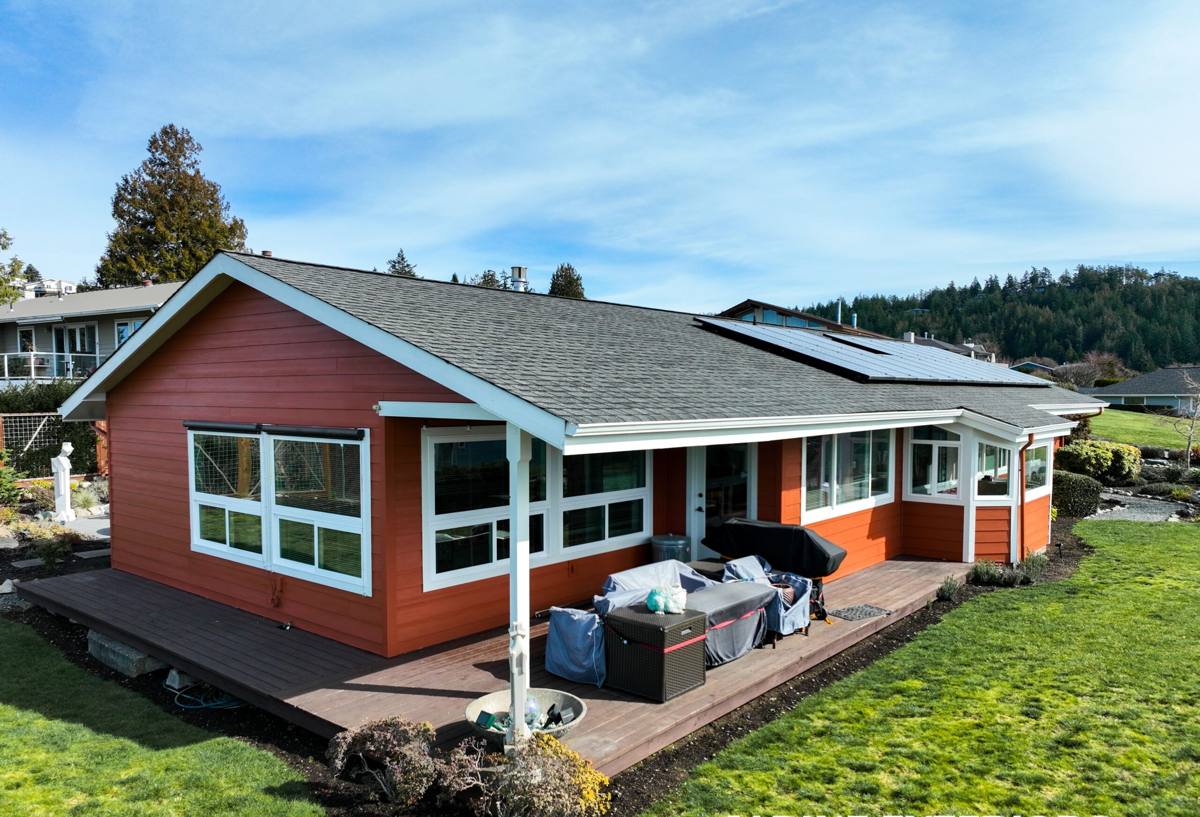
Why Fiber Cement Is the Right Material for This Environment
It doesn't feed moss the way wood does
Moss and algae need a food source and a damp surface to hold onto. Wood siding, and wood-based composite products, give both. Fiber cement is an inorganic material — mostly cement, sand, and cellulose fiber under pressure — so it doesn't rot, and it doesn't offer the same organic surface for spores to colonize. Moss can still grow on top of it in shaded, north-facing spots that never get sun, same as it can grow on a roof or a fence post, but it's growing on the surface, not into the material. That distinction matters: surface growth washes off; growth that's degraded the substrate underneath does not come back from a rinse.
It shrugs off salt air better than metal or bare wood
Salt accelerates corrosion in metal fasteners and trim, and it dries out and checks bare or thinly-coated wood faster than inland exposure would. Fiber cement itself doesn't corrode, and when it's finished with a factory-applied coating rather than field-applied paint, the finish is far more resistant to the slow fade and chalking that salt air causes over time.
It holds up to wind-driven rain when the water management behind it is right
This is the part that's easy to get wrong. Fiber cement is water-resistant, but it isn't waterproof, and no siding product is a substitute for correct flashing, laps, and drainage behind it. In a location that gets driving rain off the water, the installation details — not just the board itself — are what actually keep a wall assembly dry over decades.
Why We Install Only James Hardie
Not every fiber cement product is engineered the same way, and we don't install competing brands or substitute materials like LP SmartSide, vinyl, Cemplank, Allura, or bare cedar and primed spruce. That's a deliberate standard, not a sales preference.
ColorPlus factory finish
Field-painted siding is only as good as the paint job and the repaint schedule that follows it — and in a salt-air, high-moisture environment, that repaint clock runs faster. Hardie's ColorPlus finish is baked on in a controlled factory setting, which gives it far more consistent coverage and UV/salt resistance than a job-site paint application, and it comes with its own finish warranty separate from the product warranty.
Climate-engineered product lines
Hardie engineers its fiber cement formulation differently depending on regional climate — moisture and humidity exposure on one hand, freeze-thaw cycling on the other. The Pacific Northwest's mild-but-wet profile calls for a different engineering target than a freeze-heavy climate does, and using the correctly-engineered product for this region is part of what makes the long-term performance claims meaningful instead of generic marketing.
A warranty that's actually transferable
Hardie's product warranty is designed to transfer to a subsequent homeowner, which matters both for resale value and as a signal of how the manufacturer expects the product to perform over a long ownership horizon — not just through one owner's tenure.
How Fiber Cement Compares to the Alternatives in Samish
| Factor | James Hardie Fiber Cement | Vinyl | Cedar / Primed Wood | LP SmartSide |
|---|---|---|---|---|
| Moss/algae resistance | Strong — inorganic substrate | Moderate — can trap moisture behind panels | Weak — organic surface feeds growth | Moderate — engineered wood, still organic |
| Salt air / coastal exposure | Strong, factory finish holds color | Can become brittle over time | Finish fails faster, needs frequent recoating | Finish maintenance more frequent than Hardie |
| Wind-driven rain tolerance | Strong with correct flashing/laps | Prone to gaps and warping over time | Absorbs moisture, prone to rot at joints | Vulnerable at cut edges if not sealed |
| Fire rating | Non-combustible | Combustible | Combustible | Combustible, engineered wood core |
| Typical maintenance | Occasional wash, no repainting for ColorPlus | Low, but limited repair options if damaged | Regular recoating/staining required | Edge sealing and repainting cycle |
None of this means the other products are unusable everywhere — they're just not what we've chosen to stand behind for homes exposed to this particular combination of salt, wind, and sustained damp.
What a Correct Installation Involves
The board is only part of the job. Most of the siding failures we get called out to inspect trace back to installation shortcuts, not the material itself. On a Samish home, a correct install includes:
Water management behind the siding
Proper weather-resistant barrier, correctly lapped and taped seams, flashing at every window, door, and roof-to-wall transition, and a drainage gap where the wall assembly calls for it. This is what actually stops driving rain from reaching the sheathing, regardless of what cladding is on the outside.
Correct clearances and fastening
Manufacturer-specified clearance from grade, decks, and roof lines; fasteners set to the correct depth and pattern (not overdriven, which cracks the board and voids warranty coverage); and joints caulked or flashed per Hardie's published details rather than eyeballed.
Trim and penetration detailing
Every hose bib, vent, light fixture, and utility penetration is a potential entry point for wind-driven rain. Each one needs to be flashed or sealed as part of the siding install, not treated as an afterthought once the boards are up.
Our Process, Start to Finish
- Walk-through and assessment — we look at existing siding condition, moisture staining, trim, and any areas showing rot or past water intrusion before quoting anything.
- Scope and estimate — a written estimate covering material, tear-off if applicable, house wrap/flashing work, and finish selection.
- Prep and removal — old siding and trim removed, sheathing inspected and repaired where needed before anything new goes on.
- Weather barrier and flashing — this stage determines long-term performance more than any other single step.
- Hardie installation — installed to manufacturer specification for fastening, clearance, and lap detail.
- Final inspection and walkthrough — we review the finished work with the homeowner before calling the job complete.
Maintenance Checklist for Samish Homeowners
Fiber cement is low-maintenance compared to wood, but "low" isn't "none." A short annual routine keeps it performing the way it's supposed to in this environment:
- Rinse the exterior once or twice a year to clear settled salt spray and airborne grime, especially on sides facing open water or prevailing wind
- Check shaded, north-facing sections for early moss or algae growth and wash it off before it spreads
- Inspect caulking around windows, doors, and trim joints for cracking or gaps each fall before the wet season sets in
- Keep gutters clear so overflow isn't running down the siding face during heavy rain
- Trim back vegetation and shrubs so they aren't holding moisture against the wall
- Look at any penetration points — vents, fixtures, hose bibs — for signs of water staining below them
Why a Crew That Already Works in Samish Matters
Fiber cement installation isn't exotic, but installing it correctly for a specific site's exposure takes judgment that comes from having done it in that exact environment before. A crew that regularly works Samish and the surrounding Chuckanut area already knows which elevations take the worst of the wind-driven rain, where moss tends to establish first, and how much clearance and flashing detail a given exposure actually needs versus the bare code minimum. That's the difference between a siding job that looks right on install day and one that's still performing the way it should well into its second decade.
If you're weighing siding options for a Samish home, we're happy to take a look and put together a straightforward, no-pressure estimate — use the form below to get started.