 Chuckanut Exterior
 Why Siding Choice Matters More in Alger Than in Most Places
Homes around Alger sit close enough to the water and the tree line that they take on a specific combination of punishment: salt-laden air drifting in off the marine environment, long stretches of driving rain that hit siding sideways rather than straight down, and shaded, damp conditions that keep moss and algae active for most of the year. None of these things alone is unusual for Western Washington. Together, on the same wall, for years at a time, they narrow the list of siding products that actually hold up.
We install James Hardie fiber cement siding exclusively, and Alger is a good example of why. It's not that other siding products can't be installed here — it's that the trade-offs those products carry (moisture absorption at cut edges, coating breakdown under UV and salt exposure, seams and joints that become entry points for water) show up faster in a climate like this one. This page covers what a James Hardie installation actually needs to look like on an Alger home, and why the details matter as much as the product itself.
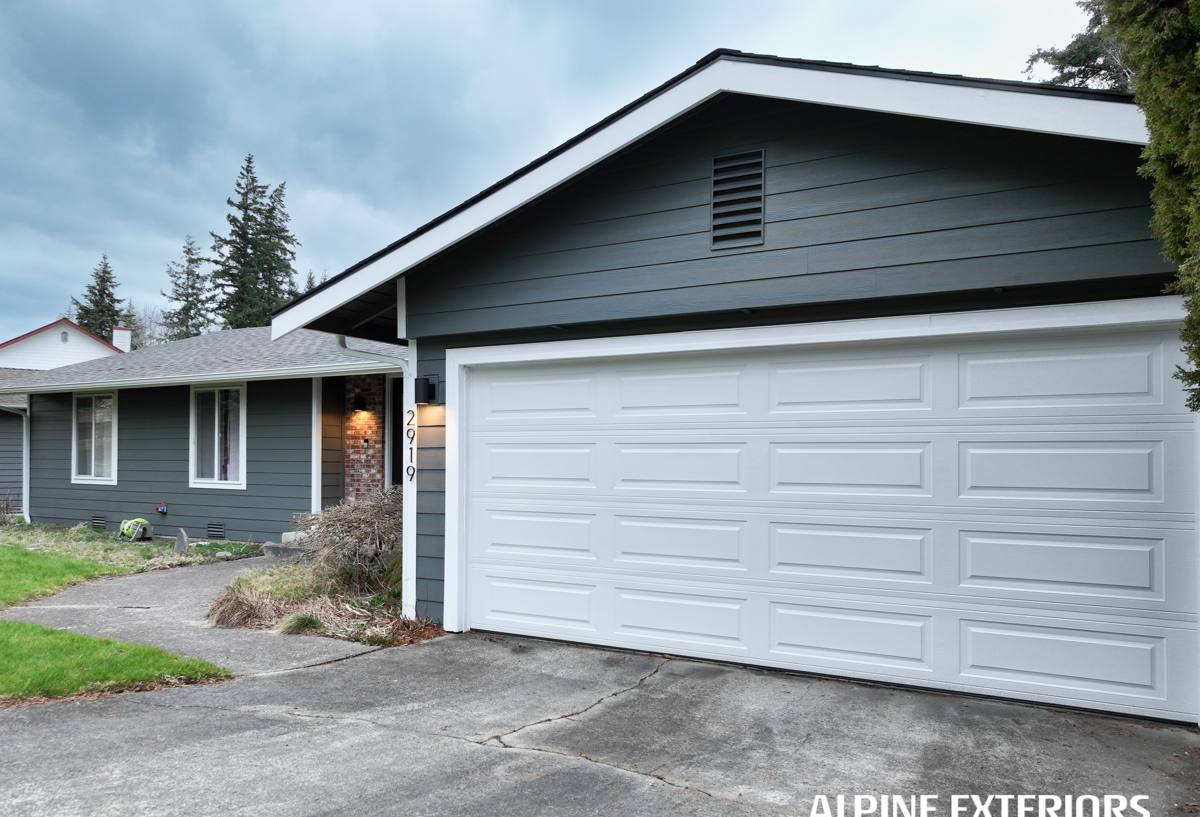
What the Chuckanut-Area Climate Actually Does to Siding
Salt Air
Airborne salt is corrosive to exposed metal fasteners, flashing, and trim, and it accelerates the breakdown of lower-grade coatings on some siding materials. It doesn't damage properly finished fiber cement the way it damages bare wood or under-protected composites, but it does mean every metal component in the assembly — fasteners, flashing, drip caps — needs to be a grade that's actually rated for coastal exposure, not just whatever is cheapest to source.
Driving Rain
Wind-driven rain doesn't just run down a wall, it gets pushed sideways and upward into laps, joints, and penetrations. A siding system that relies on paint or caulk alone to keep water out will eventually fail in these conditions. What keeps water out over the long term is correct lap geometry, proper flashing at every horizontal transition, and a drainage plane behind the siding that lets any water that does get past the surface find its way back out instead of sitting against the sheathing.
Long Moss Season
Shaded, moisture-retentive sites around Alger stay wet longer between rain events than open, sunny lots do. That extends the season during which moss, algae, and mildew can establish themselves on a wall surface. Porous or textured materials give these organisms more to grab onto; smooth, factory-sealed surfaces give them less. This is one of the more practical, everyday reasons the surface finish of a siding product matters as much as its core material.
What James Hardie Brings to This Specific Set of Problems
James Hardie siding is fiber cement — a mix of cement, sand, and cellulose fibers engineered to be dimensionally stable and resistant to moisture damage in a way that wood-based and wood-derived products aren't. A few specifics matter directly for a home in this area:
- HZ5 engineered products — Hardie's climate-specific product lines are formulated for regions with heavier moisture exposure, which fits the marine environment around Chuckanut better than a generic, one-size-fits-all siding product.
- ColorPlus factory finish — a baked-on finish applied under controlled conditions, rather than field-painted after installation. It resists fading and holds up to UV and salt exposure better than site-applied paint, and it gives you a consistent, sealed surface that sheds water and resists organic growth better than a porous or field-finished surface.
- Non-combustible core — not a climate factor specific to Alger, but a real durability and insurance-relevant advantage over wood-based sidings, and part of why we standardized on it across every job we take.
- Dimensional stability — fiber cement doesn't swell, cup, or crack the way wood and some engineered wood products can when they take on repeated moisture cycling, which is exactly what driving rain and a long wet season put a wall through every year.
What a Correct Installation Actually Requires
The material is only half the equation. Fiber cement siding installed without attention to the details below will underperform no matter how good the product is — and in a climate like this one, the gap between a correct install and a sloppy one shows up faster than it would in a drier region.
Clearance and Drainage
Hardie siding needs proper clearance from grade, roof lines, decks, and other horizontal surfaces so water has somewhere to go instead of wicking up into the bottom edge of the material. Behind the siding, a drainage plane — typically a weather-resistant barrier with a rainscreen gap — gives any moisture that gets past the surface a path to escape rather than sitting against the wall assembly.
Flashing at Every Transition
Windows, doors, decks, roof-to-wall intersections, and any other penetration through the siding are the places water actually gets in. Flashing has to be installed correctly at each of these before the siding goes on, not patched around it afterward with caulk. In a driving-rain climate, this step does more to determine how a wall performs over the next twenty years than almost anything else in the job.
Fastening
Hardie specifies fastener type, spacing, and placement for a reason — correct fastening keeps panels seated properly and prevents the small gaps and movement that let water and, eventually, moss and mildew get a foothold. Fasteners also need to be a corrosion-resistant grade appropriate for a marine-influenced environment, not a generic interior-rated fastener.
Cut Edges and Field Touch-Up
Every cut edge on a fiber cement board needs to be sealed with the appropriate touch-up product before installation. This is a small, easy-to-skip step that has an outsized effect on long-term performance, since an unsealed cut edge is the one part of the board that isn't protected by the factory finish.
Comparing Siding Options for a Climate Like This
| Factor | James Hardie Fiber Cement | Vinyl | Wood / Cedar |
|---|---|---|---|
| Moisture behavior in driving rain | Dimensionally stable; performs well with correct flashing and drainage detailing | Can warp or blow off in high wind-driven rain and gusts; joints rely on lapped fit | Absorbs moisture readily; prone to cupping, checking, and rot without constant upkeep |
| Resistance to moss and algae | Sealed ColorPlus finish sheds water and resists organic growth | Textured surfaces can trap grime and support algae growth | Porous surface is highly favorable to moss and mildew, especially in shade |
| Coastal / salt air durability | Core material unaffected by salt; hardware selection matters | Can become brittle and discolor faster under UV and salt exposure over time | Finish breaks down faster under salt and UV, requiring more frequent refinishing |
| Maintenance over 10+ years | Periodic washing; factory finish reduces repainting needs | Low structural maintenance, but color fades and can't be easily refinished | Regular refinishing, sealing, and rot inspection required |
| Fire performance | Non-combustible core | Combustible; can melt or deform near heat sources | Combustible |
This isn't a knock on every other product on the market — vinyl and wood both have legitimate uses and plenty of homes wear them fine in gentler climates. It's a straightforward statement of why, for the specific combination of salt air, driving rain, and moss exposure that Alger and the surrounding Chuckanut area deal with, we standardized on one material and stopped installing the others.
How We Approach a Job in the Alger Area
Assessment
We start by walking the home and looking specifically at the conditions that drive failure in this climate: shaded, moisture-retentive sides of the house, existing moss or algae growth, areas where the current siding shows signs of water intrusion, and any spots where clearance from grade, decks, or roof lines is already tight.
Tear-Off and Sheathing Check
Once old siding comes off, we check the sheathing and framing underneath for hidden moisture damage before anything new goes on. Covering up a problem that's already there just locks it in behind a new wall — we'd rather find it now and address it properly.
Weather Barrier and Drainage Plane
This is where long-term performance is actually decided. We install the weather-resistant barrier and drainage detailing to spec, with particular attention to laps, seams, and every point where the barrier meets a window, door, or roof transition.
Hardie Installation
Panels or planks go on to Hardie's fastening and clearance specifications, with corrosion-resistant hardware appropriate for a marine-influenced climate and sealed cut edges throughout.
Final Detailing
Trim, flashing, and touch-up work get finished and inspected before we call the job done. A siding job is only as good as its weakest transition point, so this step doesn't get rushed.
Living With Moss and Mildew After Installation
No siding material makes moss and algae impossible in a climate this wet — anything exposed outdoors in the Chuckanut area will eventually collect some organic growth if it's shaded and damp enough. What changes with a correctly installed Hardie system is how much of that growth actually takes hold and how easy it is to deal with. A sealed, factory-finished surface sheds spores and grime far more readily than a porous one, and an occasional gentle wash (never a high-pressure blast directly at seams or edges) is usually enough to keep a wall looking clean. Homes with a lot of shade from surrounding trees will need more frequent washing than those in open exposure, regardless of siding material — that's a site condition, not a product flaw.
Why It Matters That a Crew Already Works This Area
A crew that regularly works Alger and the broader Chuckanut area already knows which sides of a house tend to hold moisture longest, how far siding needs to clear grade and hardscaping given the local rain patterns, and which hardware grades actually hold up to the salt exposure here instead of corroding within a few seasons. That's the kind of judgment that doesn't come from a spec sheet — it comes from having installed and later serviced siding on homes with the same climate exposure, and seeing firsthand what holds up and what doesn't.
It also means a more accurate estimate up front. Local knowledge of typical lot conditions, tree cover, and exposure in this area lets us scope a job realistically instead of under-bidding on drainage and flashing work that ends up being necessary anyway once tear-off starts.
What to Ask Before Hiring for a Siding Job in This Climate
- Will you install a drainage plane / rainscreen behind the siding, not just a weather-resistant barrier alone?
- What flashing details will you use at windows, doors, and roof-to-wall transitions?
- What fastener and hardware grade are you using, and is it rated for coastal/marine exposure?
- Will all cut edges be sealed with manufacturer-approved touch-up product before installation?
- What clearance will the finished siding have from grade, decks, and roof lines?
- Is your crew certified or specifically experienced with James Hardie products, not just fiber cement in general?
- Will you check and address any moisture damage in the existing sheathing before installing new siding?
If a contractor can't answer these clearly, that's worth noticing before the job starts, not after the first hard winter storm finds the gaps.
Get a Straight Answer for Your Home
Every home in the Alger area carries its own mix of tree cover, sun exposure, and wind direction, and that mix affects how siding should be detailed just as much as the product choice does. We're happy to take a look at your home, walk you through what we're seeing, and give you a straightforward, no-pressure estimate for a James Hardie installation built for the conditions your house actually faces. Use the form below to get started.