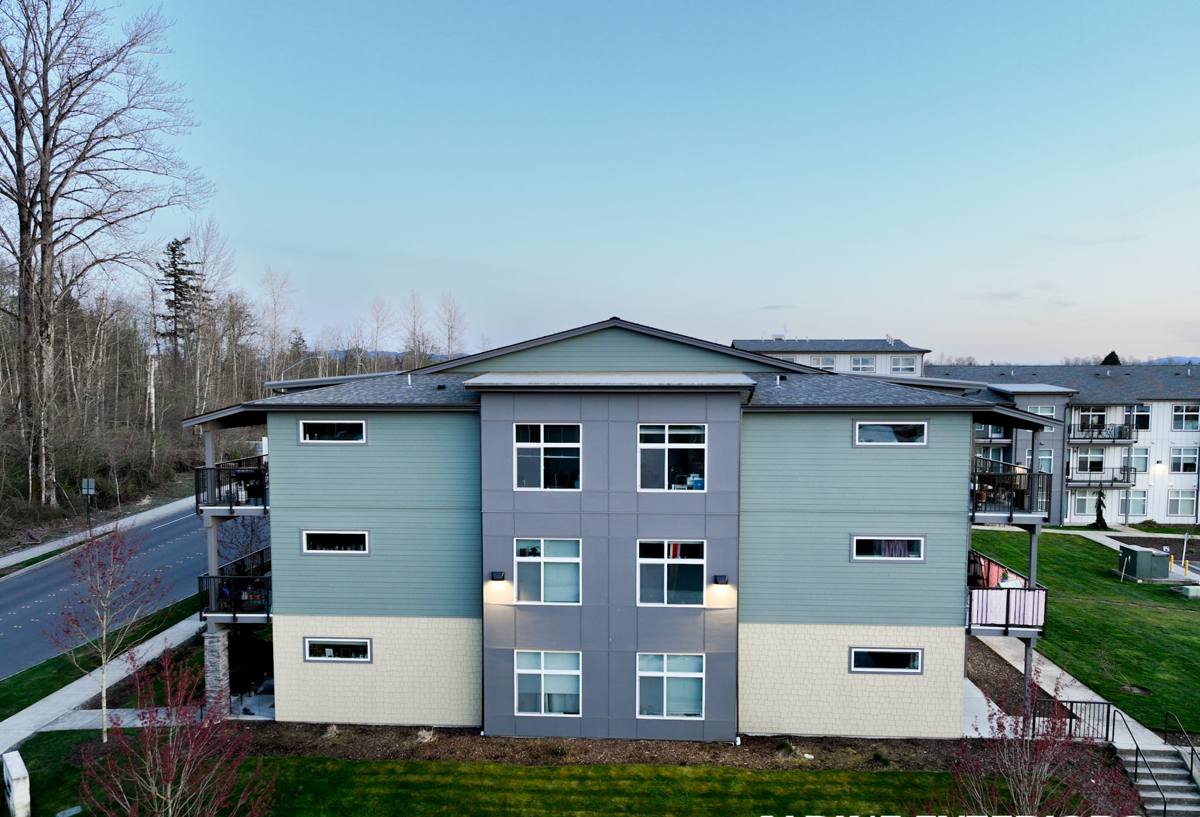
 Chuckanut Exterior
 Fairhaven Roofs Face a Different Kind of Wear
Fairhaven sits close enough to the water that roofs here deal with a combination most inland Whatcom County homes don't: salt-laden air off Bellingham Bay, wind-driven rain that comes in sideways during winter storms, and a moss season that stretches longer than most homeowners realize. None of these alone is dramatic. Together, over years, they wear down flashing, loosen shingles, and create the conditions for leaks that show up long after the storm that caused them has passed.
When we talk about "storm damage roof repair" for Fairhaven specifically, we're not describing a generic service. We're describing repair work that accounts for salt-air corrosion on metal components, moisture that gets driven under shingle edges by wind rather than just falling straight down, and moss growth that holds water against roofing material for months at a stretch. A repair that doesn't account for those factors tends to fail again within a season or two.
What Counts as Storm Damage (Even When It's Not Obvious)
Wind and Driving Rain
Coastal storms in this part of Washington rarely bring the kind of hail damage you see in other regions. Instead, the damage is mechanical and cumulative: wind gets under shingle tabs and breaks the seal, sustained gusts lift or crease shingles without fully removing them, and horizontal rain pushes water past flashing details that were only ever designed to shed water moving straight down. A roof can look intact from the ground after a storm and still have compromised seals that let water in during the next one.
Damage That Shows Up Later
Some of the most common calls we get aren't right after a storm — they're weeks later, when a stain appears on a ceiling or ice-dam-style moisture shows up along an eave. By then the actual damage (a lifted shingle, a cracked pipe boot, flashing pulled loose from a chimney) happened during the storm, but the visible sign took time to travel through the roof deck and attic space. This is why we recommend a roof check after any significant wind event, not just after obvious damage like a fallen branch.
The Salt Air and Moss Factors
These two conditions don't cause storm damage directly, but they determine how much damage a storm does and how fast small problems turn into leaks.
- Salt air: accelerates corrosion on exposed nail heads, metal flashing, and vent stacks — corroded fasteners back out or lose their seal faster than they would inland, giving wind and rain an easier way in.
- Moss: Whatcom County's damp, mild winters give moss a long growing season on north-facing and shaded roof sections. Moss holds moisture against shingles, lifts edges as it grows, and works into gaps that wind then widens during a storm.
A repair crew that isn't used to working in Fairhaven or similar coastal neighborhoods may fix the visible storm damage and miss the underlying corrosion or moss growth that made the roof vulnerable in the first place — which means the same spot fails again next winter.
What a Correct Storm Damage Repair Actually Involves
A Real Inspection, Not a Guess
A proper storm damage repair starts with getting on the roof, not just looking at it with binoculars from the yard. That means checking every shingle course near the damaged area (wind damage is rarely isolated to one spot), inspecting flashing around chimneys, vents, and valleys, checking the roof deck itself for soft spots where water has already gotten through, and looking at attic insulation and framing from the inside where accessible. Skipping this step is the single most common reason storm repairs don't hold up.
Repair vs. Replace — Made Honestly
Not every storm-damaged roof needs a full replacement, and not every roof can be safely patched. The decision comes down to a few honest questions: How much of the roof is affected? Is the underlying deck sound? How much life was left in the roofing material before the storm? A contractor who recommends full replacement for a single damaged section without a clear reason, or who patches a roof that's clearly at the end of its service life, isn't doing the homeowner any favors either way.
Our Process for Fairhaven Storm Repairs
- Initial assessment: We inspect the full roof, not just the reported problem area, since wind damage often extends beyond what's visible from the ground.
- Documentation: We record what we find with clear notes and photos, useful both for your records and for any insurance claim you may file.
- Scope and options: We explain what needs to happen — repair, partial replacement, or full replacement — and why, in plain terms, with the trade-offs of each.
- The repair itself: Matching materials where possible, re-sealing and re-flashing with attention to the coastal exposure of the specific roof section, and making sure fasteners and flashing are suited to a salt-air environment.
- Final check: We verify the repair is watertight and walk through what we did before we consider the job finished.
Repair Types and What Affects the Cost
Costs vary based on the extent of damage, roof access, and material availability, but the factors below give a realistic sense of what drives price on a storm repair.
| Repair Type | What's Typically Involved | What Affects Cost |
|---|---|---|
| Shingle repair/replacement | Replacing individual lifted, torn, or missing shingles and re-sealing surrounding tabs | Number of shingles affected, age match, roof pitch and access |
| Flashing repair | Re-securing or replacing flashing at chimneys, valleys, vents, and wall intersections | Number of penetrations, corrosion level, whether siding or trim must be pulled back |
| Deck/sheathing repair | Replacing water-damaged plywood or board decking beneath the roofing material | Extent of rot, whether it's isolated or spread along a section |
| Moss remediation + repair | Removing moss growth, treating the area, and repairing any shingle damage moss caused | Roof size, moss coverage, whether gutters and downspouts also need clearing |
| Full section replacement | Tearing off and replacing an entire roof slope when damage is widespread | Square footage, material choice, tear-off and disposal |
Storm Damage and Insurance Claims
Most homeowners' insurance policies cover sudden storm damage — wind, falling debris, driven rain intrusion — though coverage details and deductibles vary by policy. Long-term wear from moss or gradual salt-air corrosion is generally treated differently by insurers than a discrete storm event, which is part of why clear documentation matters. Photos and a written assessment taken close to the time of the storm give you the clearest record if you decide to file a claim. We're glad to provide that documentation; we don't handle the claim itself, but we can make sure you have what you need to support it.
Why Local Fairhaven Experience Matters
A roofing crew that works regularly in Fairhaven and the surrounding Chuckanut area already knows which roof orientations take the worst of the wind off the bay, which neighborhoods hold moss longest into the summer, and which flashing details tend to fail first in this specific coastal exposure. That knowledge shortens the inspection, sharpens the diagnosis, and means the repair is built for the conditions the roof will actually face again — not just for the damage that's visible today.
Reducing Repeat Storm Damage
A few habits go a long way toward catching problems before the next storm turns them into a leak:
- Walk your property after any significant wind event and scan the roofline from the ground for missing or displaced shingles
- Check ceilings and attic spaces for new stains after heavy or prolonged rain
- Keep gutters and downspouts clear so storm runoff doesn't back up under roof edges
- Have moss removed before it spreads across a full slope, rather than after
- Get flashing and fasteners checked periodically, especially on roofs over 10-15 years old, given how salt air accelerates corrosion here
- Don't wait on a minor leak — small water intrusion after a storm is far cheaper to fix than deck rot that develops over a winter
Get a Straight Answer About Your Roof
If a recent storm has you wondering whether your roof took damage, or you've noticed a stain, a lifted shingle, or moss creeping across a slope, it's worth getting a second set of eyes on it before the next system rolls through. We offer free, no-pressure estimates for Fairhaven homeowners — we'll tell you honestly what we find and what it would take to fix it, whether that's a small repair or something bigger. Use the form below to get started.