 Chuckanut Exterior
 Siding Installation Built for Columbia's Conditions
Homes in the Columbia area near Chuckanut sit in one of the more demanding exterior environments in Whatcom County. You've got salt-laden air moving in off the water, driving rain that comes in sideways during winter storms, and a moss season that stretches for months on the shaded, north-facing walls of nearly every property in the neighborhood. Siding here isn't just cosmetic — it's the first and most important layer of defense between your home's structure and a climate that never really lets up.
A lot of siding problems we get called out to inspect in this area didn't start as siding problems at all. They started as installation shortcuts: wrong fastener spacing, missing flashing, caulk used where a proper drainage gap should have been. In a milder inland climate those shortcuts might take a decade to show up. In Columbia, with the moisture load this area sees, they show up in three to five years. That's the whole reason installation quality matters more here than almost anywhere else in the region.
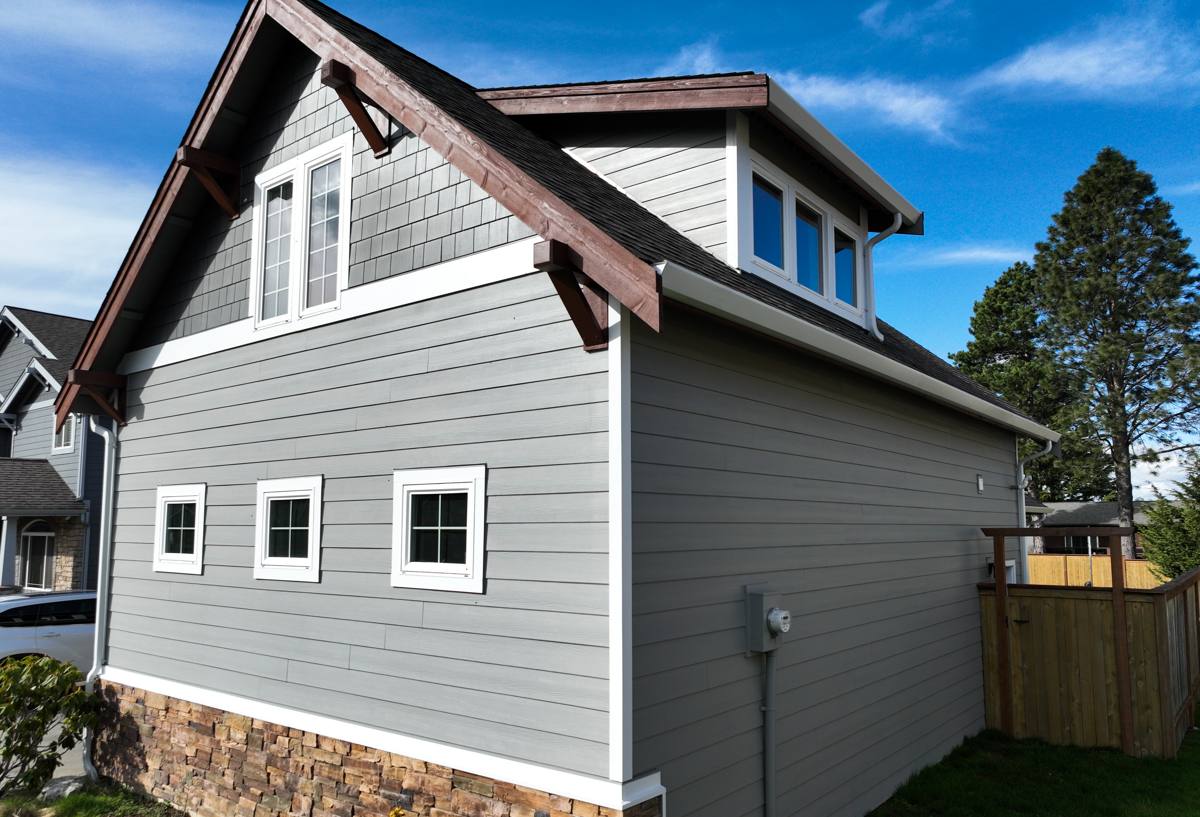
What This Climate Actually Does to Siding
Salt Air
Airborne salt is corrosive to exposed metal fasteners, staples, and trim flashing, and it accelerates the breakdown of lower-grade paint finishes on wood and composite products. Over years, salt exposure also tends to pull moisture into porous siding materials faster than it would in a dry inland climate, which sets the stage for swelling, cracking, and coating failure.
Driving Rain
Wind-driven rain doesn't just fall — it gets pushed sideways and upward, finding every gap, seam, and unsealed joint. On a Chuckanut-area home, that means the water-resistive barrier behind the siding, the flashing details around windows and doors, and the drainage plane behind the siding panels matter just as much as the siding material itself. Siding that looks fine from the street can still be letting water behind it if those details were rushed.
Moss and Sustained Moisture
Shaded walls, tree cover, and the region's long wet season create ideal conditions for moss and algae growth on siding surfaces. Beyond the cosmetic issue, sustained moss coverage holds moisture against the siding surface for weeks at a time, which is exactly the kind of prolonged wet exposure that breaks down wood-based and lower-grade composite sidings from the surface inward.
Why We Install Only James Hardie Fiber Cement Siding
We made a decision as a company to install James Hardie fiber cement siding exclusively — not LP SmartSide, not vinyl, not Cemplank or Allura, not primed spruce or cedar. That's not a marketing position; it's a standard we hold because of what we've seen happen to other products in exactly this kind of coastal, high-moisture Pacific Northwest climate.
Vinyl siding is inexpensive and easy to install, but it's a petroleum-based product that expands and contracts significantly with temperature swings, can become brittle over time, and offers limited protection in wind-driven rain events because of how its panels are designed to overlap. LP SmartSide and other wood-strand composite products perform reasonably well when installation is flawless and maintenance is consistent, but they're wood-based, and wood-based products are more vulnerable to the sustained moisture and moss exposure this area sees — any breach in the factory coating becomes an entry point for water into an engineered wood substrate. Primed spruce and cedar require the homeowner to stay on top of repainting and resealing on a schedule most people can't realistically maintain, and any gap in that maintenance shows up fast in this climate.
James Hardie fiber cement is non-combustible, dimensionally stable across temperature and moisture swings, and comes with a factory-applied ColorPlus finish that's baked on rather than painted after installation — which means better fade and chip resistance over the life of the product. Hardie also engineers specific product lines (HZ5 and HZ10) for different climate zones, so the material specified for a home in Whatcom County is built for exactly the moisture and temperature profile it will face. Installed correctly, it holds up to salt air, driving rain, and moss exposure better than any other product we've evaluated — which is why it's the only thing we put on a home.
What a Correct Installation Actually Involves
The siding material is only half the equation. The other half is the installation system behind and around it — the part homeowners rarely see but that determines whether the siding performs for 30-plus years or starts failing in five.
Moisture Management Behind the Siding
Every correct installation starts with a continuous water-resistive barrier and a drainage plane that lets any moisture that does get behind the siding drain out and evaporate rather than sit against the sheathing. Skipping or shortcutting this layer is the single biggest cause of hidden water damage we find behind older siding in this area.
Fastening and Clearances
James Hardie specifies exact fastener types, spacing, and penetration depth, along with minimum clearances between the siding and grade, roofing, and decking surfaces. These clearances exist specifically to keep splash-back moisture and standing water away from the bottom edge of the siding — a detail that matters more in a high-rainfall area like Columbia than almost anywhere.
Flashing, Trim, and Sealant
Every window, door, and penetration needs proper head flashing and integration with the water-resistive barrier — caulk alone is never an acceptable substitute for flashing, though it plays a supporting role at specific joints. Trim details around corners and transitions need to shed water outward, not channel it toward a seam.
What a Correct Job Includes
- Full removal and inspection of existing siding and sheathing for hidden rot or water damage
- Repair of any compromised sheathing before new material goes up
- Continuous water-resistive barrier with properly lapped and taped seams
- Manufacturer-specified fastener type, spacing, and penetration depth
- Correct clearance from grade, roofing, and horizontal surfaces
- Properly flashed and integrated window and door openings
- Factory-finished ColorPlus panels installed to avoid field-cut exposed edges wherever possible
Our Process for a Columbia Siding Project
- On-site assessment — we walk the exterior, check for existing moisture damage, and evaluate exposure on each elevation, since a shaded, moss-prone wall may need different detailing than a wall that takes direct weather.
- Product and color selection — we help you choose the right Hardie line and ColorPlus finish for your home's exposure and the look you want.
- Written scope and estimate — a clear breakdown of materials, prep work, and what the job includes before anything starts.
- Prep and tear-off — removal of old siding, sheathing repair where needed, and installation of the water-resistive barrier system.
- Installation to manufacturer spec — fastening, flashing, and trim work done to James Hardie's published installation requirements, not shortcuts.
- Final walkthrough — we go over the finished work with you before calling the job complete.
Choosing the Right Hardie Line for This Area
| Product Line | Best Suited For | Why It Fits Columbia's Climate |
|---|---|---|
| HardiePlank Lap Siding (HZ5) | Most Columbia homes | Engineered for the moisture and freeze-thaw profile of northern climate zones like Whatcom County |
| HardieShingle | Accent walls, gables, dormers | Adds texture and dimension while keeping the same fiber cement moisture resistance |
| HardiePanel (vertical) | Modern or mixed-material exteriors | Clean vertical lines with the same non-combustible, factory-finished performance |
| HardieTrim | Corners, window and door trim, fascia | Matches the siding's stability so trim and field siding age and weather consistently |
What Affects the Cost of a Siding Installation
| Factor | How It Affects the Project |
|---|---|
| Extent of hidden sheathing damage | Water-damaged sheathing found during tear-off adds repair scope before new siding can go on |
| Home size and number of elevations | More square footage and more corners, windows, and trim details mean more labor and material |
| Product line and profile | Lap, shingle, and panel profiles carry different material and labor costs |
| Access and site conditions | Slopes, tree cover, and tight setbacks common in Columbia can affect staging and labor time |
| Trim and detail work | Homes with more architectural detail require more precise, time-intensive trim installation |
We don't quote a job until we've actually looked at the house. Broad ranges from a phone call rarely hold up once tear-off reveals what's really going on behind the old siding, so we'd rather give you an honest number after a proper walk-through.
Signs Your Columbia Home May Need New Siding
- Persistent moss or algae growth that returns quickly after cleaning
- Soft spots, bubbling, or visible warping in the siding surface
- Paint or finish that's peeling, chalking, or fading unevenly across walls
- Gaps, cracks, or separation at seams, corners, or trim joints
- Musty odors or visible staining on interior walls near exterior siding
- Siding that feels spongy or gives when pressed near the bottom edge
Why Hire a Crew That Already Works in Columbia
A crew that works regularly in Columbia and elsewhere near Chuckanut already understands the exposure patterns specific to this stretch of Whatcom County — which walls take the worst of the driving rain, which sides stay shaded long enough to grow moss even with good drainage detailing, and how salt air factors into fastener and flashing choices. That's not something you get from a general contractor who installs siding occasionally in a dozen different climates. It's the difference between an installation that meets code and one that's actually built for what your specific property faces year after year.
If you're weighing a siding replacement or just want an honest read on the condition of what's currently on your home, we're happy to come take a look. There's no pressure and no obligation — just a straightforward assessment and, if it makes sense, a written estimate for James Hardie siding installation done right the first time.