 Chuckanut Exterior
 Building New in Samish? Get the Windows Right the First Time
When you're framing a new home in the Samish area, the windows are one of the few components that have to perform on two fronts at once: they need to look right for decades, and they need to keep water out of a wall assembly you'll never see again once the siding goes on. In Chuckanut and the surrounding Whatcom County shoreline, that second job is harder than it looks. Salt-laden air, wind-driven rain off the water, and a moss season that can stretch for months put real, sustained stress on window openings that a drier inland build simply doesn't face.
New construction is actually the best window opportunity you'll ever get on a house. The wall is open, the weather-resistive barrier is exposed, and there's no old frame, no old caulk, and no hidden rot to work around. Done correctly, a new-construction window install here can outperform almost any retrofit for 20, 30, even 40 years. Done poorly — even with an expensive window — it can start letting water into the framing before the house is five years old. This page is about what "done correctly" actually means for a Samish build, and why the install matters as much as the window itself.
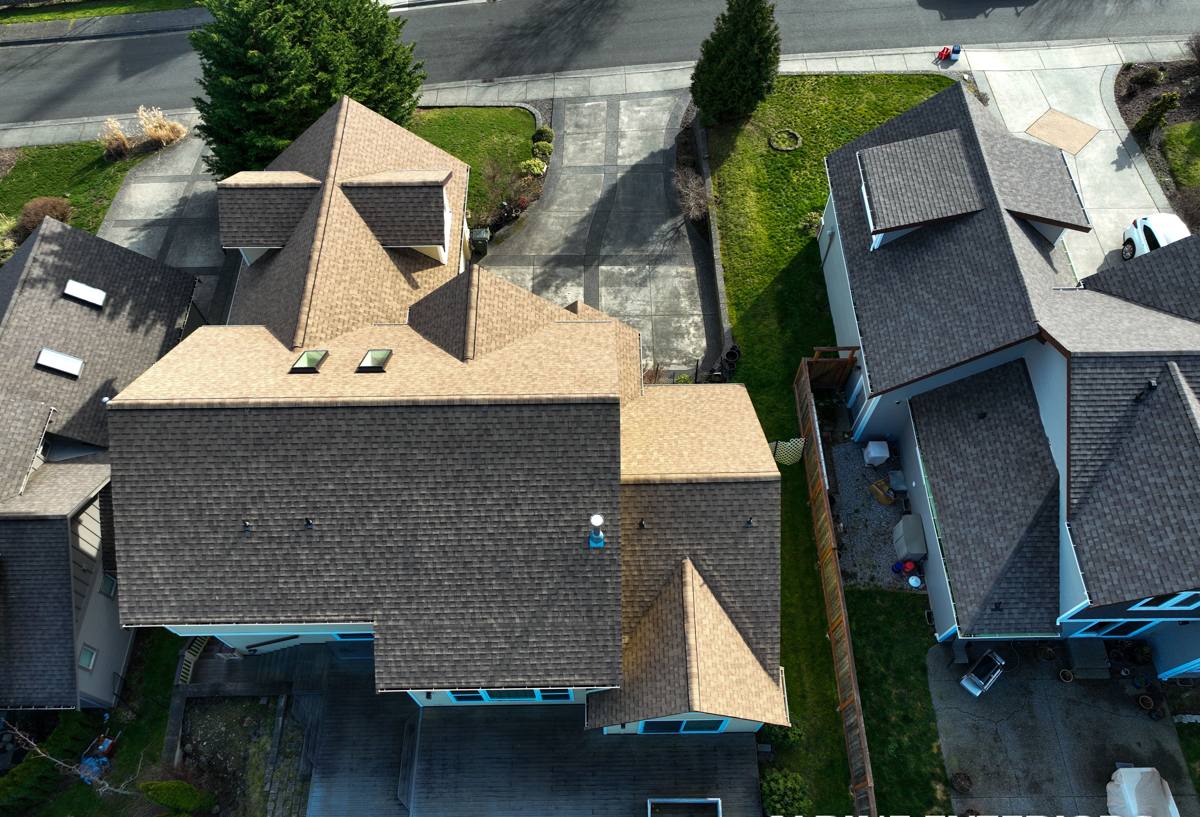
What Chuckanut's Coastal Climate Demands From New Windows
Salt Air and Corrosion
Homes near the water in this part of Whatcom County are exposed to airborne salt that settles on every exterior surface, including window hardware, screen frames, and exposed fasteners. Over time, salt exposure accelerates corrosion on lower-grade hardware, pits aluminum components, and can cause galvanic reactions where dissimilar metals touch. For a new build, this means hardware selection and fastener material matter as much as the frame material itself — it's not something you can fix later without pulling trim.
Driving Rain and Wind-Driven Water
Rain in this region rarely falls straight down. Storms off the water push rain sideways and upward under eaves, against wall assemblies, and into any gap in the window flashing detail. A window that's simply "caulked in" will eventually leak under these conditions — the water doesn't need much of a path, just time and pressure. This is why flashing sequence, not sealant alone, is what actually keeps a new-construction opening dry.
Moss, Mildew, and Prolonged Damp
Whatcom County's long wet season means anything that stays damp for extended periods becomes a host for moss, algae, and mildew growth. On windows, that shows up as staining on sills, grime buildup in tracks, and — if drainage details are wrong — trapped moisture inside the rough opening that never fully dries between storms. Correct sill pan drainage and a slight outward slope at the sill are small details that make a big difference here.
New Construction vs. Retrofit: Why the Install Method Matters
"New-construction window" refers to a specific type of window with a nailing flange, installed into an open wall before siding goes on — different from a pocket or insert replacement window installed into an existing frame. For a ground-up build or an addition in Samish, new-construction windows are almost always the right call, because they let the crew integrate the window directly with the weather-resistive barrier and flashing system rather than working around what's already there.
| Factor | New-Construction Window | Insert/Replacement Window |
|---|---|---|
| Installation point | Open wall, before siding | Existing frame, finished wall |
| Flashing integration | Direct to WRB and sheathing | Limited — works around old frame |
| Best use case | New builds, additions, full re-frames | Existing homes keeping the original opening |
| Long-term water control | Highest, if detailed correctly | Good, but dependent on old frame condition |
| Sizing flexibility | Full flexibility | Constrained to existing rough opening |
Because Samish sits in a marine-influenced exposure, we treat the flashing integration column in that table as non-negotiable. It's the single biggest factor in whether a new-construction window stays dry for the life of the house.
What a Correct New-Construction Window Install Involves
Flashing and Weather-Resistive Barrier Integration
Every opening gets a sill pan flashing before the window ever goes in, so that any water that does get past the window has a sloped, sealed path back to the exterior instead of into the framing. The weather-resistive barrier is then lapped over the flange in the correct shingle-style sequence — head flashing last, over the top of the barrier, so water always flows over the next layer down rather than behind it. This sequence sounds simple, but it's the single most common thing done wrong on production builds, and it's the thing that determines whether a window leaks in year two or stays dry for thirty years.
Window Selection: Frame Materials and Glass Packages
Frame material affects how a window handles this climate long-term — expansion and contraction with temperature swings, resistance to moisture at the frame-to-sill joint, and how hardware corrosion-resistance holds up near salt air. Glass packages matter too: in a marine climate with more overcast days and cooler averages than the interior of the state, the right low-E coating and gas fill balance heat retention against solar gain differently than they would on the dry side of the Cascades.
Sealing and Fastening Standards
Fasteners at the nailing flange should be corrosion-resistant and installed at the spacing the manufacturer specifies — not stretched out to save time. Sealant goes only where the manufacturer's instructions call for it; over-sealing a window (caulking the bottom flange solid, for example) can actually trap water that needs a way out, which causes more damage than it prevents.
Choosing the Right Window Products for a Samish Build
| Frame Material | Coastal Climate Behavior | Maintenance Consideration |
|---|---|---|
| Vinyl | Good moisture resistance, won't corrode; can expand/contract more with temperature swings | Low — occasional track and weep-hole cleaning |
| Fiberglass | Very stable dimensionally, strong resistance to moisture and salt exposure | Low — durable finish, minor cleaning |
| Wood-clad | Attractive interior wood with exterior cladding protecting from weather; cladding integrity at joints is critical near salt air | Moderate — watch cladding seams and interior wood over time |
| Aluminum | Strong but conducts heat/cold and can be more prone to condensation and corrosion near salt air without upgraded finishes | Moderate to high depending on finish quality |
We don't push one frame material on every job. The right choice depends on your budget, the architectural style of the build, and how much long-term maintenance you want to take on. What we won't do is install a product whose sill or cladding detailing is known to trap water in a marine exposure — that's a call we make based on how the product actually holds up here, not brand loyalty in either direction.
Our Process for New-Construction Window Installs
- Rough opening check. We verify every opening is square, level, and sized correctly before a window ever arrives on site — catching framing issues now is far cheaper than after windows are ordered.
- Sill pan flashing. Every opening gets a sloped, sealed sill pan as the first line of drainage defense.
- Window set and fasten. The window is set plumb, level, and square, then fastened per manufacturer spec — not "close enough."
- Flashing sequence. Jamb and head flashing integrate with the weather-resistive barrier in proper shingle-lap order.
- Interior air seal. The gap between frame and rough opening is sealed on the interior side for both energy performance and moisture control.
- Final inspection. We check operation, seal integrity, and flashing coverage before the crew moves on to siding.
Mistakes We See on New-Construction Window Jobs
Most window leaks we're called to diagnose in older Whatcom County homes trace back to a handful of avoidable install errors. On a new build, this is your one chance to make sure none of these happen:
- No sill pan flashing, or a flat/unsloped sill pan that can't drain
- Weather-resistive barrier lapped in the wrong order at the head flashing
- Nailing flange caulked solid on all four sides, trapping any water that gets behind it
- Fasteners skipped or spaced too far apart at the flange
- Window not shimmed square, causing early hardware wear and air/water infiltration at the sash
- Interior air seal skipped, leading to condensation and energy loss even if the exterior is watertight
Why Hire a Crew That Already Works in Samish and Chuckanut
A window install that would be perfectly fine in a dry inland climate can fail early on a lot near the water in Whatcom County. Knowing that ahead of time — and building the flashing and drainage detail for it from day one — is the difference between a crew that's installed windows and a crew that's installed windows on this coastline specifically. We know how far wind-driven rain travels under an eave here, how long moss season runs, and which frame and hardware combinations hold up against salt air over the long term, because we see the results on homes we and others have built in this area.
That local experience also means fewer surprises during permitting and inspection. Whatcom County's energy code requirements and inspection checkpoints for weather-resistive barrier and flashing detail are things we build into the schedule as a matter of course, not something we're learning on your job.
Cost Factors for New-Construction Windows in Samish
Every build is different, but the factors that move the price on a new-construction window package are consistent: number and size of openings, frame material, glass package (impact resistance, upgraded low-E coatings, grid patterns), and how much detail work the flashing and trim require on a given wall assembly. Coastal-grade hardware and corrosion-resistant fasteners add a modest cost over standard-grade components, and it's money well spent on a home exposed to salt air. Rather than quote a broad range that won't reflect your actual plan set, we'll walk your drawings with you and give you real numbers tied to your specific window schedule.
If you're framing a new home or addition in the Samish area and want windows detailed correctly for this coastline from the start, we're happy to take a look at your plans and walk the site. Reach out for a free, no-pressure estimate using the form below.