 Chuckanut Exterior
 Composite Decking in Samish: Built for a Coastal Whatcom County Climate
Samish sits close enough to the water that the air itself works against a deck year-round. Salt-laden moisture off the bay, long stretches of driving rain through fall and winter, and a moss season that can run half the year all put real stress on outdoor living spaces. A deck that looks fine in a showroom in Bellingham can behave very differently once it's been through a few winters on a property exposed to that kind of weather. Composite decking, installed correctly for this specific environment, is one of the more reliable ways to keep a deck usable and good-looking without constant upkeep.
This page focuses specifically on composite decking for homes in and around Samish. We're not going to give you a generic rundown of composite decking in general — we want to talk about what this material needs to do here, what a correct installation looks like given local conditions, and how we handle the job when we build one.
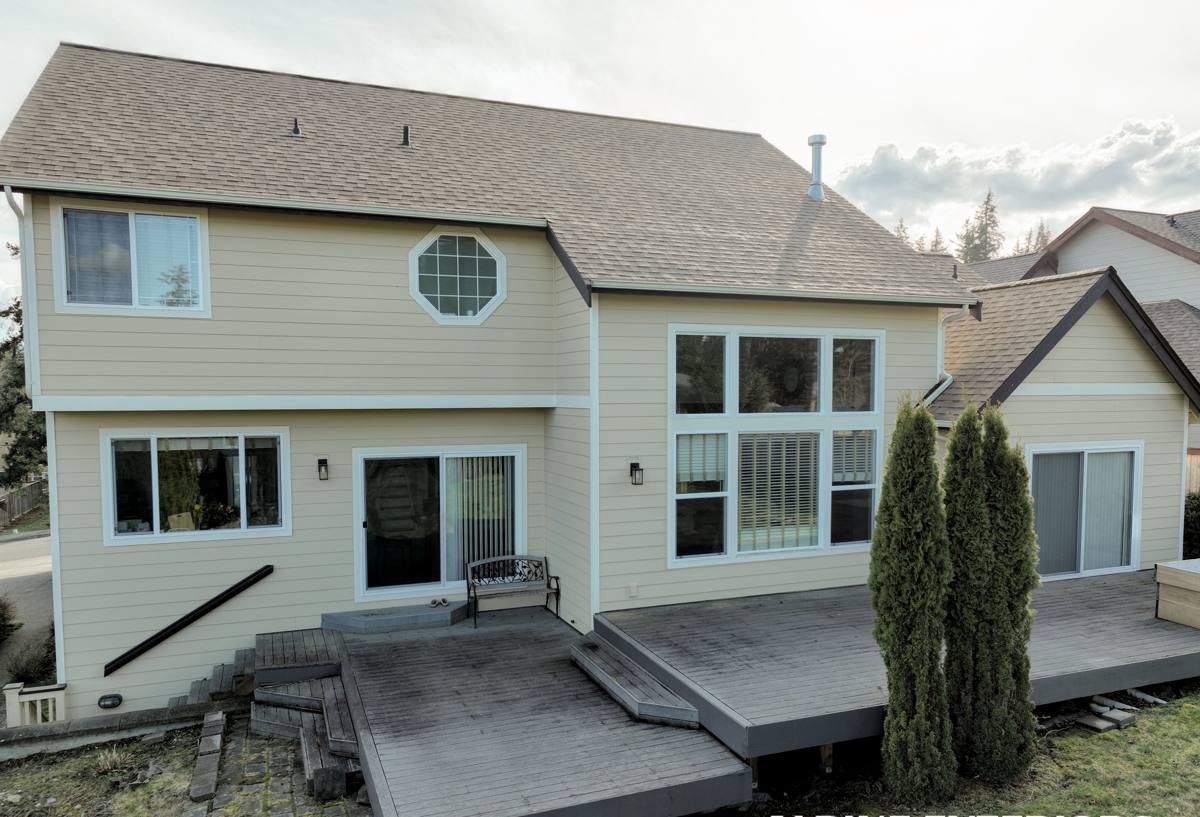
What Samish's Climate Actually Does to a Deck
Salt Air and Fasteners
Properties near Samish Bay and the surrounding shoreline get exposed to salt-carrying air even without direct ocean spray. Over years, that salt content accelerates corrosion on unprotected or poorly rated metal — fasteners, brackets, and structural hardware included. A deck can look sound on the surface while the hardware holding it together is quietly degrading underneath. This is one of the most common failure points we find on older decks in coastal-adjacent Whatcom County neighborhoods, and it's almost always invisible until something fails.
Driving Rain and the Substructure
Whatcom County doesn't just get a lot of rain — it gets a lot of wind-driven rain, which finds its way into joints, fastener holes, and end cuts that a straight-down rain would never reach. Composite decking boards themselves handle moisture well, but the substructure underneath (joists, ledger boards, framing) is usually still dimensional lumber. If that framing isn't protected and detailed correctly, moisture intrusion there is what actually shortens a deck's life, regardless of how good the decking boards are.
Moss, Algae, and Surface Traction
A long moss season means extended stretches of shaded, damp surfaces — exactly the conditions moss and algae need to take hold. On a wood deck, that growth works into the grain and accelerates surface decay. On a composite deck, growth generally stays on the surface, which matters both for longevity and for keeping the deck safe to walk on when it's wet.
Why Composite Decking Fits This Environment
We recommend composite decking for Samish properties for practical reasons, not because it's trendy. It doesn't absorb water the way wood does, so it isn't prone to the swelling, splintering, and rot that wood decking develops after repeated wet-dry cycles. It doesn't need annual staining or sealing to hold up against the rain load this area sees. And because the surface resists moisture penetration, moss and algae are easier to remove and don't establish the same foothold they get on open wood grain.
That said, composite isn't maintenance-free, and we don't sell it that way. It still needs periodic cleaning, and the substructure beneath it still needs to be built and protected correctly. The material solves specific problems this climate creates — it doesn't eliminate the need for a properly built deck.
What a Correct Composite Deck Installation Involves
The Substructure Comes First
The single biggest factor in how long a composite deck lasts here isn't the decking brand — it's what's underneath it. We build or inspect the substructure with this climate in mind: proper ledger flashing where the deck ties into the house, joist tape or comparable protection on framing members to keep driving rain from soaking directly into cut lumber, and structural hardware rated for exterior and coastal-adjacent exposure rather than standard-grade fasteners that corrode faster in salt air.
Fastening and Hidden Clip Systems
Most composite boards today are installed with hidden fastener systems rather than face-screwed the way older wood decks were. Done correctly, this gives a cleaner surface with fewer penetration points for water to find — but it depends on using clips and screws rated for the specific board profile and on correct spacing for thermal expansion, which composite boards experience more than wood. Get the spacing wrong and boards can buckle or gap as temperatures shift through the seasons.
Drainage and Airflow Beneath the Deck
A deck built low to the ground or without adequate airflow underneath traps moisture, which is exactly what you don't want given how much rain this area sees. We plan ventilation and drainage paths as part of the build, not as an afterthought, so water has somewhere to go instead of sitting under the structure through the wet months.
Decking Material Comparison for Samish Properties
| Factor | Pressure-Treated Wood | Composite Decking | PVC Decking |
|---|---|---|---|
| Moisture resistance | Absorbs water; prone to swelling and rot over time | Resists moisture absorption; suited to high-rain climates | Fully moisture resistant |
| Moss/algae behavior | Growth works into grain, accelerates decay | Growth stays on surface, easier to remove | Similar to composite, smooth surface |
| Maintenance | Annual staining/sealing recommended | Periodic cleaning, no sealing needed | Minimal cleaning |
| Upfront cost | Lowest | Mid-range | Highest |
| Expected lifespan (well-maintained) | 10-15 years before major repair | 25-30 years, board-dependent | 25-30+ years |
| Feel underfoot in wet weather | Can feel rough or slick when wet, splinter risk | Textured, generally slip-resistant when wet | Textured, generally slip-resistant when wet |
We install composite most often in this area because it lands at a practical middle point: real durability against the rain and salt air, without the cost premium of full PVC systems. PVC is a legitimate option for homeowners who want the lowest possible maintenance and are comfortable with the higher material cost — we're happy to walk through that trade-off honestly rather than push one product over another.
Our Process for Samish Deck Projects
- On-site assessment. We look at existing structure (if there is one), grading, drainage, sun/shade exposure, and proximity to salt air or standing moisture, since these all affect material and hardware choices.
- Substructure evaluation or design. On replacement projects, we check joists, ledger connections, and posts for hidden moisture damage before deciding what can be reused versus what needs to be rebuilt.
- Material selection. We walk through board profiles, color/finish options, and fastening systems suited to the specific site conditions rather than a one-size-fits-all recommendation.
- Framing and moisture protection. Ledger flashing, joist protection, and corrosion-resistant hardware go in before a single composite board is placed.
- Installation. Boards are set with correct spacing for thermal movement and fastened with the hidden clip system specified for that product line.
- Final walkthrough. We go over basic care with the homeowner — cleaning frequency, what to watch for, and what's covered under manufacturer warranty versus workmanship.
Choosing the Right Composite Board for a Coastal-Adjacent Property
Not every composite board is built the same way, and for a property exposed to salt air and heavy rain, some details matter more than they would further inland. A few things worth checking before deciding on a product:
- Whether the board is fully capped (a protective polymer shell on all sides) versus capped only on the top surface — full capping holds up better where moisture exposure is constant.
- The manufacturer's stain and fade warranty terms, since UV and moisture exposure combine differently in a marine-influenced climate than in a dry inland one.
- Whether the board profile is rated for the fastening system we plan to use, so the hidden clips seat correctly and don't create stress points.
- Slip resistance rating, particularly for stairs and areas that stay shaded and damp through moss season.
- Whether the color and texture are engineered to hide surface debris and water spotting, which matters more on a deck that sees frequent rain.
Maintenance: What Samish Homeowners Actually Need to Do
Composite decking cuts down on maintenance significantly compared to wood, but "low-maintenance" isn't "no-maintenance." In this climate, the realistic routine is periodic washing to keep moss and algae from building a foothold — more frequent during the wetter, shadier months than in summer — and keeping gutters and nearby drainage clear so water isn't running directly onto or under the deck. Checking fastener points and railing connections once or twice a year for any early signs of corrosion is also worth the few minutes it takes, especially on properties closer to the water.
Why Hiring a Crew That Already Works in Samish Matters
A lot of what determines whether a composite deck holds up here comes down to decisions made before the first board goes down — flashing details, hardware grade, drainage planning, board spacing for thermal movement. Those are the same details a crew unfamiliar with this specific microclimate can easily underspec, because they're building for a drier or less salt-exposed environment by default. Working with a crew that already builds decks in Whatcom County's coastal-adjacent neighborhoods means those decisions are made correctly the first time, based on what actually happens to a deck here over several winters — not on generic installation guidance written for a different climate.
If you're planning a new composite deck or replacing one that hasn't held up the way it should, we're glad to take a look and talk through what your property actually needs. There's a free, no-pressure estimate form below — reach out and we'll go from there.