 Chuckanut Exterior
 Why Mount Vernon Siding Takes a Different Kind of Beating
Mount Vernon sits down in the Skagit Valley, close enough to the tidal flats and Puget Sound air that homes here deal with a mix most siding products were never designed for: salt-tinged moisture in the air, wind-driven rain that comes in sideways off the water and the surrounding farmland, and long stretches of the year when surfaces just don't dry out. That last part matters more than people think. Moss and algae don't need standing water to take hold — they need shade, moderate temperatures, and siding that stays damp for days at a time. The Skagit Valley delivers all three for months on end.
Add in the salt air and you get a slower, quieter kind of damage: fasteners and trim hardware corrode faster than they would twenty miles inland, paint film breaks down sooner, and any product that relies on a surface coating to keep moisture out starts failing at the seams first. None of this is dramatic. It's cumulative. A house that looked fine at year five can be hiding real problems by year twelve if the siding and the install underneath it weren't built for this exact combination of conditions.
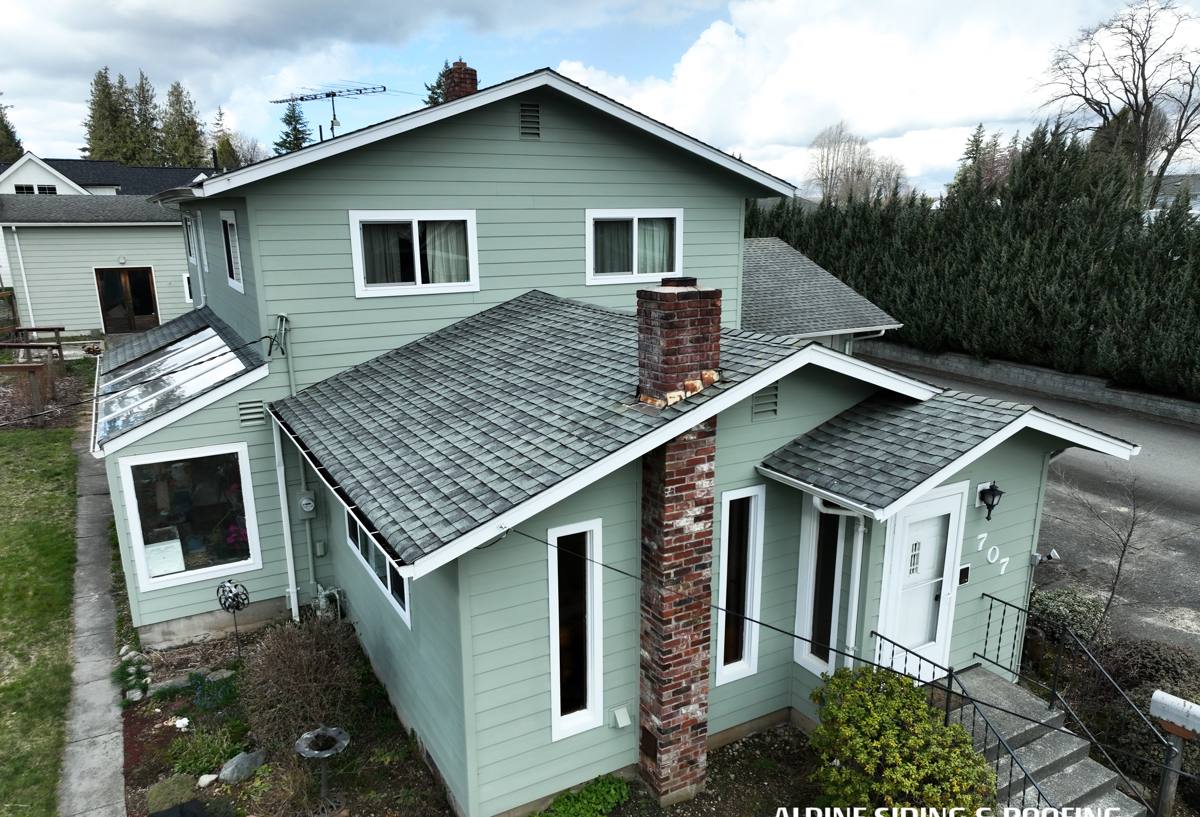
What James Hardie Actually Solves in This Climate
James Hardie fiber cement is cement, sand, and cellulose fiber — there's no wood fiber to swell, no foam substrate to trap water, and nothing for moss to root into the way it can on a rougher wood-grain surface that's holding moisture. The ColorPlus factory finish is baked on under controlled conditions rather than field-applied, which means the color layer bonds more consistently across the whole board and holds up better against the freeze-thaw-damp cycling that's normal for a Skagit Valley winter and spring.
Hardie's HZ5 product line is engineered specifically for climates with more moisture exposure and temperature swings than the standard national spec — which is exactly the profile of this part of Washington. It's not a marketing label; it's a real difference in how the board is formulated to handle the freeze-thaw and moisture load common here.
Why We Don't Swap in Something Else for This Job
We get asked about vinyl, engineered wood siding, and cedar often enough that it's worth being straight about it. Vinyl moves with temperature and can warp or gap over time, which opens paths for wind-driven rain to get behind it — a real liability in a valley that gets its share of storms off the Sound. Engineered wood products perform fine when every cut edge and seam stays sealed forever, but the moment a joint opens up in a climate this damp, the wood fiber core is what's exposed. Cedar looks great new, but it needs regular refinishing to keep moss and mildew from taking hold, and that's an ongoing cost most homeowners don't want to sign up for indefinitely. None of these are bad products in the right setting. They're just not what we're willing to warranty our work on in a climate that punishes any weak point in the moisture chain.
What a Correct Installation Actually Involves
The product is only half the equation. Most siding failures we get called out to inspect trace back to installation shortcuts, not the material itself — gaps that were never sealed correctly, flashing that was skipped to save time, or fasteners that weren't rated for the exposure. Here's the difference between a job done to spec and one that's cutting corners, even if both look identical the day they're finished.
| Detail | Correct Install | Common Shortcut |
|---|---|---|
| Clearance from grade/decks | Minimum clearance held per Hardie spec so splash-back and standing moisture never reach the bottom edge | Siding run tight to grade or a deck surface, wicking moisture into the bottom courses |
| Fasteners | Corrosion-resistant, correctly spaced and set to depth per manufacturer spec | Standard fasteners over-driven or under-driven, cracking the board or leaving it loose |
| Roof-wall intersections | Proper kick-out flashing directing water away from the wall | No kick-out, letting years of roof runoff pour straight down behind the siding |
| Weather-resistive barrier | Continuous, lapped correctly, integrated with window and door flashing | Barrier patched around penetrations instead of properly integrated |
| Cut edges | Field-cut edges sealed per Hardie's guidance before installation | Cut edges left raw, becoming the first point of moisture entry |
The Small Details That Decide Whether It Lasts
Hardie's system is designed to manage water, not fight it with caulk. That means joints and panel edges are supposed to be detailed so water sheds and drains rather than relying on sealant as the only line of defense — sealant fails eventually, and a house built on that assumption is on borrowed time. A correct install gives water somewhere to go; a shortcut install just hopes it never gets in.
Our Process for a Mount Vernon Job
- Wall assessment — we check the existing siding and sheathing for hidden moisture damage before quoting anything, since a valley climate like this one can hide rot behind siding that looks fine from the curb.
- Tear-off and sheathing repair — any compromised sheathing gets replaced, not covered over.
- Weather-resistive barrier and flashing — installed or repaired as a continuous system, with particular attention to windows, doors, and roof-wall intersections.
- Hardie installation to spec — correct clearances, fastener schedule, and sealed cut edges throughout.
- Trim and finish work — factory-finished trim installed to match, touch-up paint matched to the ColorPlus system where needed.
- Final walkthrough — we go over the job with the homeowner before calling it done.
Why It Matters That the Crew Already Works Mount Vernon
A crew that's worked houses in and around Mount Vernon knows the range of construction here — from older farmhouse-style homes to newer subdivision builds — and has already seen how each type tends to fail in this specific climate. That's not something you get from a spec sheet. It shows up in things like knowing which roof-wall details tend to get skipped on older homes, how the wind pattern off the valley tends to drive rain into certain wall orientations, and how to sequence a job so open wall sections aren't sitting exposed during the wettest stretches of the year. It also means fewer surprises with local permitting and inspection, because we're not learning the area on someone's house — we already know it.
Signs Your Siding Is Already Losing the Fight
- Dark green or black streaking that comes back within weeks of being cleaned
- Soft or spongy spots when you press on the siding near the bottom courses or below windows
- Paint that's peeling or bubbling rather than just fading evenly
- Visible gaps or warping at seams and corners
- Rusty streaks running from fastener heads or trim hardware
- Musty smell or visible staining on interior walls that back up to exterior siding
Any one of these on its own isn't necessarily an emergency, but they're worth having looked at before the next wet season rather than after.
Cost Factors for a Mount Vernon Hardie Install
| Factor | How It Affects the Job |
|---|---|
| Existing wall condition | Hidden rot or sheathing damage adds repair scope before new siding goes on |
| Home size and wall complexity | More corners, dormers, and trim detail means more labor and material |
| Siding profile chosen | Lap, shingle-style, and panel options carry different material and labor costs |
| Trim and accessory scope | Fascia, soffit, and trim board replacement alongside siding affects total price |
| Access and site conditions | Tight lots, decks, or landscaping close to the house can add labor time |
We give homeowners an honest range up front and a firm number after the assessment — not a number built to win the bid and change later.
Warranty and Long-Term Value
James Hardie backs its products with a strong, transferable warranty when installed to their specifications — which is part of why installation quality isn't optional in our shop. A warranty is only as good as the install underneath it, and we install to spec specifically so that warranty means something if you ever need it. For a house in this climate, that's the difference between siding that's still doing its job in twenty years and siding that's back on the repair list in eight.
If you're weighing options for a home in the Mount Vernon area, we're glad to come take a look and give you a straight, no-pressure estimate — no obligation, just an honest read on what your house actually needs.