 Chuckanut Exterior
 Why Happy Valley Homes Wear Differently
Homes in the Happy Valley area of Chuckanut sit in a specific overlap of conditions that most siding products were never designed around: salt-laden air off the nearby water, long stretches of driving rain pushed sideways by wind, and a shade-heavy, moisture-retentive landscape that keeps moss and algae active for most of the year. Individually, none of these are unusual for Whatcom County. Together, on a single wall assembly, they accelerate almost every failure mode siding can have — swelling, delamination, fastener corrosion, paint breakdown, and hidden rot behind the cladding.
That combination is why we treat siding replacement in this neighborhood as a climate-specific job, not a generic one. The material choice, the flashing details, and the fastening schedule all change when a home is regularly exposed to wind-driven moisture and sits under tree cover long enough each day to stay damp.
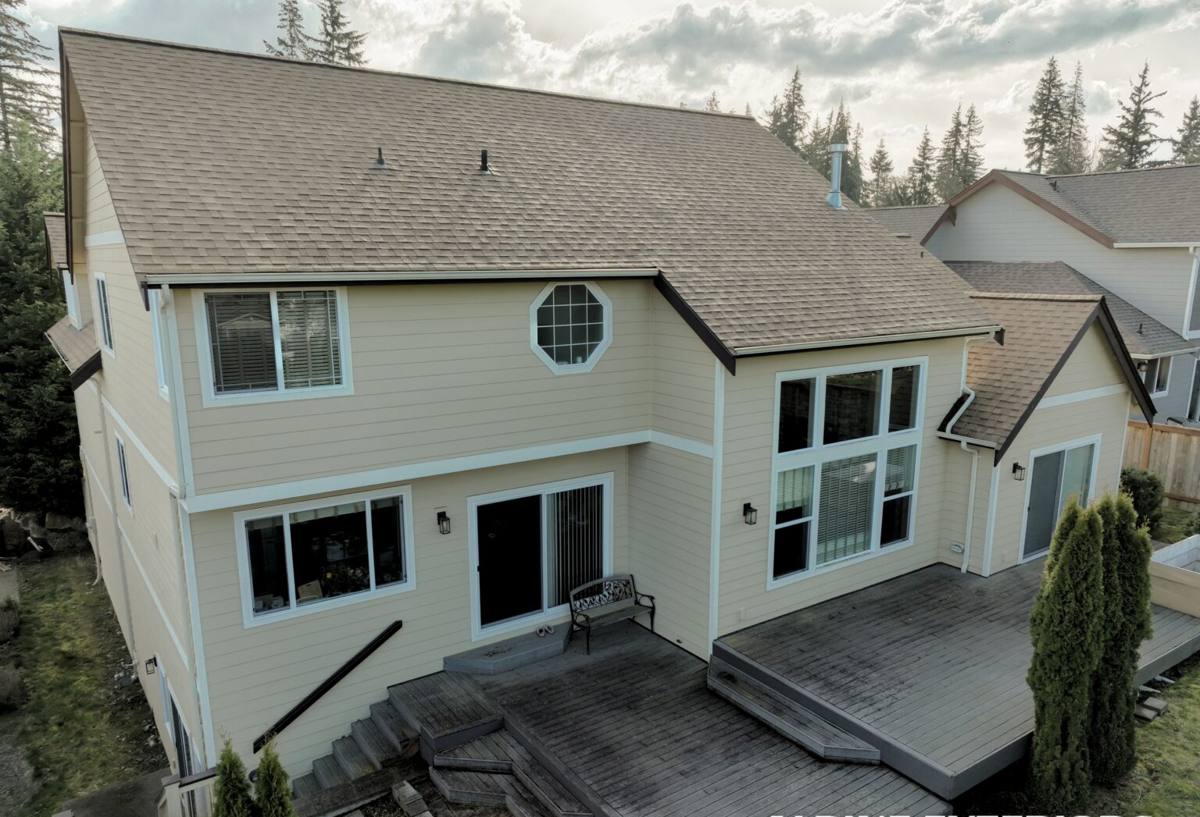
Signs a Happy Valley Home Needs Siding Replacement, Not Just Repair
Siding problems in this area rarely show up as one obvious failure. They show up as a pattern of small symptoms that, taken together, mean the assembly behind the cladding has been compromised.
- Soft or spongy spots when you press on the siding, especially near the bottom courses and around window trim
- Persistent moss or dark algae streaking that returns within weeks of being cleaned off
- Paint that is peeling, bubbling, or chalking unevenly, particularly on north- and west-facing walls
- Visible cupping, warping, or separation at panel seams
- Rust staining running down from nail heads or trim fasteners
- A musty smell in interior rooms along exterior walls, which often points to moisture already inside the wall cavity
Any one of these can sometimes be spot-repaired. Several appearing together, on a home of typical age for the area, usually means the underlying moisture barrier and fastening have been failing for a while and full replacement is the more honest recommendation.
What a Correct Siding Replacement Actually Involves
Replacing siding well is mostly about what happens before the new cladding goes up. In a climate that drives rain sideways into wall assemblies, the sequence and detailing behind the siding matter more than the siding itself.
Tear-Off and Sheathing Inspection
Every board comes off so the sheathing underneath can actually be seen, not guessed at. Any soft, delaminated, or rotted sheathing gets cut out and replaced before anything new goes back on — covering damaged sheathing with new siding just hides a problem that will resurface.
Weather-Resistive Barrier and Drainage Plane
A continuous, properly lapped weather-resistive barrier goes down next, with a drainage gap behind the siding so any moisture that does get past the cladding has somewhere to go besides the sheathing. In a wind-driven-rain climate, this drainage plane is not optional — it's the difference between water that runs out and water that sits and soaks in.
Flashing at Every Penetration
Windows, doors, hose bibs, vents, and any other wall penetration each need their own flashing detail, integrated with the weather-resistive barrier so water is shed outward at every layer. This is the step most often shortcut on lower-bid jobs, and it's the step most responsible for hidden rot years later.
Fastening to Manufacturer Spec
Fiber cement siding has a specific nailing pattern, fastener type, and embedment depth. Corrosion-resistant fasteners matter everywhere in this region, but especially in areas exposed to salt air, where the wrong fastener can start rusting and staining within a few seasons.
Why We Install Only James Hardie Fiber Cement
We standardized on James Hardie fiber cement siding and don't install vinyl, LP SmartSide, Cemplank, Allura, or raw wood siding like primed spruce or cedar. That's not a marketing position — it's a practical one built around what actually holds up under salt air, sustained damp, and moss pressure year after year.
Vinyl siding can warp and gap under thermal and moisture cycling, and its seams and J-channels give moisture an easy path inward. Engineered wood products like LP SmartSide perform reasonably well when detailing is perfect, but wood-based substrates are more sensitive to sustained moisture exposure than fiber cement, and this area doesn't offer much of a dry season to let a wall assembly recover. Raw cedar or primed spruce look excellent on day one but require an ongoing maintenance commitment — refinishing, caulking, moisture monitoring — that most homeowners underestimate until the first signs of rot appear.
James Hardie fiber cement is non-combustible, dimensionally stable in wet-dry cycling, and comes with a factory-applied ColorPlus finish that resists the fading and chalking we see on field-painted siding in this climate. Hardie also builds region-specific HZ product lines engineered for different moisture and freeze exposure levels, which lets us match the product to what a Happy Valley wall actually faces rather than using a one-size product everywhere.
Material Comparison for This Climate
| Material | Moisture Behavior | Maintenance Burden | Typical Lifespan Here |
|---|---|---|---|
| James Hardie Fiber Cement | Dimensionally stable, resists swelling and rot | Low — factory finish, occasional wash | 30+ years to first repaint need |
| Vinyl Siding | Seams and channels allow water intrusion; can warp | Low labor, but limited repair options | Variable; earlier failure at seams and fasteners |
| LP SmartSide / Engineered Wood | Performs well only with perfect sealing and flashing | Moderate — seam and edge inspection needed | Shorter if moisture gets past any seal |
| Cedar / Primed Spruce | Absorbs and releases moisture; prone to cupping | High — refinishing and caulk maintenance ongoing | Shortest without disciplined upkeep |
This table reflects general product behavior, not brand-specific failure claims — every product on it can perform acceptably in the right conditions with disciplined maintenance. The question for a Happy Valley home is how much ongoing attention you're willing to give the siding, and how forgiving you need the material to be when a maintenance cycle gets skipped.
Our Replacement Process
- On-site inspection of the current siding, trim, and any visible moisture damage
- Walkthrough of findings with the homeowner, including sheathing condition where accessible
- Written estimate covering tear-off, sheathing repair allowance, weather barrier, flashing, and Hardie product line and color selection
- Tear-off and sheathing inspection, with any rot addressed before moving forward
- Weather-resistive barrier, drainage plane, and flashing installation at every penetration
- Hardie panel or plank installation to manufacturer fastening specifications
- Final walkthrough covering trim, caulking lines, and touch-up
Every step is visible to the homeowner before it's closed up — sheathing and flashing photos are shared before the new siding covers them, so you know what condition the wall was actually in.
Why a Crew That Already Works Happy Valley Matters
Siding failures in this part of Whatcom County follow patterns that a crew working the area regularly learns to recognize quickly: which wall orientations hold moisture longest under tree cover, how much extra attention flashing needs on homes closer to the water, and how quickly moss returns without the right drainage detailing. A crew unfamiliar with these local conditions can still do competent work, but they're more likely to apply a generic approach where a climate-specific one is needed.
Local familiarity also shows up in practical ways — knowing realistic timelines around this area's rain patterns, coordinating tear-off so exposed sheathing isn't left open longer than necessary, and understanding what disposal and access look like on the area's typical lots.
Cost Factors to Expect
Every siding replacement quote should be broken down by the same core drivers, so you can compare estimates on equal terms rather than just comparing a bottom-line number.
- Total square footage and number of stories, which affects both material and labor
- Condition of the existing sheathing — hidden rot repair is priced separately because it can't be accurately estimated until tear-off
- Trim, fascia, and soffit scope, since these are often replaced or capped alongside siding
- James Hardie product line selected (lap siding, panel, shingle-style) and factory color/finish
- Site access and disposal logistics for the property
Be cautious of any quote that skips a sheathing repair allowance entirely — on a home in this climate, it's unusual to open up the walls and find zero moisture-related damage.
Ready for a Straight Answer on Your Siding
If your Happy Valley home is showing moss buildup that keeps coming back, paint that won't hold, or soft spots you can feel by hand, it's worth having someone look at what's actually happening behind the siding before deciding between repair and replacement. We offer a free, no-pressure estimate — walk the exterior with us, get a straight assessment of condition, and see what a James Hardie replacement would look like for your home, with no obligation attached.