 Chuckanut Exterior
 Siding Built for Happy Valley's Weather, Not Just Its Curb Appeal
Happy Valley sits in a part of Whatcom County where the weather does real work on a house year-round. Salt-laden air off the water, driving rain that comes in sideways during winter storms, and a moss season that seems to stretch longer every year all put steady pressure on whatever is covering your exterior walls. Siding here isn't just a cosmetic choice — it's the first line of defense against moisture intrusion, wood rot, and the slow, expensive damage that shows up years later as soft trim, stained sheathing, or a failed weather barrier behind a wall that looked fine from the street.
When we install siding on a Happy Valley home, we're not treating it like a generic Pacific Northwest job. We're accounting for the specific combination of salt exposure, wind-driven rain, and persistent dampness that this stretch of Chuckanut deals with, and we're installing a product system that's engineered to handle it.
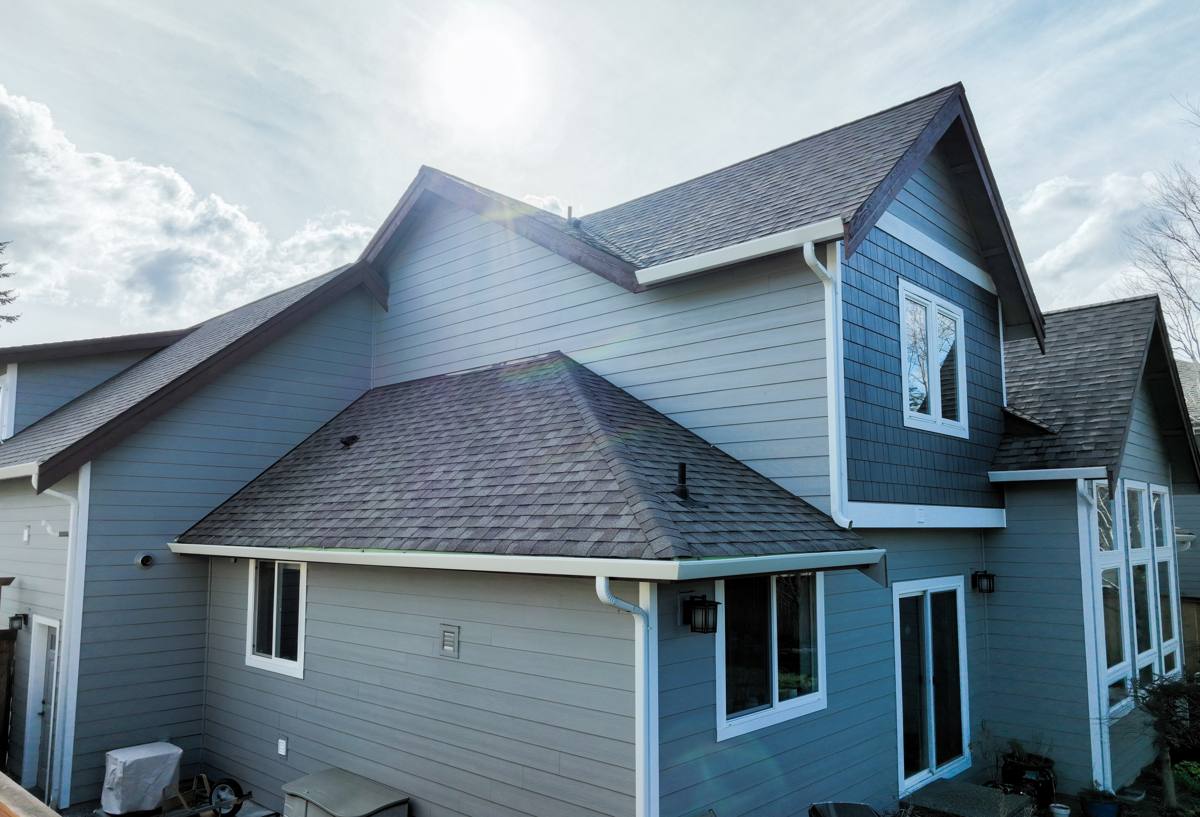
What Local Homes Actually Need From Their Siding
Salt Air and Corrosion
Proximity to salt water accelerates corrosion on fasteners, flashing, and any metal components in a siding system. Cheap or mismatched fasteners are one of the most common failure points we see on homes near the water — not because the siding itself failed, but because the hardware holding it up didn't.
Driving Rain and Wind-Loaded Walls
Rain that falls straight down is far less demanding on a wall assembly than rain that's being pushed sideways by wind. Wind-driven rain forces water into every seam, joint, and penetration it can find. A siding installation that isn't detailed correctly at these points — window and door trim, corners, hose bibs, light fixtures — will eventually let water behind the cladding, regardless of how good the siding material is.
Moss, Algae, and Extended Dampness
A long moss season means extended periods where a home's north- and shade-facing walls simply don't dry out fully between rain events. Siding material that absorbs moisture, or that relies on a surface coating rather than a factory-cured finish, tends to show algae staining and softening faster in these conditions.
Why We Install James Hardie Fiber Cement — and Nothing Else
We made a deliberate decision to install only James Hardie fiber cement siding on the homes we work on, including here in Happy Valley. That's not a marketing position — it's a practical one, based on how different siding materials actually perform in this exact climate over decades, not just the first few years.
- Non-combustible core: fiber cement doesn't feed a fire the way wood-based products can, which matters for insurance and long-term peace of mind.
- Factory-applied ColorPlus finish: the color is baked on at the factory under controlled conditions, rather than field-painted, which holds up far better against UV, salt air, and moisture than a job-site paint job.
- Climate-engineered HZ product lines: Hardie's HZ5 formulation is built specifically for the wetter, cooler climate zones like ours, with moisture management as a core design goal rather than an afterthought.
- Dimensional stability: fiber cement doesn't expand, contract, warp, or cup the way wood-based siding does when it cycles between wet and dry repeatedly through a Whatcom County winter and spring.
- Strong transferable warranty: a manufacturer warranty that's meaningful and can pass to a future owner adds real resale value, not just protection for the current homeowner.
We don't install vinyl, LP SmartSide, Cemplank, Allura, primed spruce, or cedar. Each of those has legitimate uses and real advantages in the right application, but we've standardized on Hardie because it's the product we're confident will still be performing correctly on a Happy Valley home fifteen and twenty years from now, in this specific climate, with normal maintenance.
What a Correct Installation Actually Involves
The siding panel itself is only part of the system. Most siding failures we're called to diagnose on other companies' work trace back to installation details, not the material. A correct Hardie installation in this climate includes:
Weather-Resistive Barrier and Flashing
A properly lapped weather-resistive barrier behind the siding, with correctly integrated flashing at every window, door, and penetration, so that any water that does get past the cladding has a clear path back out rather than a place to collect.
Rainscreen Gap Where It's Needed
On walls with heavy rain exposure — which describes a lot of Happy Valley given the driving rain off the water — a drainage gap behind the siding lets the wall assembly dry out between storms instead of staying damp against the sheathing.
Correct Fastening
Fasteners spaced, driven, and placed to Hardie's specifications, using corrosion-resistant hardware appropriate for coastal exposure. Over-driven or under-driven nails are one of the most common defects we find in prior installations, and they quietly compromise the whole system.
Proper Caulking and Sealant Strategy
Sealant belongs at specific joints, not everywhere. Over-caulking traps moisture just as reliably as under-caulking lets it in — knowing the difference comes from experience with how the product is designed to shed water.
Our Process for Happy Valley Siding Projects
- On-site assessment: we look at your home's specific exposure — how much salt air, wind, shade, and rain each wall actually sees — because those vary even within a single lot.
- Removal and inspection: old siding comes off and we inspect the sheathing and framing underneath for hidden rot or moisture damage before anything new goes up.
- Repair as needed: any compromised sheathing or framing gets addressed before the new siding goes on — covering up a problem is not an option.
- Weather barrier and flashing installation: the unglamorous but most important layer of the whole system.
- Hardie panel installation: installed to manufacturer spec, with attention to fastening, gapping, and trim details specific to your home's exposure.
- Final detailing: caulking, touch-up, and a walkthrough so you understand what was done and why.
Cost Factors for a Happy Valley Siding Project
Every home is different, but the factors that move the price on a siding installation in this area are fairly consistent. This is meant to help you understand what drives the number, not to promise an exact figure.
| Factor | Why It Matters Here |
|---|---|
| Home size and wall complexity | More corners, dormers, and trim details mean more labor and more flashing points to detail correctly |
| Existing siding removal and sheathing condition | Homes with hidden moisture damage from prior siding need repair before new siding goes on |
| Wall exposure to wind and rain | Sides facing prevailing wind and water often need additional drainage detailing |
| Hardie product line and profile | Lap siding, panel siding, and shingle-style profiles carry different material and labor costs |
| Trim and accessory scope | Corner boards, window trim, and fascia work are often bundled with a siding project |
Signs Your Current Siding Is Already Losing the Battle
- Soft or spongy spots when you press on the siding, especially near the bottom courses
- Paint that's peeling or bubbling repeatedly in the same spots year after year
- Visible warping, cupping, or gaps at seams and corners
- Persistent moss or algae growth that comes back quickly after cleaning
- Rising energy bills that suggest air and moisture are getting through the wall assembly
- Visible staining on interior walls or trim near exterior corners
If any of these sound familiar, the siding is likely past the point where patching or repainting will solve the underlying problem.
Why Hiring a Crew That Already Works Happy Valley Matters
Siding installation isn't a one-size-fits-all trade, and it especially isn't in a place with this much microclimate variation. A crew that already understands how salt air behaves on this side of Chuckanut, how the prevailing storms load up certain walls more than others, and where moss tends to take hold first, is going to make better judgment calls on flashing details, gap sizing, and fastener choice than a crew seeing the area for the first time. That local familiarity, combined with installing a single, well-understood product system rather than juggling five different materials, is a big part of why our installs hold up.
Get a Straightforward Estimate
If your Happy Valley home's siding is showing its age, or you're planning ahead before the next wet season sets in, we're happy to take a look and give you a straightforward, no-pressure estimate for a James Hardie fiber cement installation built for this exact climate. Fill out the form below and we'll get in touch to schedule a time that works for you.