 Chuckanut Exterior
 Siding in Bow Has a Different Job to Do
Bow sits close enough to Samish Bay and Chuckanut Bay that homes here deal with a combination of weather stresses most siding products were never designed to handle together: salt-laden air rolling in off the water, driving rain pushed sideways by wind off the bay, and long stretches of overcast, damp weather that turn north-facing walls and shaded siding into moss farms. Any one of those on its own is manageable. All three, year after year, is what separates siding that looks good for five years from siding that still looks good in twenty.
This page is specifically about fiber cement siding installed on homes in and around Bow — not a generic overview of the product. If you're comparing siding options for a Bow property, the local conditions should shape both the material you choose and how it gets installed, not just the color.
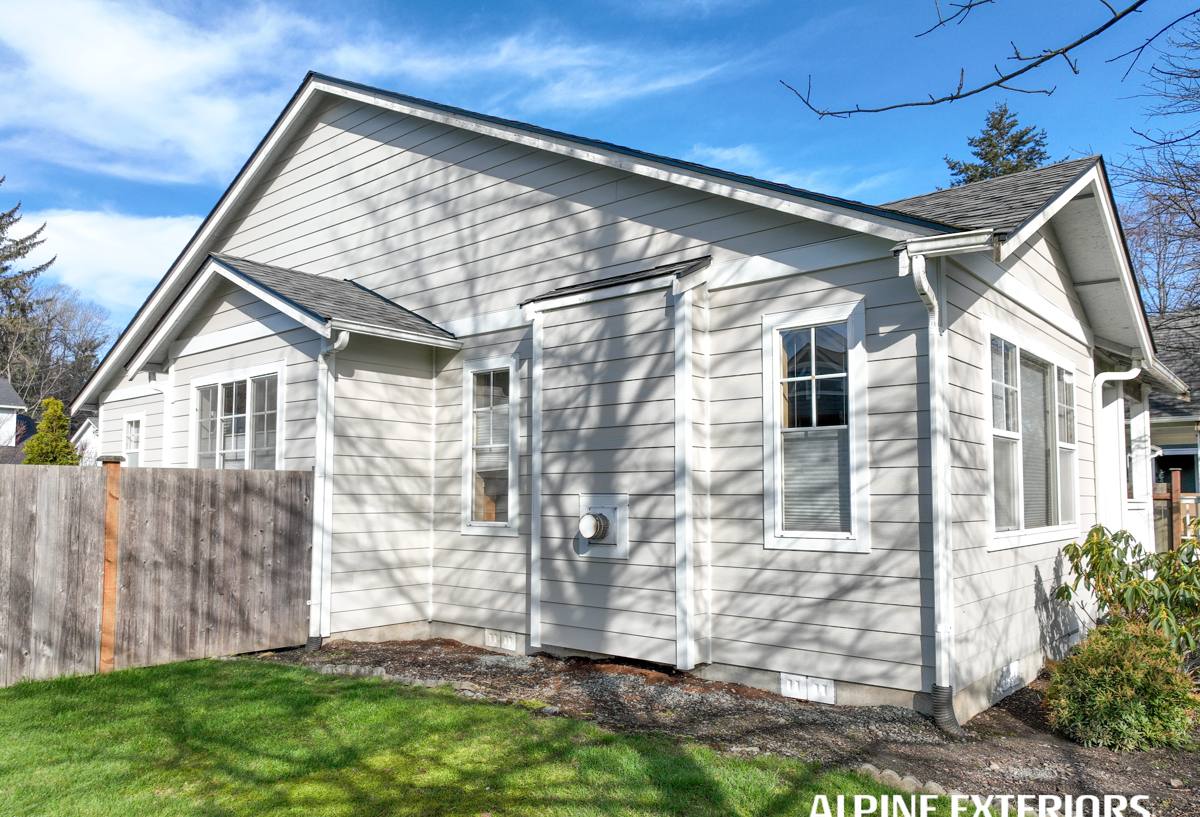
What Bow's Climate Actually Does to Siding
Salt Air
Homes closer to the water pick up airborne salt that settles on exterior surfaces. Over time, salt exposure accelerates corrosion on metal fasteners, trim, and flashing, and it can degrade paint films and caulk faster than the same products would wear inland. Siding that isn't dimensionally stable — meaning it swells, shrinks, or warps with moisture — tends to open up gaps at seams and fastener points, which gives salt-laden moisture a path into the wall assembly.
Driving Rain
Wind off the bay doesn't just drop rain straight down — it drives it sideways into walls, under laps, and around penetrations like light fixtures, hose bibs, and vents. This is a wind-driven-rain climate, which means the water-management details behind and around the siding (housewrap, flashing, kick-out flashing at roof-wall intersections, proper lap and gap dimensions) matter as much as the siding material itself. A great product installed with poor water management will still leak.
Moss Season
Whatcom County's wet, mild winters and shaded, tree-lined lots around Bow create ideal conditions for moss and algae growth on siding, especially on north- and west-facing walls that stay damp longest. Moss holds moisture against the surface, which is a slow but steady threat to any siding material that isn't fully moisture-resistant at its core — and it's an ongoing maintenance and appearance issue even on siding that structurally holds up fine.
Why We Install Only James Hardie Fiber Cement
Chuckanut Exterior Company installs James Hardie fiber cement siding exclusively — we don't install vinyl, LP SmartSide, primed wood, cedar, or other fiber cement brands. That's a deliberate standard, not a sales preference, and it's especially relevant in a climate like Bow's.
Fiber cement is a mix of cement, sand, and cellulose fibers, engineered to be dimensionally stable and non-combustible. Because it doesn't swell and shrink with moisture the way wood-based products can, it holds its seams, its fastening, and its paint film far more consistently over years of wet-dry cycling. James Hardie specifically manufactures HZ5 siding — engineered for the wetter, more humid climate zones that include Western Washington — which is a meaningful difference from siding rated for a national average climate rather than the Pacific Northwest specifically.
The factory-applied ColorPlus finish is also relevant here: it's baked on under controlled conditions and backed by its own finish warranty, which matters in a salt-air environment where field-applied paint tends to fail faster than factory finishes.
How Fiber Cement Compares
| Factor | James Hardie Fiber Cement | Vinyl Siding | Wood / LP SmartSide |
|---|---|---|---|
| Moisture response | Dimensionally stable, resists swelling | Stable but can warp/melt with heat | Prone to swelling, rot at cut edges |
| Salt air durability | Strong — cement core doesn't corrode | Can chalk and become brittle | Moderate — coating is the only barrier |
| Moss/algae resistance | Good with correct finish and gapping | Prone to algae streaking | Moderate, depends on coating upkeep |
| Fire resistance | Non-combustible | Melts, can contribute to fire spread | Combustible |
| Typical repaint interval | 15+ years (factory finish) | Doesn't fade the same way, can't repaint easily | 5–10 years |
This isn't a claim that other products are unusable — vinyl and engineered wood both have applications where they make sense. It's why, given Bow's specific combination of salt air, wind-driven rain, and moss exposure, we've standardized on one product system we can back with confidence.
What a Correct Fiber Cement Job Looks Like Here
The siding board itself is only part of the system. In a climate like Bow's, the installation details are where jobs succeed or fail:
- Weather-resistant barrier: A continuous, properly lapped housewrap behind the siding, with all penetrations sealed before the siding goes on.
- Correct clearances: Minimum gaps between siding and roofing, decking, and grade so water has somewhere to go instead of wicking into the board's bottom edge.
- Flashing at every transition: Windows, doors, roof-wall intersections, and any wall penetration get flashed so water sheds outward, not behind the siding.
- Manufacturer-spec fastening: Corrosion-resistant fasteners, correct spacing, and nailing into framing — not just sheathing — so the siding stays put through wind events off the bay.
- Field-cut edges sealed and painted: Any cut edge is a place moisture can enter the board; those get treated per Hardie's specifications, not left raw.
- Proper joint and caulk detailing: Butt joints, corners, and trim get the right sealant and gap, not just caulk smeared over a tight seam.
Skip any one of these and you can still end up with moisture problems behind fiber cement siding — the product's durability doesn't compensate for a rushed installation.
Our Process for Bow Homes
1. On-Site Assessment
We look at your home's actual exposure — which walls take the most wind-driven rain, which stay shaded and damp longest, and where existing moisture or moss problems are already showing. This shapes both the installation plan and where we pay extra attention to flashing and clearances.
2. Tear-Off and Substrate Check
Once the old siding comes off, we check the sheathing and framing underneath for any hidden rot or moisture damage — common on homes that have dealt with years of driving rain — and address it before anything new goes up. Covering up a damaged substrate is how new siding fails early.
3. Water Management Installation
Housewrap, flashing, and any needed drainage plane details go in before a single piece of siding is hung. This is the step that determines how the wall handles the next twenty years of Bow's weather.
4. Siding Installation to Spec
HardiePlank or HardiePanel goes up per James Hardie's published installation instructions — clearances, fastening schedule, joint treatment — with attention to the north- and west-facing walls that see the most moss pressure.
5. Trim, Caulk, and Final Detailing
Corners, trim boards, and penetrations get finished and sealed, and we walk the whole exterior to confirm every clearance and joint is correct before calling the job done.
Why a Local Crew Matters for This Job
Siding installation isn't purely a product question — it's a site-conditions question, and Bow's site conditions are specific. A crew that regularly works this stretch of Whatcom County near the water already knows which walls on a typical Bow lot take the worst of the wind-driven rain, how much moss pressure to expect on shaded north sides, and how salt exposure changes fastener and flashing choices compared to an inland job forty minutes east. That's knowledge you don't get from a manufacturer's install manual alone — it comes from doing the work in this specific climate, repeatedly.
A local crew is also easier to hold accountable. If a callback is needed for a caulk line or a trim detail, you're not waiting on a company that has to schedule a truck in from out of the area. And a contractor who plans to keep working in Bow has a real incentive to do the water-management details right the first time — a leak that shows up two years later on a house down the street is bad for business in a community this size.
What Correct Fiber Cement Costs to Get Right
| Cost Factor | What Drives It |
|---|---|
| Substrate condition | Rot or moisture damage found during tear-off adds repair scope before new siding goes up |
| Home size and complexity | More corners, dormers, and penetrations mean more flashing and trim detail work |
| Siding profile | Lap width, panel vs. plank, and trim style affect material and labor |
| Color and finish | Factory ColorPlus finish vs. field-primed for paint changes material cost |
| Access and site conditions | Steep lots, limited driveway access, or heavy landscaping near walls affect labor time |
We won't quote a number without seeing the actual house — anyone who does is guessing, and on a job where the water-management details matter this much, guessing is a bad sign. What we can tell you honestly: a correctly installed fiber cement system costs more upfront than vinyl, and it's meant to — the difference shows up in how few problems you have to deal with over the next couple decades.
Living With Fiber Cement Siding in Bow
Once it's installed correctly, fiber cement is genuinely low-maintenance, but "low-maintenance" isn't "no-maintenance" in this climate. A few practical habits keep it performing:
- Rinse siding periodically, especially shaded north- and west-facing walls, to keep moss and algae from establishing.
- Keep gutters clear so overflow doesn't run down and pool against siding near rooflines.
- Trim back vegetation and tree limbs that keep walls shaded and damp longer than necessary.
- Inspect caulk lines at trim and penetrations every year or two, and re-caulk before gaps open up, not after.
- Watch for any siding that stays visibly damp longer than surrounding areas — it can flag a clearance or flashing issue worth checking.
None of this is heavy lifting, but it's the difference between siding that reaches its full lifespan and siding that develops slow, quiet problems nobody notices until a repaint or a resale inspection.
Questions Worth Asking Before You Hire
Whoever you choose for a Bow siding project, these are reasonable things to ask before signing anything:
- Do they install per the manufacturer's published specifications, including clearances and fastening schedule?
- Will they check and address substrate condition during tear-off, not just cover it up?
- Do they detail flashing at every penetration and transition, or just caulk over gaps?
- Can they explain how their installation plan accounts for wind-driven rain and shaded, moss-prone walls?
- Do they carry proper licensing and insurance for exterior work in Washington?
A contractor who can answer these clearly, without hedging, is one who understands what this climate actually requires.
If you're weighing siding options for a home in Bow, we're happy to take a look and walk you through what we'd actually recommend for your walls, your exposure, and your budget — no pressure, no obligation. Use the form below to request a free estimate.