 Chuckanut Exterior
 Why Happy Valley Decks Wear Out Faster Than the Brochure Says
Happy Valley sits close enough to the water and tree cover that a deck here ages differently than one built inland. Salt-laden air off the bay works on fasteners and metal connectors year-round, driving rain gets pushed sideways by wind off the water and finds its way under flashing and into end grain, and the long stretch of overcast, wet months from fall through spring keeps wood damp longer than it ever fully dries. Add the shade from mature trees common on Happy Valley lots, and you get moss and algae that hold moisture against the decking boards for weeks at a time. None of this means a deck is doomed — it means the repair has to account for those conditions, not just patch what's visible on top.
We've repaired decks all over Chuckanut and Whatcom County, and the pattern in Happy Valley is consistent: surface boards look worse than the structure underneath, or the reverse — a deck that looks fine from the yard has soft framing nobody's checked in a decade. A proper inspection looks at both.
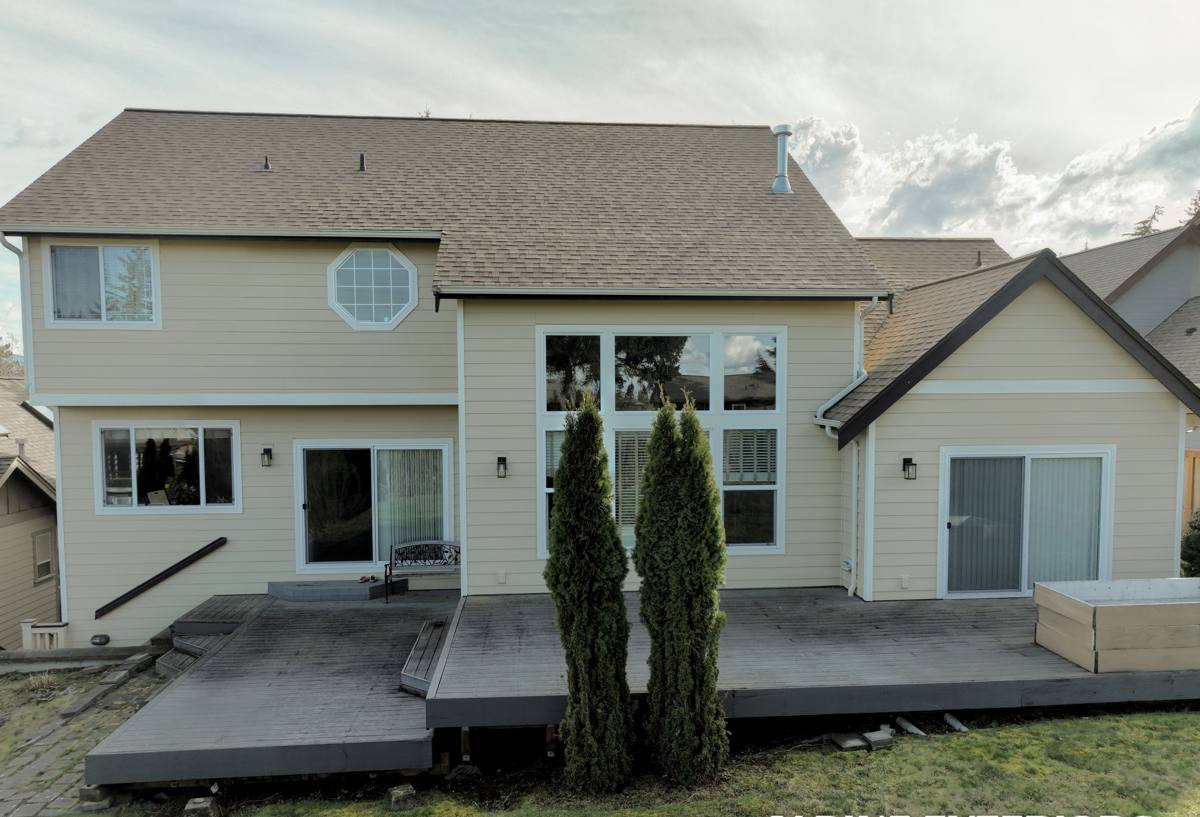
Signs a Happy Valley Deck Needs Repair
Some damage is obvious. Some isn't, and that's the kind that costs the most if it's ignored through another wet Whatcom County winter.
- Soft or spongy spots when you walk the deck, especially near the house or at board ends
- Rust streaking below screws or nail heads — a sign the fastener itself is failing, not just cosmetic
- Gaps or separation where the deck ledger meets the house siding
- Railings that flex or wiggle when leaned on
- Persistent green or black staining on boards that stays wet longer than the rest of the deck
- Visible daylight or gaps between joists and beams, or sagging between support posts
- Stair stringers that feel loose or bounce underfoot
Any one of these can be a small fix. Several at once, especially structural ones, usually mean the repair needs to start below the decking, not at it.
Surface Damage vs. Structural Damage
Surface damage — cupped boards, faded finish, minor splintering — affects comfort and looks but not safety. Structural damage — rotted joists, a failing ledger connection, corroded hardware — affects whether the deck holds weight the way it's supposed to. We always separate the two out loud with the homeowner before quoting anything, because they're priced and prioritized very differently.
What a Correct Deck Repair Actually Involves
A repair that only replaces what's visible from above tends to fail again within a season or two in this climate, because the cause — trapped moisture, a bad flashing detail, undersized or corroding fasteners — is still there. A repair that's done right addresses the cause and the symptom together.
- Diagnose the source of moisture before replacing anything. A rotted joist under a shaded corner of the deck usually has a reason — missing flashing, a low spot that pools water, or boards installed tight with no drainage gap.
- Check the ledger board connection where the deck attaches to the house. This is the single most common point of failure and the most dangerous one to leave alone, since it's what keeps the deck from pulling away from the structure.
- Inspect joists, beams, and posts for rot, checking, or insect damage, probing suspect wood rather than just looking at it.
- Replace fasteners with the correct grade for treated lumber and coastal exposure — mismatched metal accelerates corrosion, which is a major reason repairs fail early around here.
- Re-flash and re-seal any connection point to the house, since a repair that skips flashing is a repair that invites the same rot back in.
- Replace decking and railing components to match structural repairs, with attention to drainage gaps and airflow underneath.
Repair or Replace? A Straight Answer
Homeowners in Happy Valley often ask us to "just fix what's broken," which is the right instinct — full replacement isn't always necessary. But there's a point where patching costs more over time than starting over on the framing. Here's how we walk through that decision.
| Factor | Favors Repair | Favors Replacement |
|---|---|---|
| Ledger board condition | Solid, properly flashed | Rotted or improperly attached originally |
| Extent of joist damage | Isolated to one or two joists | Widespread soft spots across the frame |
| Age of structure | Under 15-20 years, treated lumber intact | Original framing near or past its service life |
| Post and footing condition | Stable, no movement or heaving | Settling, rot at grade, undersized footings |
| Code compliance | Railings, stairs, spacing already meet current code | Older deck built before current guardrail/attachment codes |
In most Happy Valley repairs we handle, the framing is salvageable and the real cost driver is the ledger connection and a handful of joists — not the whole structure. But we won't recommend repair just to make the estimate smaller if the framing genuinely won't hold up through another wet season.
Our Process
We keep this straightforward because deck repair shouldn't be a mystery to the homeowner paying for it.
- On-site inspection — we walk the deck, probe suspect areas, and check the ledger, framing, and posts, not just the decking surface
- Written scope — what's being repaired, what's being replaced, and why, in plain language
- Honest pricing — a range based on what we find, with any surprises (like hidden rot once boards come up) discussed before we proceed, not after
- The work itself — structural repairs first, then decking, railing, and finish work
- Final walk-through — we point out what we did and what to watch for going forward
Materials We Use and Why
For structural repairs — joists, beams, ledger blocking — we use pressure-treated lumber rated for ground contact where it's within reach of splashback or standing moisture, which is common on shaded Happy Valley lots. For decking and railing, the right choice depends on the homeowner's priorities: wood offers a lower repair cost and a traditional look but needs periodic sealing to hold up against Whatcom County's rain; composite decking costs more up front but needs less maintenance and handles constant moisture and moss growth better over time. We'll walk through the trade-offs honestly rather than pushing one material — the deciding factor is usually how much upkeep the homeowner wants to do, not which product is "better."
Fasteners matter more here than in drier climates. We use stainless steel or hot-dip galvanized fasteners rated for treated lumber and coastal exposure — cheaper coated screws corrode faster in salt air and are one of the most common reasons we get called back to a deck someone else repaired a few years earlier.
Keeping a Repaired Deck in Good Shape
A repair holds up longer with a little seasonal attention, especially given how much moss and standing moisture this area sees.
- Sweep debris and fallen leaves off the deck regularly, especially in fall — trapped organic matter holds moisture against boards
- Clean moss and algae off decking and stairs before they build up a slick layer, particularly on shaded sections
- Check the ledger flashing and house connection once a year for gaps or water staining
- Reseal or restain wood decking on the schedule the product calls for — usually every 1-3 years in this climate
- Keep gutters and downspouts clear so runoff isn't draining directly onto or under the deck
- Test railings and stair stringers periodically for looseness rather than waiting for a visible problem
Why Hiring a Crew That Already Works Happy Valley Matters
Deck repair advice that works in a dry inland climate doesn't always hold up here. A crew unfamiliar with coastal Whatcom County conditions might use the wrong fastener grade, skip flashing details that matter more in driving rain, or misjudge how much moss and shade a shaded lot actually deals with over a winter. We work these neighborhoods regularly, so we're not guessing at how a Happy Valley deck ages — we've seen the same failure points repeat across similar builds and know where to look first.
That local familiarity also means a straighter estimate. We're not padding the scope to cover uncertainty about conditions we haven't dealt with before — we know what driving rain off the bay and a long moss season actually do to a deck around here, and we price accordingly.
If you've got soft spots, a wobbly rail, or just want an honest read on whether your Happy Valley deck needs repair or replacement, we're happy to take a look. The estimate is free, there's no pressure, and you'll get a straight answer either way — just fill out the form below.