 Chuckanut Exterior
 Decking Built for Columbia's Weather, Not Just Its View
Homes in the Columbia area near Chuckanut sit close enough to the water that salt air is part of daily life, and far enough into the Pacific Northwest that rain, humidity, and shade-driven moss growth are a year-round concern rather than a seasonal one. A deck out here does a lot more work than a deck in a dry inland climate. It has to shed water fast, resist the slow corrosive effect of salt-laden air on fasteners and hardware, and stay usable through a moss season that can stretch from fall through spring in shaded yards.
Composite decking has become a popular answer to that combination of problems, but "composite" covers a wide range of products and installation approaches, and not all of them hold up the same way in a Whatcom County climate. This page walks through what actually matters for a Columbia property specifically: what the climate does to a deck, what a correctly built composite deck looks like, and what our process covers from tear-out to final walkthrough.
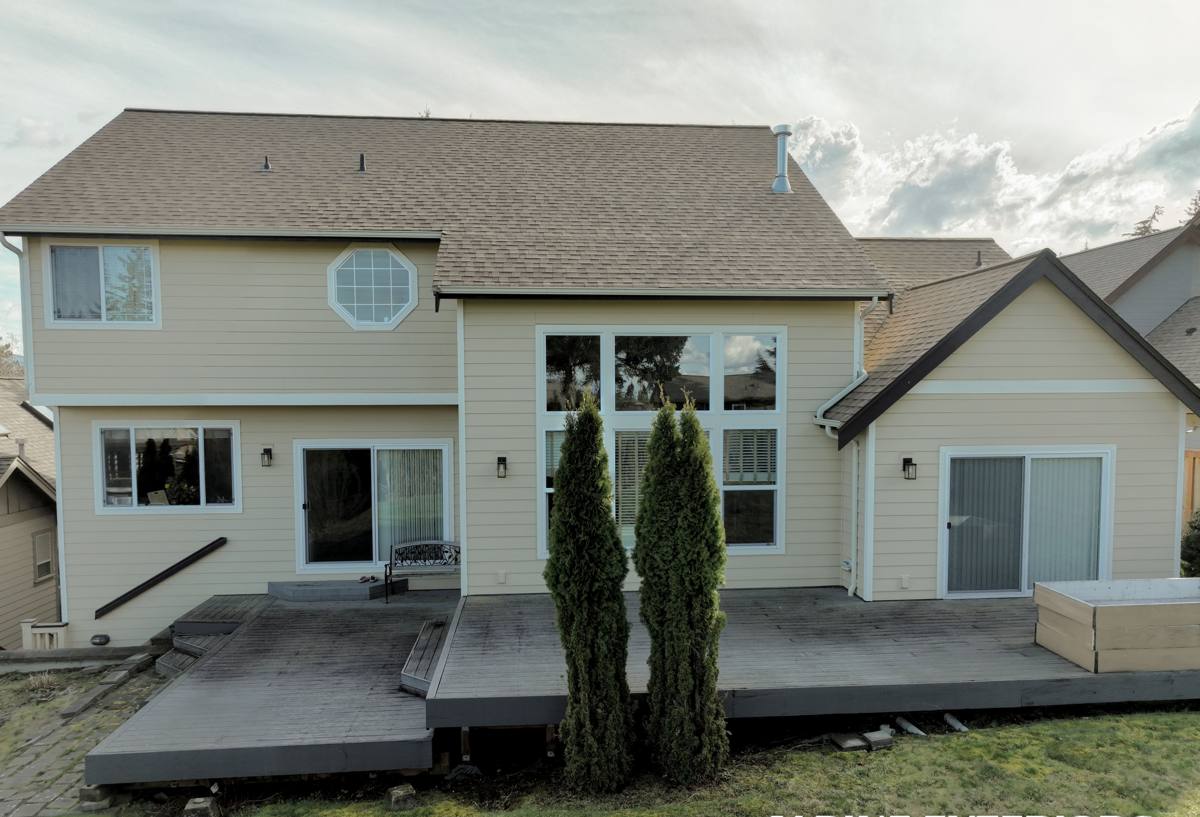
What Salt Air, Driving Rain, and Moss Actually Do to a Deck
Salt Air and Metal Hardware
Salt-laden air accelerates corrosion on any exposed metal — screws, joist hangers, post bases, railing brackets. On an older deck, this often shows up first as rust streaking down the face of boards or fasteners that back out because the metal has weakened around the threads. It's rarely the decking surface itself that fails first near the water; it's the hardware holding everything together.
Driving Rain and Water Intrusion
Rain that comes in sideways off a storm doesn't just fall on a deck, it drives into seams, ledger connections, and anywhere two materials meet. Over time, water that isn't given a clear path off the structure works its way into end grain, fastener holes, and the ledger-to-house connection. That's where rot starts on wood decks and where corrosion accelerates on fasteners in any deck type.
Moss and Algae in Shaded, Damp Conditions
Long moss season is a fact of life in this part of Whatcom County. Wood decking, especially in shaded areas or under tree cover, gives moss and algae a surface to grip and organic material to feed on. Once established, moss holds moisture against the board, which speeds up decay underneath even when the surface still looks intact. A slick, moss-covered deck is also a real fall hazard, particularly on stairs.
Why Composite Decking Fits This Climate Well
Composite decking — boards made from a blend of wood fiber and plastic, most of them capped with a protective outer shell — was designed to solve exactly these problems: it doesn't absorb water the way solid wood does, it doesn't need staining or sealing to keep weather out, and a capped composite surface gives moss and algae far less to grip onto compared to open wood grain.
That doesn't mean composite decking is maintenance-free or immune to the climate. It still needs to be washed periodically to keep organic growth from taking hold, the substructure underneath still needs to manage water correctly, and every fastener and connector in the system still needs to be rated for the exposure. Composite decking solves the surface problem. A correct installation solves the rest.
Composite vs. the Alternatives for a Columbia Property
| Material | Moisture Behavior | Moss/Algae Resistance | Maintenance | Typical Lifespan |
|---|---|---|---|---|
| Pressure-treated wood | Absorbs water, prone to cupping and checking | Low — open grain holds moisture and organic growth | Annual cleaning, periodic staining/sealing | 10-15 years before major repair |
| Cedar or other natural wood | Better natural resistance but still absorbs water | Low to moderate | Regular sealing to maintain appearance and protection | 10-20 years with upkeep |
| Capped composite | Low absorption, plastic cap sheds water | High — smooth cap resists grip and staining | Periodic washing, no staining/sealing | 25-30 years, often backed by warranty |
| PVC decking | Essentially non-absorbent | High | Periodic washing | 25-30+ years |
We install capped composite as our standard recommendation for Columbia properties because it gives the best balance of moisture and moss performance against upfront cost. PVC is a reasonable option for full-sun, high-exposure areas where an owner wants the lowest possible maintenance and is comfortable with the higher price point. We're honest about that trade-off rather than pushing one product for every situation.
What a Correct Composite Deck Installation Actually Involves
The composite boards get most of the attention, but in this climate the structure underneath the boards is what determines whether the deck performs for the next 20-plus years. A correct installation in a Columbia setting includes:
Substructure and Framing
- Joists and framing sized and spaced correctly for the specific composite product being installed — composite has different span requirements than solid wood
- Corrosion-resistant fasteners and connectors rated for coastal/salt-air exposure, not standard interior-grade hardware
- A ledger connection to the house that's properly flashed to keep water from tracking behind the siding
Drainage and Airflow
- Deck framing and grading that direct water away from the house rather than pooling under the deck
- Adequate ventilation beneath the deck surface so moisture doesn't sit trapped against the framing
- Board spacing set correctly for the specific product to allow drainage and account for thermal movement
Fastening and Finish Details
- Hidden fastener systems where the product allows, reducing exposed metal on the walking surface
- Properly finished board ends and picture-frame trim to protect cut edges from moisture intrusion
- Railing posts and stair stringers anchored with hardware matched to the same corrosion-resistance standard as the deck framing
Our Process, Start to Finish
- On-site assessment — we look at the existing structure (if there is one), sun/shade exposure, drainage path, and proximity to salt air to determine the right product and framing approach for that specific yard.
- Product selection — we walk through composite options with actual cost and performance trade-offs, not a single default recommendation.
- Tear-out and structural check — if we're replacing an existing deck, we inspect ledger, posts, and footings before building on top of them; problems here get fixed, not covered up.
- Framing and hardware — corrosion-resistant fasteners and connectors installed to spec, with attention to ledger flashing and drainage.
- Composite installation — boards installed per manufacturer spacing and fastening requirements to protect the warranty.
- Railings, stairs, and trim — finished to match the deck system and the house.
- Final walkthrough — we cover maintenance expectations and warranty paperwork so there are no surprises later.
What Maintenance Actually Looks Like
Composite decking cuts down maintenance significantly compared to wood, but "low maintenance" isn't "no maintenance," especially with a long moss season working against you. A realistic routine for a Columbia property:
- Sweep debris (leaves, needles, seed pods) off the deck regularly — trapped organic debris is what gives moss and algae a foothold even on composite
- Wash the deck surface with mild soap and water a couple of times a year, more often in shaded or low-airflow areas
- Rinse salt residue off periodically if the deck is close to the water and gets direct sea spray
- Check railing and stair hardware annually for corrosion, especially on older installations using standard-grade fasteners
- Keep gutters and downspouts near the deck clear so runoff isn't dumping extra water onto or under the structure
Cost Factors for a Columbia Composite Deck
| Factor | How It Affects Cost |
|---|---|
| Deck size and shape | Larger square footage and multiple levels or angles increase material and labor |
| Composite tier | Entry-level capped composite vs. premium composite or PVC changes material cost per square foot |
| Substructure condition | Replacing rotted or undersized framing adds cost but is not optional for a safe, lasting deck |
| Height and access | Elevated decks require more substantial framing, railing, and sometimes stairs |
| Fastening system | Hidden fastener systems cost more in labor but improve appearance and reduce exposed metal |
| Site exposure | Higher salt exposure or difficult drainage sites may need upgraded hardware and flashing |
We give firm, itemized quotes after the on-site assessment rather than rough phone estimates, because the substructure condition and site exposure make too much difference in this climate to guess accurately from a description alone.
Why a Crew That Already Works Columbia Makes a Difference
A deck built to a generic inland spec doesn't hold up the same way three blocks from the water as it would 50 miles inland. Crews that already work Columbia and the broader Chuckanut area know which hardware grade to default to, how much airflow a given lot typically needs under a deck, and where moss tends to be a persistent problem versus a minor one. That local pattern recognition shows up in fewer callbacks and a deck that still looks and performs well after a few full Whatcom County winters, not just at handoff.
If you're planning a new composite deck or replacing one that's showing its age, we're happy to come take a look and talk through what makes sense for your specific property. The estimate is free, there's no pressure, and you can use the form below to get started.