 Chuckanut Exterior
 Composite Decking in Burlington's Marine Climate
Burlington sits close enough to the water and to Chuckanut's tree cover that a deck here deals with a different set of stresses than a deck fifty miles inland. Salt-tinged air moves through on the wind, driving rain comes in sideways for months at a stretch, and shaded corners of a yard can stay damp long after the rest of the property has dried out. Add a moss season that runs longer here than in drier parts of the state, and you have a set of conditions that will find every weak point in a deck's design within a few winters.
Composite decking exists largely to handle exactly this kind of environment — it doesn't absorb water the way wood does, it won't splinter or rot, and it doesn't need the yearly staining cycle that keeps a cedar or fir deck looking decent. But composite isn't maintenance-free or mistake-proof. A poorly installed composite deck will trap moisture, grow moss on shaded boards, and loosen at the fasteners just as readily as a poorly installed wood deck — sometimes worse, because the failure is hidden under a surface that still looks fine. Our work in Burlington is built around that reality: get the structure, drainage, and hardware right, and the composite decking on top will do its job for decades.
What Burlington Homes Actually Need From a Deck
Drainage comes first
Most deck problems we find in this area start below the boards, not on top of them. A deck built tight to grade, or without a real slope and gap plan, holds water against the framing every time it rains — which in Whatcom County is often. Standing water under a deck is what feeds moss, mildew, and eventually rot in the substructure, even when the decking itself is composite and technically waterproof on the surface.
Salt air and hardware
Coastal-influenced air corrodes exposed metal faster than homeowners expect, especially on fasteners, joist hangers, and railing brackets. Cheap or mismatched hardware is one of the more common shortcuts we see on decks that are only a few years old but already showing rust streaks and loosening connections.
Moss and shade
Composite decking resists rot, but it doesn't repel organic growth on its own. Boards in shaded, low-airflow areas of a Burlington yard — under overhangs, near fence lines, on the north side of a house — will collect moss and algae over a long wet season just like any other surface exposed to that much moisture and shade. Design and airflow matter as much as the material choice.
Composite vs. Wood for This Climate
Homeowners in Burlington often ask us to lay out the honest trade-offs rather than just recommend the more expensive option. Here's how we explain it:
| Factor | Composite Decking | Wood Decking |
|---|---|---|
| Moisture absorption | Very low — capped boards shed water on the surface | Absorbs water, swells and contracts seasonally |
| Rot risk | None in the board itself; substructure can still rot if drainage is poor | Ongoing risk, especially at fastener points and end grain |
| Annual maintenance | Occasional washing; no staining or sealing required | Sanding, staining, or sealing on a recurring cycle |
| Moss and algae resistance | Resists staining but still needs airflow and periodic cleaning in shaded spots | More porous surface holds moisture, moss establishes faster |
| Upfront cost | Higher material cost | Lower material cost |
| Long-term cost | Lower over 15-25 years given minimal upkeep | Higher over time due to recurring maintenance and earlier replacement |
| Appearance consistency | Color and grain pattern stay consistent for the product's warranty period | Weathers and fades unevenly unless maintained closely |
Wood still has a place — it's a reasonable choice for homeowners who want the lowest upfront cost and are committed to the maintenance schedule. But for a Burlington property exposed to this much rain and salt air, most of our clients land on composite once they see the maintenance math over a decade or more.
What a Correct Composite Decking Installation Involves
Framing and substructure
Composite boards are only as good as what they're fastened to. We build or evaluate the substructure first — proper joist spacing for the specific composite product being used (composite typically needs tighter joist spacing than wood, especially at angles or on stairs), pressure-treated or otherwise moisture-resistant framing, and a slope away from the house so water actually leaves the deck instead of pooling under it.
Fasteners and hardware
We use fastener systems rated for coastal and marine-influenced environments, not standard hardware that will streak or corrode within a couple of seasons. Hidden fastener clip systems are common with composite decking and, done correctly, give a clean surface with no exposed screw heads to collect moisture or discolor.
Ventilation and clearance
Low-clearance decks are one of the biggest sources of long-term problems in this climate. We build in enough airflow underneath to let the substructure dry out between rain events, and we keep decking edges and end cuts properly capped or finished so water can't wick into the core of the board.
Board layout and expansion gaps
Composite still expands and contracts with temperature, just less than wood. Getting the gap spacing right at seams, walls, and fixtures prevents buckling and keeps water moving off the surface instead of sitting in tight joints.
Our Process, Start to Finish
- On-site assessment — we look at the existing structure (if there is one), drainage patterns across the yard, sun and shade exposure, and how the deck will actually be used.
- Honest scope and estimate — a clear breakdown of what needs to be rebuilt versus reused, what composite product fits the budget and use case, and what the timeline looks like.
- Substructure work — repair or rebuild framing to current standards before a single composite board goes down.
- Decking installation — proper fastening, spacing, and edge treatment, with attention to drainage and airflow throughout.
- Railings and finish details — matched or complementary railing systems, stair details, and any lighting or fascia work.
- Final walkthrough — we go over care basics and answer questions before calling the job done.
Repairing, Resurfacing, or Replacing an Existing Deck
Not every Burlington deck needs a full teardown. We regularly find that the framing underneath an old wood deck is sound enough to carry new composite decking, which saves on both cost and disruption. Other times — especially on decks that have had standing water against the joists for years — the substructure has to come out entirely. We'll tell you honestly which situation you're in rather than defaulting to the bigger job.
Warning signs that usually mean it's time to look at a repair or replacement include soft or spongy spots underfoot, boards that have visibly cupped or split, persistent moss that comes back within weeks of cleaning, and railings or stair stringers that have started to move under normal use.
What Drives the Cost of a Composite Deck Here
Every Burlington property is a little different, and pricing depends on more than square footage. The main factors we walk through with homeowners:
- Whether the existing substructure can be reused or needs to be rebuilt
- Deck size, shape, and how much cutting and layout complexity is involved (multiple levels, angles, stairs)
- The composite product tier chosen — board profiles, cap technology, and color options vary in price
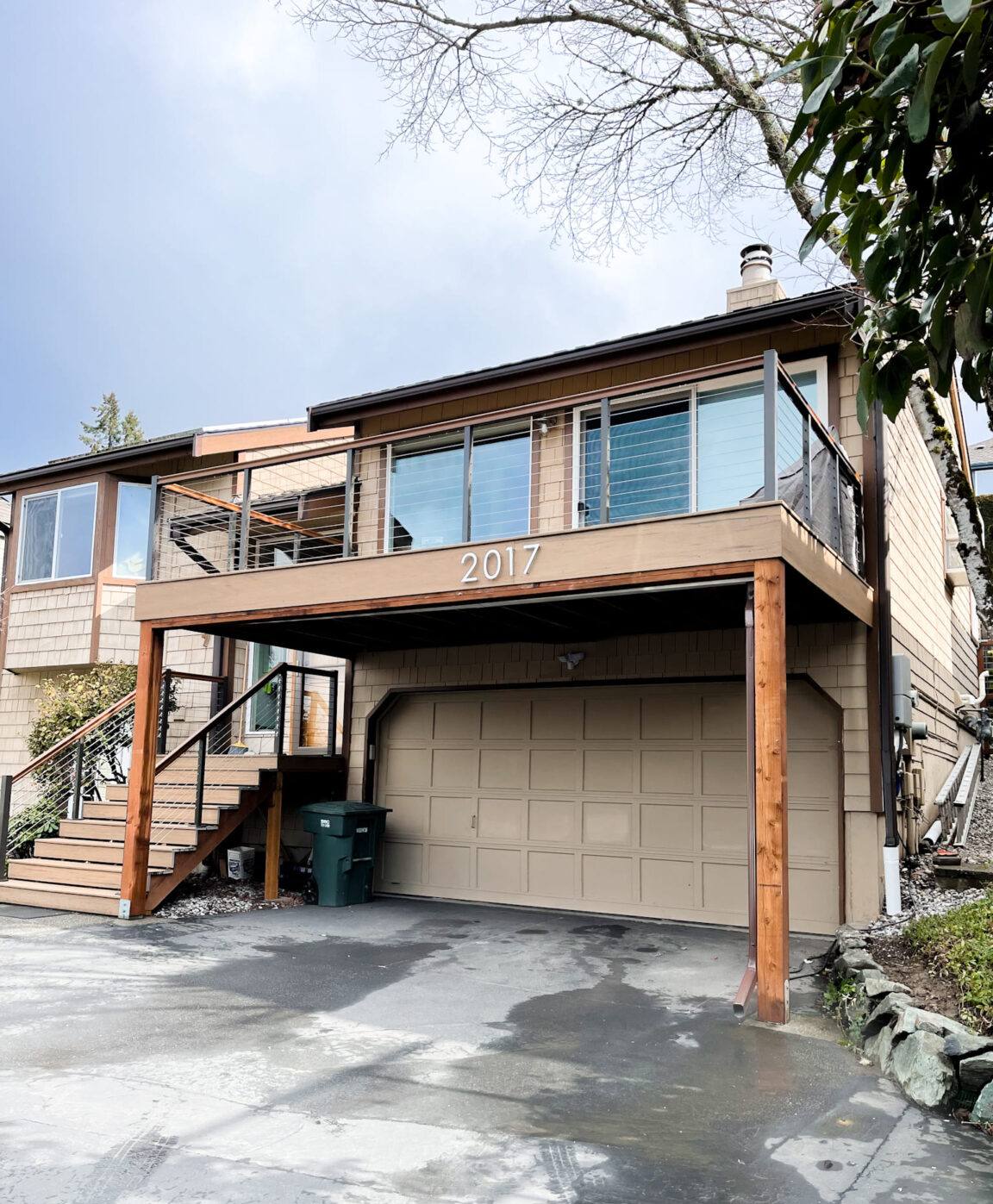
- Railing system — composite, cable, glass, or metal all carry different costs
- Site access and how much material has to be moved by hand versus machine
- Any drainage, grading, or moisture correction work needed before building can start
We give a real number after seeing the site, not a phone estimate — too many of these factors depend on what's actually going on underneath an existing deck or in the yard's drainage.
Living With a Composite Deck Through a Whatcom County Winter
Composite decking cuts maintenance dramatically compared to wood, but "low maintenance" isn't "no maintenance" in a climate that stays wet as long as this one does. A short seasonal routine keeps a composite deck performing the way it's supposed to:
- Sweep debris and standing leaves off the surface regularly through fall, especially in shaded corners
- Rinse or lightly scrub with soap and water a couple of times a year to prevent moss and algae from establishing
- Check that gaps between boards and around posts stay clear so water keeps draining rather than pooling
- Look underneath once or twice a year for any signs of moisture buildup, blocked airflow, or hardware corrosion
- Keep planters, mats, and furniture feet from sitting in one spot long enough to trap moisture against the board surface
Why a Crew That Already Works Burlington Makes a Difference
Deck-building advice that works in a dry climate doesn't always hold up here. Framing details, fastener choices, and drainage planning all need to account for the amount of rain and the salt-air exposure this part of Whatcom County actually gets. We build decks in this specific environment regularly, which means we're not guessing at joist spacing or hardware ratings — we know what holds up through a Burlington winter and what comes back as a callback a year later.
Local experience also means fewer surprises during the project itself. We know what typical soil and drainage conditions look like around here, how sun and shade move across a yard through the seasons, and what composite products perform well once the driving rain and long moss season set in.
Get a Straightforward Estimate
If you're weighing composite decking for a home in Burlington, we're glad to come take a look, walk the site with you, and put together a clear, no-pressure estimate. There's no obligation — just an honest read on what your deck needs and what it would take to do it right.