 Chuckanut Exterior
 Siding in Columbia Has to Answer to the Weather First
Homes in the Columbia neighborhood near Chuckanut sit close enough to the water and the tree line that siding gets tested from two directions at once. Off the water, you get salt-laden air that slowly works on anything not built to resist it. Off the hillside and tree cover, you get shade, moisture, and the long, damp stretch of Pacific Northwest winter that turns north- and west-facing walls into moss farms if the siding can't shed water and dry out between storms. Add Whatcom County's driving, wind-pushed rain — the kind that doesn't just fall straight down but gets pushed sideways into laps, seams, and trim — and you have a climate that punishes any siding product with a weak moisture strategy.
This isn't a theoretical concern. It's the reason so many older homes in this area show soft trim boards, peeling paint at butt joints, and dark streaking on shaded walls within a decade of a siding job that looked fine on installation day. The material matters, but so does how it's detailed against this specific climate. That's the lens we bring to every Columbia-area project.
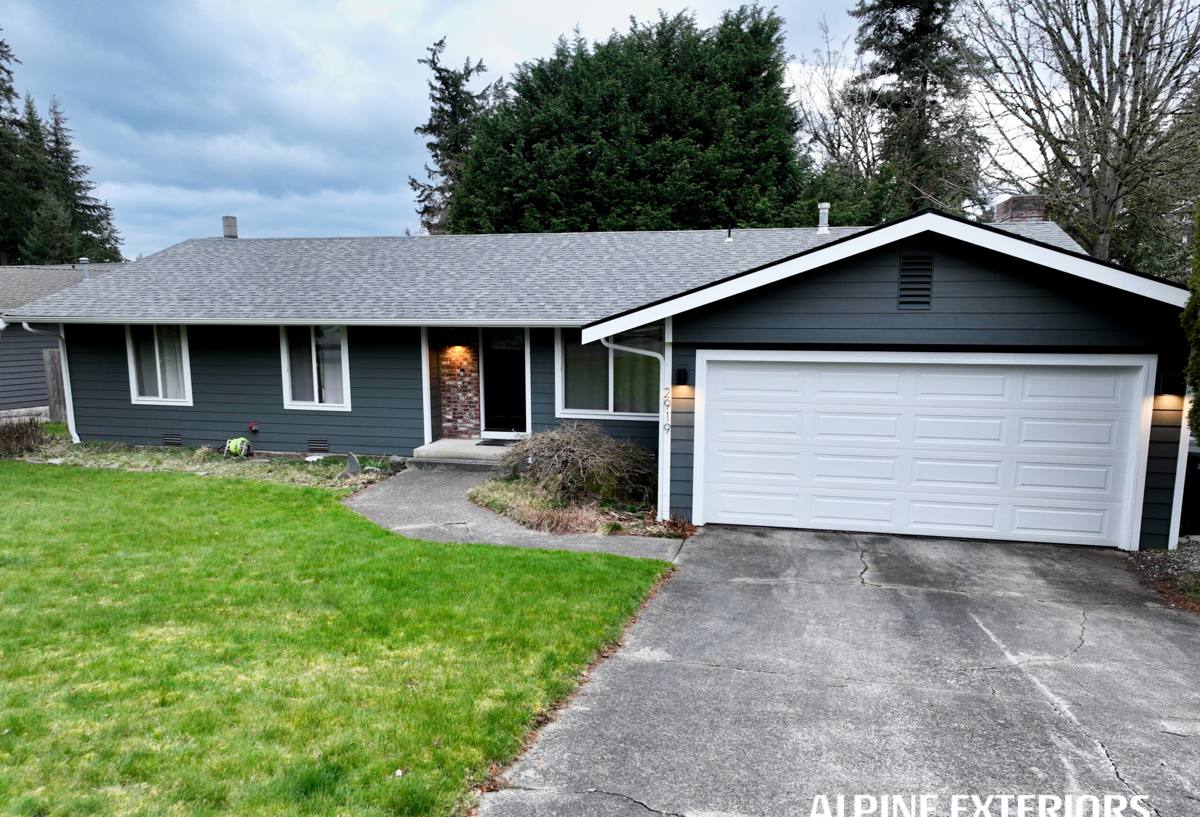
What James Hardie Siding Is Built to Do Here
James Hardie fiber cement siding is engineered from cement, sand, and cellulose fibers, then cured under pressure. That composition makes it dimensionally stable — it doesn't swell, cup, or split the way wood-based products can when they take on moisture and dry out repeatedly, which is exactly the cycle a Chuckanut winter puts siding through. It's also non-combustible, which matters in a region where wildfire smoke and dry-season fire risk have become a normal part of summer, even on the wetter west side of the state.
Hardie's ColorPlus finish is baked on at the factory rather than field-applied, which gives it better adhesion and color retention against UV and salt exposure than a job-site paint job. For a home a few minutes from tidal air, that's not a cosmetic detail — it's the difference between repainting in year six and not touching the color for well over a decade.
HardieZone: Built for This Specific Climate Band
James Hardie engineers its products by climate zone under its HardieZone system, and most of Whatcom County — including the Chuckanut and Columbia area — falls into HZ10, the zone built for wetter, more temperate coastal conditions. HZ10 formulations are engineered with moisture and mildew resistance tuned for exactly this kind of climate, rather than a one-size-fits-all product shipped the same way to a dry inland climate. When we spec a Hardie job here, we're using the version of the product this region was actually designed for.
Product Lines That Make Sense for Columbia Homes
Not every Hardie product fits every house. Part of doing this job right is matching the profile to the home's style, exposure, and existing trim details.
| Product | Typical Use | Why It Fits This Area |
|---|---|---|
| HardiePlank Lap Siding | Most traditional and craftsman-style homes | Widely used regional profile; sheds driving rain well when lapped and fastened correctly |
| HardiePanel Vertical Siding | Accent walls, gables, modern facades | Fewer horizontal laps means fewer water-catch points on exposed walls |
| HardieShingle | Cottage and Craftsman detailing | Popular for street-facing accents; needs careful flashing where it meets flat siding |
| HardieTrim | Corners, window and door casing | Resists the rot that softens wood trim in shaded, damp wall sections |
What a Correct Installation Actually Involves
Fiber cement siding is only as good as the assembly behind it. Most of the siding failures we get called out to inspect in this area aren't a material problem — they're an installation shortcut that let water get behind the cladding. On a climate like this one, a handful of details separate a siding job that lasts thirty-plus years from one that starts showing problems in five.
Moisture management behind the siding
A weather-resistive barrier and properly integrated flashing at every window, door, and penetration are not optional extras — they're what keeps the wall assembly dry when wind-driven rain gets past the face of the siding, which it will, eventually, on every home. Hardie siding is durable, but it's still a rain-screen component, not a waterproof membrane by itself.
Fastening and clearances
Hardie specifies exact nailing patterns, fastener types, and minimum clearances from grade, roof lines, and decks. Skipping these to save time is one of the most common causes of edge swelling and paint failure we see on re-side inspections — and it's invisible until the damage is already done.
Caulking and joint treatment
Butt joints and trim transitions need the right sealant, applied correctly, or they become the exact water-entry points this climate is built to exploit. Over-caulking is almost as bad as under-caulking — it can trap moisture instead of letting the assembly breathe and drain.
Factory-finish touch-up
Field cuts expose raw fiber cement edges. Those need Hardie-approved touch-up product on every cut edge, every time, or you've compromised the factory finish's whole advantage right at the seams — which is often where a wall sees the most water.
What Moss Season and Salt Air Do to a Poorly Installed Job
Even with the right material, bad detailing shows up in predictable ways around here:
- Dark streaking and moss growth concentrated on north- and west-facing walls that stay shaded and damp longest
- Soft or discolored trim at inside corners and under window sills, where flashing was skipped or undersized
- Paint or caulk failure at butt joints first, since these are the highest-stress points in any lap siding assembly
- Efflorescence or chalky residue near grade, a sign of moisture wicking up from poor clearance
- Fastener staining bleeding through the finish where the wrong fastener type was used near salt air exposure
None of these are Hardie's fault as a material — they're what happens when a good product goes on with shortcuts. It's also why we don't treat "we install Hardie" as the whole pitch. The install standard is the actual product.
Our Process for a Columbia Siding Project
- On-site assessment — we look at existing siding, trim condition, moisture staining, and how each elevation is exposed to prevailing wind and rain
- Tear-off and sheathing check — old siding comes off so we can inspect the sheathing underneath for rot or hidden damage before anything new goes up
- Weather-resistive barrier and flashing — installed at every penetration, window, and door before a single piece of Hardie goes on
- Hardie installation to spec — correct fastener type, nailing pattern, clearances, and joint treatment for HZ10 conditions
- Finish and touch-up — all field-cut edges sealed with Hardie-approved product to protect the factory finish
- Final walkthrough — we review the completed job with the homeowner before calling it done
Why We Only Install James Hardie
We don't install LP SmartSide, vinyl, Cemplank, Allura, primed spruce, or cedar. That's a deliberate standard, not a limitation in what we're capable of installing. Vinyl and engineered wood products each carry real trade-offs in a climate like this one — moisture sensitivity, maintenance burden, or long-term appearance — that we'd rather not carry on our name in a place where the weather doesn't give a mediocre install any slack. Non-combustible fiber cement with a factory-baked finish, backed by a strong transferable warranty when installed to Hardie's specification, is what we're willing to stand behind on a Columbia home for the next thirty years.
Why Local Installation Experience Matters
A crew that's worked houses in and around Chuckanut already knows which elevations catch the worst of the wind-driven rain, how long moss season really runs here, and how salt air ages an improperly finished cut edge. That's knowledge you don't get from a spec sheet — it comes from doing the work in this exact climate, repeatedly, and seeing what holds up and what doesn't five and ten years later. It shapes small decisions on every job: where we add extra flashing attention, which walls get the most careful joint treatment, and how we sequence work around the wet season.
Cost Factors on a Real Project
| Factor | Why It Moves the Price |
|---|---|
| Tear-off vs. new construction | Removing old siding, disposing of it, and inspecting sheathing adds labor a fresh install doesn't need |
| Home size and wall complexity | More corners, gables, and dormers mean more cutting, flashing, and trim work |
| Siding profile mix | Combining lap, panel, and shingle products for architectural detail costs more than a single profile |
| Existing damage | Rot or water damage found under old siding needs repair before new siding goes on |
| Trim and accent work | Custom trim details around windows, doors, and corners add labor time |
We don't quote a number without seeing the house — every one of these factors changes with the actual condition and layout of the home.
If your Columbia-area home is due for new siding, we're happy to take a look and give you a straightforward, no-pressure estimate. Use the form below to get started — no obligation, just an honest read on what your home needs.