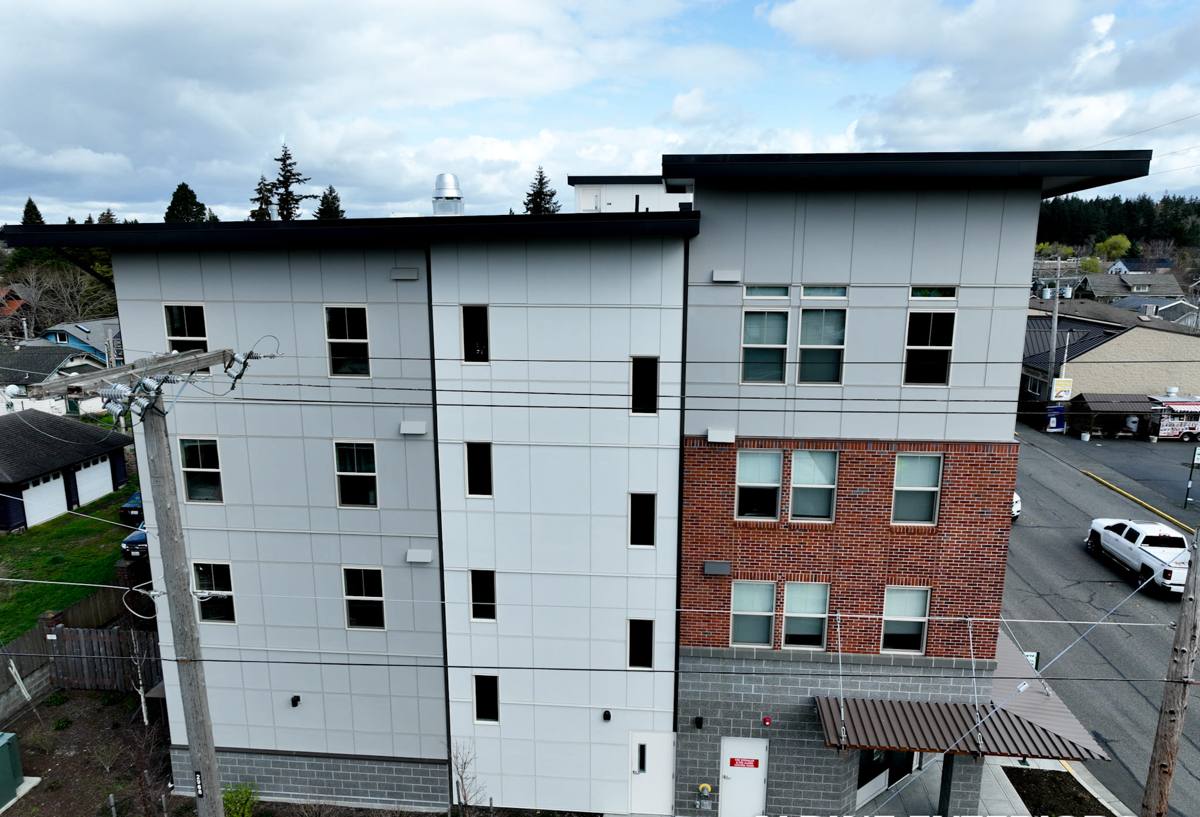
 Chuckanut Exterior
 Why Bow's Climate Is a Tough Testing Ground for Siding
Homes in Bow sit close enough to the water that salt-laden air is a daily fact of life, not an occasional nuisance. Add Chuckanut's driving rain — wind-blown, coming in at an angle instead of straight down — and a moss season that can stretch from fall through spring, and you've got a combination that exposes weak siding fast. Materials that hold up fine in a dry inland climate often show their limits here within a few winters.
Salt air accelerates corrosion on anything metal: fasteners, flashing, trim caps. Driving rain finds gaps that a straight-down rain would never reach — around window trim, at butt joints, behind loosely fitted J-channel. And the shade from Chuckanut's tree cover, combined with near-constant dampness for months at a time, gives moss and algae exactly what they need to take hold on north- and west-facing walls. Any siding installed in Bow has to be chosen and installed with all three of those pressures in mind, not just one.
What James Hardie Siding Brings to This Climate
We install James Hardie fiber cement siding exclusively, and in a place like Bow that's not a marketing position — it's a practical one. Fiber cement is non-combustible, dimensionally stable, and doesn't rot, swell, or delaminate the way wood-based or wood-composite products can when they stay damp for long stretches.
The HZ5 Engineering Difference
James Hardie engineers its siding by climate zone, and the Pacific Northwest falls into the HZ5 category — formulated to handle prolonged moisture exposure and freeze-thaw cycling better than the product formulations sold in drier regions. For a Bow home sitting in near-constant marine humidity, that's the right starting specification, not an upgrade.
ColorPlus Factory Finish
Hardie's ColorPlus finish is baked on at the factory under controlled conditions, which gives it better adhesion and UV resistance than a field-applied paint job. In a salt-air environment, factory finish also resists the chalking and fading that field-painted surfaces show first — which matters because the sooner a finish degrades, the sooner moisture and organic growth get a foothold on the substrate underneath.
Correct Installation: Where a Bow Project Actually Gets Won or Lost
Fiber cement siding performs exactly as well as it's installed — no better. The material itself is proven, but a large share of the siding failures we get called out to inspect trace back to installation shortcuts, not the product. In a climate that pushes rain sideways and salt into every seam, those shortcuts show up faster than they would somewhere drier.
Clearances and Flashing
Hardie's own specifications call for minimum clearances from grade, roof lines, decks, and other flat surfaces where water can pool or wick upward. Skipping these clearances is one of the most common corner-cutting moves we see, and it's also one of the most consequential in a high-rainfall area like Chuckanut. Every horizontal transition — window heads, door heads, roof-to-wall intersections — needs proper flashing installed before the siding goes on, not caulked over after.
Fastening for Salt Air
Fastener choice matters more here than almost anywhere inland. We use corrosion-resistant fasteners rated for the exposure, because a fastener that starts to rust doesn't just fail on its own — it stains the siding around it and creates a moisture entry point exactly where you don't want one.
Joints, Gaps, and Caulking
Butt joints, panel seams, and trim intersections are where driving rain gets tested hardest. Hardie specifies exact gap widths and sealant types for a reason — too tight and the material can't move with temperature and moisture changes; too loose and wind-driven rain gets pushed straight through. This is the kind of detail that's invisible once the job is finished, which is exactly why it's worth asking about before the job starts.
Trim, Fascia, and the Parts That Fail First
On most Bow homes we inspect, trim and fascia show wear before the field siding does. These smaller components have more exposed edges, more fastener penetrations, and more direct rain contact at rooflines and window heads. We install Hardie trim boards alongside the plank or panel siding specifically so the whole envelope is fiber cement — mixing Hardie field siding with a lesser trim product just moves the weak point instead of eliminating it.
Moss and Algae: What Actually Reduces It
No siding material is moss-proof if conditions are damp and shaded enough — but installation choices make a real difference in how much takes hold and how fast.
- Proper rainscreen or drainage gap behind the siding so moisture doesn't sit trapped against the wall assembly
- Correct panel and lap orientation so water sheds rather than collects at horizontal seams
- Adequate clearance from landscaping, gutters kept clear so overflow doesn't run down the wall face
- ColorPlus finish, which sheds surface grime more easily than a porous or field-painted surface
- Trimming back tree cover where practical, since reduced airflow and shade are what let moss establish in the first place
None of this makes a home moss-immune — Bow's tree cover and marine humidity are what they are. But a well-installed Hardie system dries out faster between rain events than most alternatives, which is the real variable that determines how much moss and algae you're dealing with each spring.
How Siding Options Actually Compare in Bow's Conditions
| Factor | James Hardie Fiber Cement | Vinyl | Wood / Wood Composite |
|---|---|---|---|
| Salt air / coastal exposure | Engineered for moisture exposure (HZ5); factory finish resists degradation | Can become brittle and discolored over time in coastal UV and salt exposure | Vulnerable to moisture intrusion and accelerated weathering |
| Driving rain resistance | Strong when flashed and gapped to spec | Depends heavily on installation; panels can be pushed by wind-driven rain | Prone to swelling and warping with repeated wetting |
| Moss / algae resistance | Sheds moisture faster; factory finish limits surface grip for growth | Non-porous but can trap moisture behind panels if installed poorly | Porous surface holds moisture, encourages growth |
| Fire resistance | Non-combustible | Combustible | Combustible |
| Finish longevity | Factory ColorPlus finish, long service life before repaint | Color molded in but can fade and chalk | Requires regular repainting or staining |
This is why the company standardized on Hardie rather than offering multiple product lines: in Bow's specific mix of salt air, driving rain, and shade-driven moss, it's the option that holds up with the least maintenance burden over time.
Our Process on a Bow Project
Assessment
We start by walking the exterior and identifying the conditions specific to that lot — sun exposure, tree cover, proximity to water, drainage patterns, and the condition of the existing siding, trim, and any water damage already present underneath.
Prep and Weather Barrier
Old siding and compromised sheathing come off, the weather-resistive barrier and drainage plane go in correctly, and any rot or moisture damage found underneath gets addressed before new siding ever goes up. Covering up an existing problem is how small issues turn into expensive ones.
Installation to Spec
Flashing, clearances, fastening, and gaps are all installed to Hardie's published specifications for the HZ5 zone — not shortcuts based on what's faster.
Final Walkthrough
We walk the finished job with the homeowner, covering what maintenance (if any) to expect and what the warranty actually covers.
Questions Worth Asking Before You Hire
- Are you installing to James Hardie's published fastening, clearance, and gap specifications, or working from general experience?
- What flashing details will be used at window heads, door heads, and roof-to-wall transitions?
- Will trim boards also be fiber cement, or a different material paired with the field siding?
- What does the warranty cover, and does it require registration or specific installation documentation?
- Have you installed Hardie siding on other homes in this area, and can you speak to how it's held up?
Why a Crew That Already Works This Area Matters
Chuckanut Drive, Bow, and the surrounding Whatcom County coastline aren't a generic siding environment. A crew that's used to inland conditions can install a technically correct job on paper and still miss the details that matter here — the extra attention to flashing at rain-exposed elevations, the fastener spec that accounts for salt air, the drainage detail that keeps moss from getting a head start. Working this area regularly means those adjustments happen automatically, not as an afterthought.
If your Bow home's siding is aging, showing moss buildup, or you're planning ahead for a replacement, we're happy to walk the exterior with you and give you a straightforward, no-pressure estimate. There's no cost to have us take a look and tell you honestly what we see.