 Chuckanut Exterior
 New Roof Installation for Blanchard Homes
Blanchard sits in the Chuckanut corridor of Whatcom County, where forested hillsides, close proximity to salt water, and a long wet season put roofs through more than most manufacturers' test data accounts for. A new roof installation out here isn't just about swapping old shingles for new ones — it's about building an assembly that can shed driving rain, resist moss colonization under heavy tree cover, and hold up against the salt-laden air that drifts inland off the water. We install new roofs on Blanchard-area homes with those specific conditions in mind, not a generic weatherproofing approach lifted from a drier climate.
This page covers what a correct new roof installation looks like for this area, how our process works from first look to final walk-through, and why local experience on Chuckanut-area roofs actually changes the outcome.
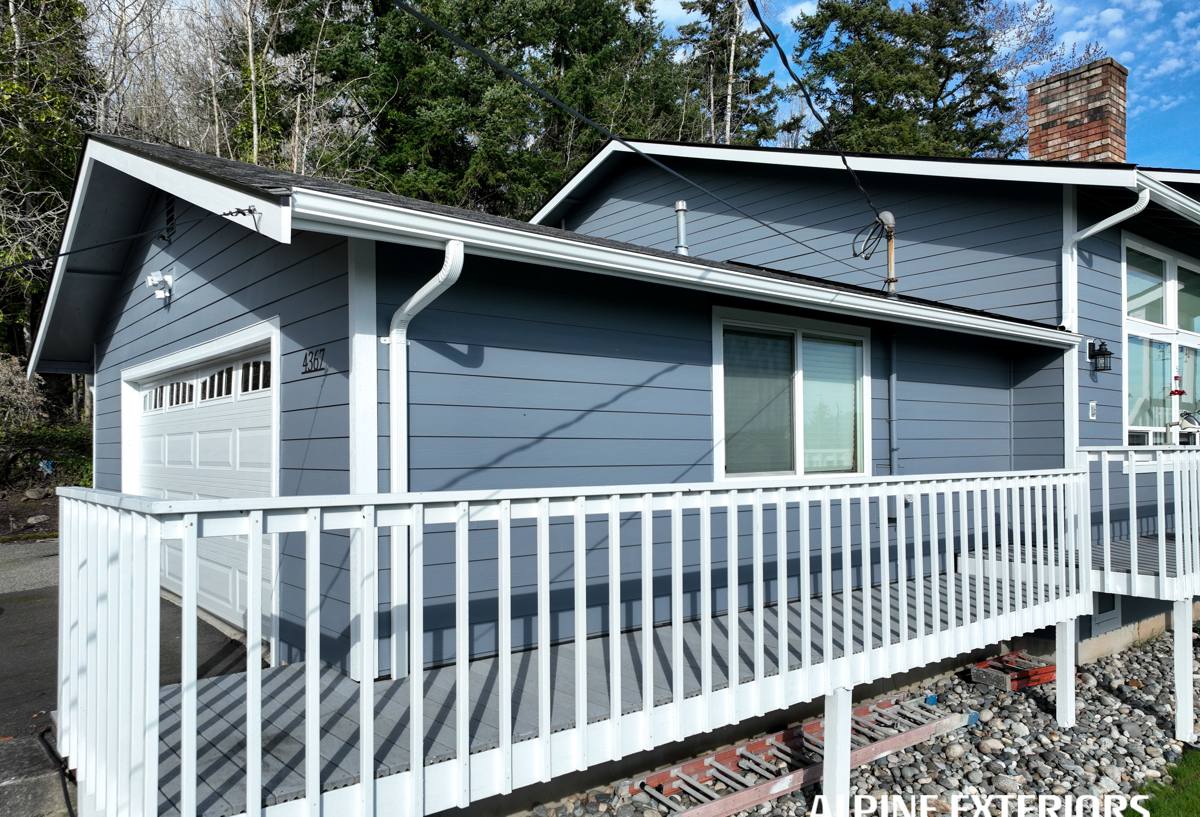
Why Blanchard's Climate Is Hard on Roofs
Salt Air
Homes closer to the water deal with airborne salt that accelerates corrosion on exposed metal — nails, flashing, vent caps, and fasteners. Standard electro-galvanized fasteners can start showing rust streaks and weakening well before a roof's shingles are due for replacement. On a new install, the fastener and flashing spec matters as much as the shingle brand.
Driving Rain
Wind-driven rain off the water doesn't just fall straight down — it gets pushed sideways under shingle tabs, around chimneys, and into valleys. A roof that would perform fine in a calmer climate can leak here if the underlayment, valley treatment, and flashing details aren't upgraded to handle rain moving at an angle instead of straight down.
Moss Season
Tree cover throughout the Chuckanut area keeps roofs shaded and damp for long stretches of the year, which is exactly what moss needs to establish. Moss doesn't just look bad — its root structure lifts shingle edges, holds moisture against the roof deck, and shortens the life of an otherwise sound roof. A new roof installation is the best opportunity to build in moss resistance from day one, because retrofitting it later is far more limited.
Signs a Blanchard Roof Needs Full Replacement, Not a Repair
Not every roof problem calls for a full tear-off. But in this climate, certain signs usually mean repair is a short-term patch rather than a real fix:
- Granule loss heavy enough that you can see bare asphalt in multiple spots, especially on south- and west-facing slopes
- Soft or spongy decking felt underfoot in the attic or on the roof itself — a sign moisture has already reached the wood
- Moss or algae staining that returns within a season or two of cleaning, indicating the shingles have lost their protective coating
- Curling, cracking, or cupped shingles across large sections rather than one isolated area
- Daylight visible through the roof deck from inside the attic
- A roof already past 20-25 years old with multiple prior repairs
If your roof shows one or two of these in a limited area, a targeted repair may still make sense. When several show up together, or the roof is old enough that more failures are likely close behind, replacement is usually the more honest recommendation.
What a Correct New Roof Installation Involves
Tear-Off and Deck Inspection
We remove the old roofing down to the deck rather than layering over it. This lets us actually see the plywood or plank decking underneath, which is the only way to catch soft spots, rot, or delamination before they're sealed under a new roof for the next 20-plus years.
Underlayment Upgrade
Given how much wind-driven rain this area sees, we don't treat underlayment as an afterthought. Synthetic underlayment holds up better than old-style felt under repeated wet-dry cycling, and self-adhered ice-and-water membrane goes in at vulnerable points — eaves, valleys, and roof-to-wall transitions — where wind-driven rain is most likely to find a way in.
Flashing and Fasteners
Every flashing point — chimneys, skylights, sidewalls, vent penetrations — gets new flashing, not reused flashing tucked under new shingles. Given the salt-air exposure common to homes in this corridor, we pay attention to fastener and flashing material so corrosion doesn't undercut the new roof from the inside out.
Ventilation
A roof that can't breathe traps moisture in the attic, which speeds up deck rot and gives moss and mildew a head start from underneath. Balanced intake and exhaust ventilation is part of a correct installation here, not an optional upgrade.
Shingle or Material Installation
Whatever material is chosen, it's installed to the manufacturer's nailing pattern, exposure, and starter-course specifications — details that directly affect wind resistance and warranty validity, and that get skipped more often than homeowners realize.
Comparing Roofing Materials for Blanchard's Conditions
| Material | Moss/Moisture Resistance | Salt Air Durability | Typical Lifespan | Relative Cost |
|---|---|---|---|---|
| Standard 3-tab asphalt shingle | Fair — needs regular cleaning | Moderate; fasteners are the weak point | 15-20 years | $ |
| Architectural (laminate) shingle | Good, especially with algae-resistant granules | Good with proper fastener spec | 25-30 years | $$ |
| Metal roofing (standing seam or panel) | Very good — sheds moss and debris well | Good with coated/coastal-rated fasteners | 40-50+ years | $$$ |
| Cedar shake | Poor without diligent upkeep in shaded, damp areas | Fair | 20-25 years with maintenance | $$$ |
We don't push one material for every home. Architectural shingles with algae-resistant granules are a solid, cost-effective choice for most Blanchard properties. Metal roofing costs more upfront but sheds moss and handles this climate with less long-term maintenance, which appeals to homeowners planning to stay long-term. Cedar shake can look great, but in heavily shaded, damp lots it demands more upkeep than most homeowners want to sign up for — we'll say so plainly rather than sell you a product that fights the site conditions.
Our New Roof Installation Process
- On-site assessment — we look at the existing roof, attic ventilation, decking condition, and site-specific exposure (tree cover, wind direction, proximity to water) before recommending anything.
- Written estimate — clear scope, material options, and pricing, with the trade-offs explained in plain terms.
- Scheduling around weather — tear-off and dry-in are timed to avoid leaving a home exposed during a stretch of driving rain.
- Tear-off and deck repair — old roofing removed, deck inspected, any soft or damaged sections replaced before anything new goes down.
- Underlayment and flashing installation — the moisture-management layer that does the real work over the life of the roof.
- Material installation — shingles, panels, or shakes installed to spec, with attention to ventilation and edge details.
- Cleanup and walk-through — site cleaned, magnetic sweep for stray fasteners, and a final walk-through so you know what was done and why.
Why a Crew That Already Works Blanchard Matters
A new roof installed by a crew unfamiliar with this specific stretch of Whatcom County can still turn out fine on paper — and still underperform in practice. Knowing which slopes on a Chuckanut-area property hold moisture longest, which fastener choices actually hold up against salt air over years rather than months, and how driving rain typically finds its way into a roof here isn't something you learn from a manufacturer's install guide. It comes from doing this work, on these kinds of roofs, in this exact climate, repeatedly.
That local pattern recognition shows up in small decisions — where we add extra underlayment even if it's not strictly required, which valleys get extra attention, how we pitch ventilation recommendations — that add up to a roof that's actually built for Blanchard, not just built to code minimums.
Before You Hire: A Practical Checklist
- Ask whether the estimate includes full tear-off and deck inspection, not just an overlay
- Confirm what underlayment is being used and whether ice-and-water membrane is included at eaves and valleys
- Ask about fastener and flashing material given the area's salt-air exposure
- Check that attic ventilation is being assessed, not just the roof surface
- Get the manufacturer warranty terms in writing, including what voids them
- Ask how the crew handles weather delays mid-project — an exposed deck in a rainstorm is a real risk here
After Your New Roof Goes On
A new roof reduces moss risk significantly, but it doesn't eliminate the conditions that cause it — shade and moisture are still part of living in this area. Keeping gutters clear, trimming overhanging branches where practical, and doing an occasional visual check after major storms will help the new roof hold its condition and reach its full expected lifespan.
If you're weighing a new roof for a Blanchard-area home, we're happy to take a look and walk you through what your specific roof and site actually need — no pressure, no upsell, just a straight assessment. Use the form below to request a free estimate.