 Chuckanut Exterior
 The Marine Climate Bellingham Windows Are Actually Fighting
Bellingham sits close enough to the water that its windows deal with a different set of stresses than homes further inland. Salt-laden air off the bay works its way into hardware, tracks, and unprotected metal over years, slowly corroding balances and locks that were never rated for a marine environment. Add in wind-driven rain that comes at the house sideways during winter storms, and any weakness in the window's seal or flashing turns into a slow leak rather than an obvious one.
Then there's moss season. Whatcom County's long stretch of damp, low-light months keeps north-facing walls and shaded window trim wet for extended periods, which is exactly the environment moss, algae, and wood rot need to take hold. Windows that were installed without proper flashing or that have failing caulk lines are usually the first place that shows up, because moisture finds the path of least resistance and settles into the sill.
None of this means Bellingham homes need exotic products. It means the details of the installation — flashing, sealants, drainage, and material choice — matter more here than they would in a drier climate, and cutting corners on any one of them shows up faster on this coast than it would elsewhere.
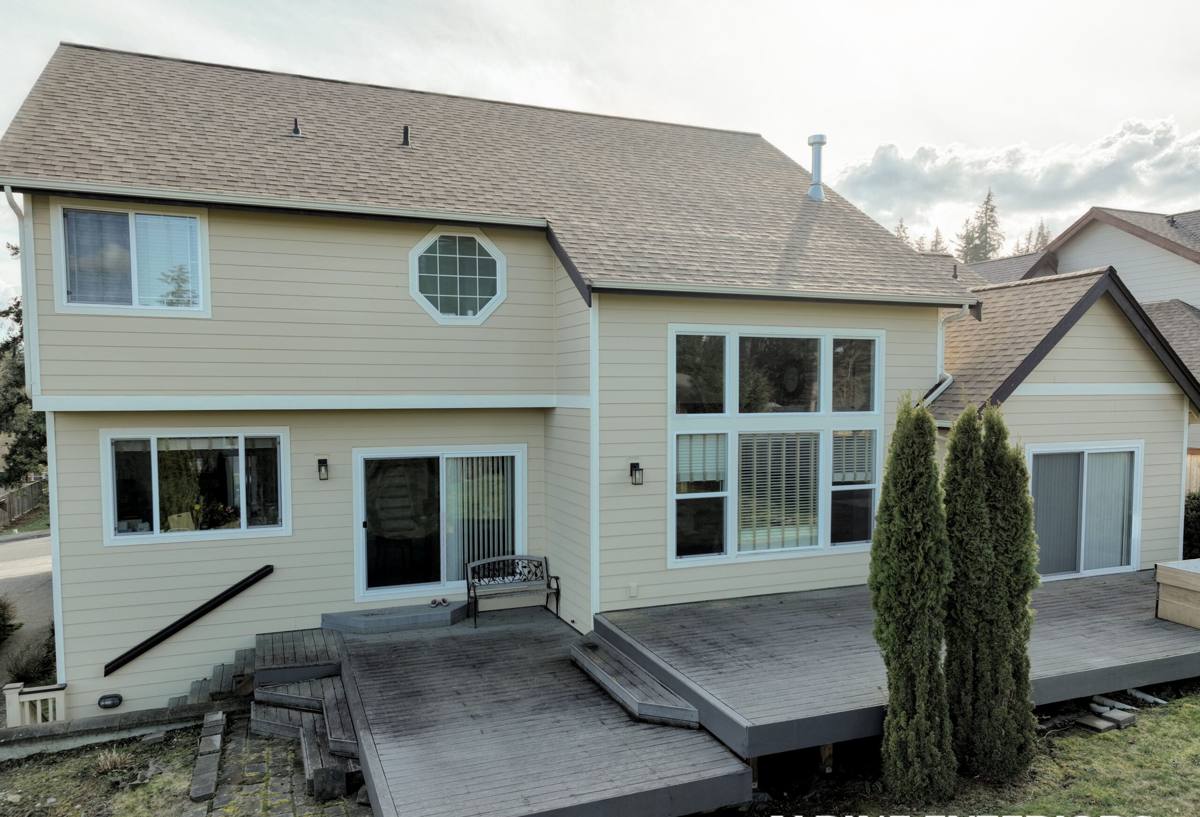
What a Correct Window Replacement Actually Involves
Swapping the visible window out for a new one is the easy part. What actually determines whether that window performs for the next twenty years is everything you don't see once the trim goes back on: the sill pan, the flashing tape, the order of layers, and how the new unit ties into the existing weather-resistive barrier on the wall.
A correct installation builds a drainage path so that any water that gets past the glass and frame has somewhere to go besides your wall cavity. That means a sloped sill pan, properly lapped flashing (so upper layers always overlap lower ones, never the reverse), and sealant used only where it belongs — not as a substitute for good flashing, but as a backup to it.
Full-Frame vs. Insert (Pocket) Replacement
There are two basic approaches, and the right one depends on the condition of what's already in the wall:
- Insert replacement fits a new window into the existing frame, leaving exterior trim and siding largely undisturbed. It's faster and less invasive, and it's a reasonable option when the old frame and sill are still structurally sound and dry.
- Full-frame replacement removes the window down to the rough opening, exposing the sill and framing so any rot or old flashing failures can be found and corrected. It costs more and takes longer, but it's the only option when there's evidence of water damage, or when you're changing the window's size or style.
We inspect the opening before recommending either approach. An insert replacement over a sill that's already compromised just seals moisture damage behind a new window rather than fixing it, and in a climate like this one, that catches up with a house.
Signs a Bellingham Home Needs Window Replacement
Windows rarely fail all at once. The signs usually show up gradually, and homeowners often adjust to them without realizing how much they're compensating:
- Visible fogging or a hazy film between the panes of a double-pane window — the seal has failed and the insulating gas is gone
- Drafts you can feel near the frame even with the window fully latched
- Soft or discolored wood at the sill or lower corners, a common sign of moisture intrusion
- Windows that are difficult to open, close, or lock, often from corroded hardware or a swollen frame
- Condensation forming on the inside of the glass regularly during cooler months
- A noticeable jump in heating costs without a clear explanation
- Moss, algae, or dark staining building up on the exterior frame or trim, especially on shaded walls
Any one of these on its own might just mean routine maintenance. Several together, especially paired with visible wood damage, usually mean the window has reached the point where repair is throwing money at a problem replacement would solve for good.
Choosing Frame Materials and Glass for Coastal Whatcom County Weather
There isn't one "correct" material for every home — it depends on your home's style, your budget, and how much upkeep you want to take on. Here's how the common options actually perform in this climate:
| Frame Material | How It Handles This Climate | Upkeep |
|---|---|---|
| Vinyl | Won't rot or corrode from salt air; performs consistently in wet conditions | Low — occasional cleaning |
| Fiberglass | Very stable through temperature and moisture swings; strong resistance to warping | Low |
| Wood-clad | Warm interior look, but the exterior cladding and any exposed joints need attention to stay sealed against driving rain | Moderate to higher |
| Aluminum | Durable but conducts cold and is more prone to condensation on interior surfaces in a damp climate | Low |
On glass, most Bellingham homes do well with a dual-pane, low-E coated unit filled with argon gas — it's a solid balance of energy performance and cost for this region's mild-but-wet winters. Triple-pane glass adds real insulating value and can be worth it on north- or west-facing walls that catch the worst of the wind and rain, or for homeowners prioritizing noise reduction and energy efficiency over the added upfront cost. We'll walk through what makes sense for your specific exposure rather than defaulting to the most expensive option.
Our Window Replacement Process
- On-site assessment — we inspect existing windows, sills, and framing to identify moisture damage and determine whether insert or full-frame replacement is appropriate
- Measuring and product selection — precise measurements and a walkthrough of material, glass, and style options suited to your home and budget
- Careful removal — old windows come out cleanly, with attention to protecting surrounding siding and interior finishes
- Sill and flashing preparation — any damaged wood is addressed, and a proper drainage plane and flashing sequence is built before the new unit goes in
- Installation — the new window is set plumb, level, and square, then secured and insulated around the frame
- Sealing and exterior trim — weatherproofing details are finished and exterior trim is restored to match your home
- Cleanup and walkthrough — job site cleared, and we walk you through the operation and care of your new windows
What Window Replacement Costs in Bellingham
Costs vary widely based on the scope of the job, but the main factors that move the price are consistent from house to house:
| Factor | How It Affects Cost |
|---|---|
| Number of windows | More units means more labor and material, though per-window pricing often improves with volume |
| Frame material | Vinyl is typically the most budget-friendly; fiberglass and wood-clad run higher |
| Glass package | Triple-pane and specialty coatings add cost over standard dual-pane low-E |
| Insert vs. full-frame | Full-frame replacement costs more due to added labor and any framing repairs uncovered |
| Trim and siding repair | Rotted sills or damaged siding around the opening add material and labor |
| Access and height | Second-story or hard-to-reach windows require more setup time |
We give a firm, itemized quote after the on-site assessment, not a rough number over the phone — the condition of your sills and framing genuinely does change the scope, and we'd rather find that out before we're mid-project.
Maintenance to Protect Your Investment
New windows are a durable, mostly low-maintenance improvement, but a little seasonal attention goes a long way in this climate:
- Rinse salt residue and grime off frames and glass a couple of times a year, especially on walls facing the water
- Check exterior caulk lines annually for cracking or separation and have gaps resealed before winter storms
- Clear moss or algae buildup from sills and trim promptly rather than letting it sit against the frame
- Operate locks and hardware periodically so you catch stiffness or corrosion early
- Keep gutters and downspouts clear so roof runoff isn't sheeting down over window heads
- Vacuum weep holes on vinyl and fiberglass frames to keep drainage paths open
Why a Crew That Already Works Bellingham Matters
A contractor who works this area regularly has already seen how driving rain off the bay finds gaps in a bad installation, how moss builds up faster on shaded north walls, and which sills tend to fail first on older Bellingham homes. That experience shows up in the details — the flashing sequence, the sealant choice, the timing of the job around the wettest months — not in anything flashy.
It also means straight answers. We'll tell you when a full-frame replacement is worth the extra cost because the sill is already compromised, and we'll tell you when an insert replacement is perfectly fine and there's no reason to spend more. Our goal is windows that hold up to what this Whatcom County climate throws at them, not the biggest invoice we can write.
If your windows are drafty, fogged, or showing wear around the frame, we're happy to take a look and give you a straightforward, no-pressure estimate — just fill out the form below.