 Chuckanut Exterior
 Bellingham sits right on Bellingham Bay in Whatcom County, and that location hands every wall in the city a specific set of problems: salt-tinged marine air that never really stops moving through, rain that comes in sideways off the water instead of falling straight down, and a moss season that barely takes a break on shaded walls. We install James Hardie fiber cement siding exclusively, and this page is about what that looks like as a service in Bellingham specifically — what the climate actually does to a wall here, what a correct fiber cement installation requires, and how our process runs from the first visit to the final walk-through.
What Bellingham's Climate Demands From Siding
A lot of siding materials are engineered and tested against generic weather models that don't account for what Bellingham actually deals with. The city's combination of bay exposure, storm patterns, and tree cover is tougher on an exterior wall than a straightforward "it rains a lot here" description suggests.
Salt Air Off the Bay
Bellingham's position on the water means the air moving through the city carries a steady trace of salt, not just on days with an obvious storm rolling in. That's a slow kind of pressure — it works on exposed fasteners, on the edges of finishes, and on any joint or seam that isn't sealed the way it should be. A material that performs fine in a drier, inland climate can start showing wear here on a noticeably shorter timeline.
Driving Rain at Laps, Trim, and Penetrations
Storms off the Salish Sea and Pacific don't just drop rain straight down onto a roof. Wind pushes it sideways into south- and west-facing walls, forcing water into lap joints, trim seams, and anywhere a window, door, or fixture penetrates the wall. A siding system that's only designed to shed vertical rainfall can still let water in here specifically because the wind is driving it in from an angle.
A Moss Season That Runs Most of the Year
Mild temperatures, consistent dampness, and tree cover across much of Bellingham add up to a moss and mildew season that can stretch across most of the calendar year on north-facing and shaded walls. Any siding material with even slight porosity, or one that holds moisture against the substrate instead of shedding it, becomes a surface that growth can take hold on — usually starting in the spots nobody checks often, like behind shrubs or under eaves.
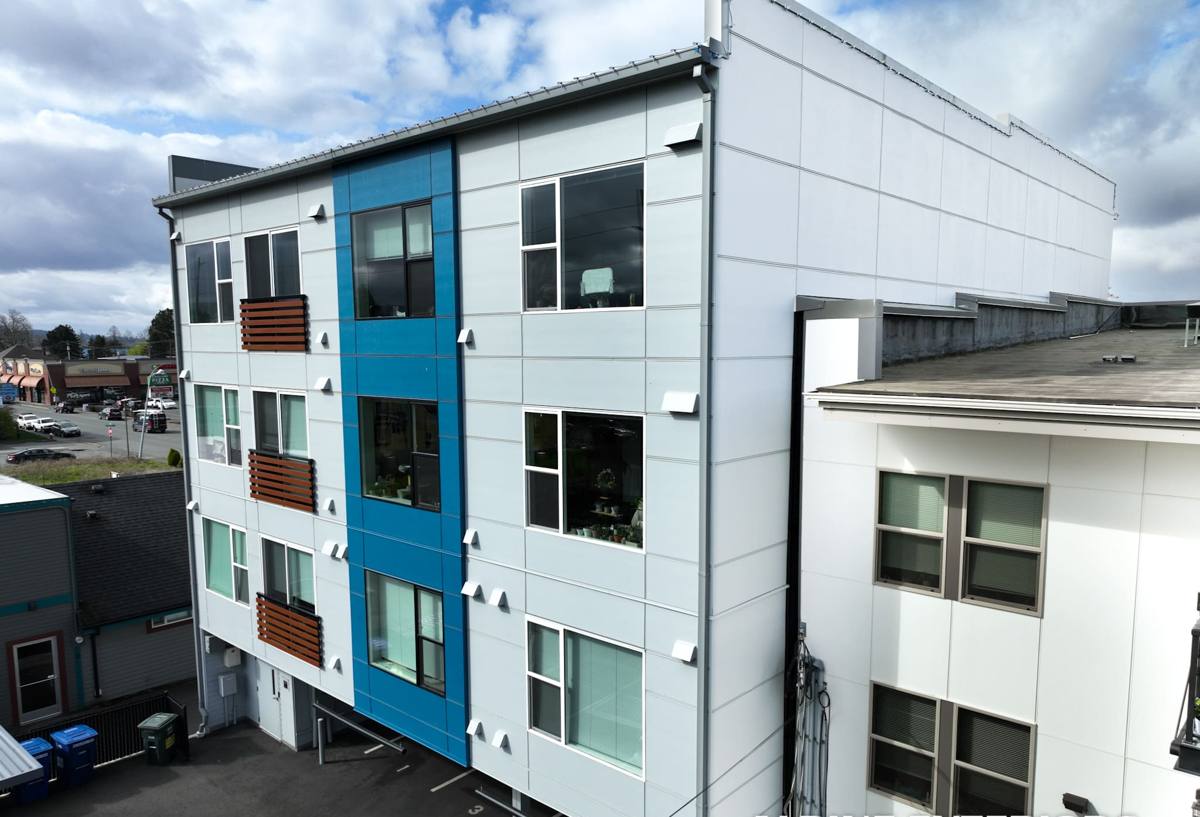
Why Fiber Cement Is the Right Material for This Combination
Fiber cement is made from cement, sand, and cellulose fiber, cured into a dense, dimensionally stable board. That composition matters directly against everything Bellingham's climate throws at a wall. It has no organic core for moss, mildew, or rot to work into over time the way wood-based siding does. It doesn't swell, cup, or warp with repeated wet-season moisture cycles the way engineered wood can. And it holds up to sustained salt exposure and wind-driven rain far better than materials that depend on a field-applied finish to keep moisture out.
That's the material-level reason fiber cement, and James Hardie's version of it specifically, is what we put on Bellingham homes. It's not a matter of one brand marketing harder than another — it's what we've consistently seen perform on tear-offs and repair calls in this exact climate.
The James Hardie Product Lines We Install
James Hardie makes several distinct product lines, and part of doing this job right is matching the right one to the home rather than defaulting to a single profile for every project.
| Product Line | Typical Use | Why It Fits Bellingham |
|---|---|---|
| HardiePlank lap siding | Traditional horizontal siding, most common choice | Wide range of profiles and textures; sheds wind-driven rain effectively when lapped and fastened to spec |
| HardiePanel vertical siding | Modern facades, accent walls, gable ends | Fewer horizontal laps for water to work into on exposed gables and upper walls |
| HardieShingle siding | Staggered or straight-edge shingle look | Gives a cedar-shake appearance without an organic substrate for moss to grow on |
| HardieTrim boards | Corners, window and door trim, fascia | Non-combustible, dimensionally stable trim that won't rot at the joints wood trim typically fails at first |
Hardie also builds its boards in different formulations engineered for different climate zones, with heavier moisture-and-freeze exposure regions getting a formulation built specifically for that stress rather than a single generic mix sold everywhere in the country. Coastal Whatcom County falls into that heavier-exposure category, and we install accordingly.
What a Correct Fiber Cement Installation Involves
Fiber cement is a forgiving, long-lasting material, but only when it's installed to spec. A rushed or corner-cut install is one of the most common reasons a good product develops problems, and most of those mistakes aren't visible until years later.
Cutting, Fastening, and Joint Treatment
Fiber cement needs to be cut with the right tools and dust-control method, both for the installer's safety and for a clean edge that seals properly. Fasteners have to be corrosion-resistant, driven flush without overdriving, and placed at the spacing Hardie's install spec calls for — too few fasteners or the wrong pattern leaves a board loose enough to work at the joints over time. Butt joints and panel seams need to be treated correctly, whether that means factory-mitered corners, proper caulking, or trim pieces designed to cover and protect the seam, rather than just butting two boards together and hoping the paint line holds.
Flashing and Clearance Where Bellingham Homes Actually Fail
A weather-resistant barrier behind the siding, correct flashing integration at every window and door, and kick-out flashing where a roofline meets a wall are what actually keep wind-driven rain out of the wall assembly — the siding itself is really the last line of defense, not the only one. Maintaining proper clearance between the bottom of the siding and grade, decks, and roof surfaces also matters more here than in a drier climate, since standing water and splash-back near the base of a wall are common spots for moisture problems to start, even on a material as water-resistant as fiber cement.
Our Process for a Bellingham Fiber Cement Project
- An on-site assessment where we look at sun exposure, wall orientation relative to the bay, existing siding condition, and any signs of past moisture problems
- A straightforward, honest quote based on what we actually see on your home, not a generic per-square-foot estimate
- Tear-off of the existing siding where called for, which lets us check the sheathing and framing underneath for hidden moisture damage before anything new goes up
- Installation of house wrap, flashing, and the Hardie product line that fits the home, following manufacturer fastening and clearance specs throughout
- A final walk-through so you can see the finished work and ask questions before we consider the job done
We lean toward tear-off over installing new siding directly over old siding whenever there's any reason to suspect moisture has been getting behind the wall. In a climate this wet, siding over a hidden problem just delays it and usually makes the eventual repair bigger.
Fiber Cement Siding Cost Factors in Bellingham
| Factor | What It Affects | Why It Matters Here |
|---|---|---|
| Tear-off vs. installing over existing siding | Labor scope and substrate access | Tear-off exposes hidden moisture damage that's common under older siding in this climate |
| Substrate condition | Repair costs before new siding goes on | Years of trapped moisture behind failing siding can damage sheathing and framing before it's visible from outside |
| Product line and profile | Material cost | HardiePlank, HardiePanel, and HardieShingle carry different material and labor costs depending on the look you want |
| Trim complexity | Labor time and material | Homes with more dormers, corners, and roof intersections have more spots where flashing detail takes extra time |
| Finish choice | Long-term maintenance cost | Factory-applied ColorPlus finish holds up to salt air and UV far longer than field-applied paint, cutting future repainting cycles |
| Site access and lot terrain | Labor time and equipment needs | Sloped or wooded lots common around Bellingham can add staging and setup time |
Because these factors vary so much from house to house, we walk the property and give you real numbers rather than quoting off square footage alone.
Signs Your Bellingham Home's Siding Needs Attention
- Moss or dark staining that returns quickly after cleaning, especially on shaded or north-facing walls
- Soft, spongy, or visibly warped siding, particularly near the base of the wall or around trim
- Peeling or bubbling paint on wood or engineered wood siding
- Visible gaps opening up at seams, corners, or trim joints where wind-driven rain can track in
- Cracked or missing sections after a windstorm off the bay
- A musty smell or rising heating bills that may point to a wall assembly that's no longer sealing properly
Why Hire a Crew That Already Works Bellingham
A crew that installs fiber cement siding in Bellingham regularly learns things that don't show up in a manufacturer's install manual: which wall orientations stay wet the longest after a storm, where extra flashing attention actually pays off on this kind of terrain, and which fastener and caulk choices hold up against sustained salt exposure instead of just looking fine on install day. That experience shows up in decisions made on the job site, not just in the brand of siding going up. Whatcom County's coastal exposure, wind patterns, and moss season aren't identical to what a crew based somewhere inland or drier deals with day to day, and that difference matters more than it might seem before the first wet winter after installation.
If your Bellingham home needs new fiber cement siding, repair work, or just an honest opinion on what's really going on behind an aging wall, we're glad to take a look. Reach out using the form below to schedule a free, no-pressure estimate.