 Chuckanut Exterior
 Roofs in the Alger Area Take a Different Kind of Beating
Homes around Alger sit inside one of the wettest, greenest corners of Whatcom County, tucked along the Chuckanut corridor where marine air off the water meets thick tree cover. That combination is good for the scenery and hard on a roof. Salt-laden air accelerates corrosion on exposed metal, driving rain gets pushed sideways into flashing and vent details that would stay dry in a calmer climate, and heavy shade keeps roof surfaces damp long enough for moss to take hold and stay there for most of the year. None of this means a roof is doomed — it means repairs here need to account for conditions a roofer working a drier, sunnier market might not think twice about.
This page is about one job, done right, in one area: roof repair for Alger homes. Not a full replacement pitch, not a generic list of services — just what actually goes wrong on roofs in this specific stretch of Whatcom County, what a correct repair looks like, and how we approach it.
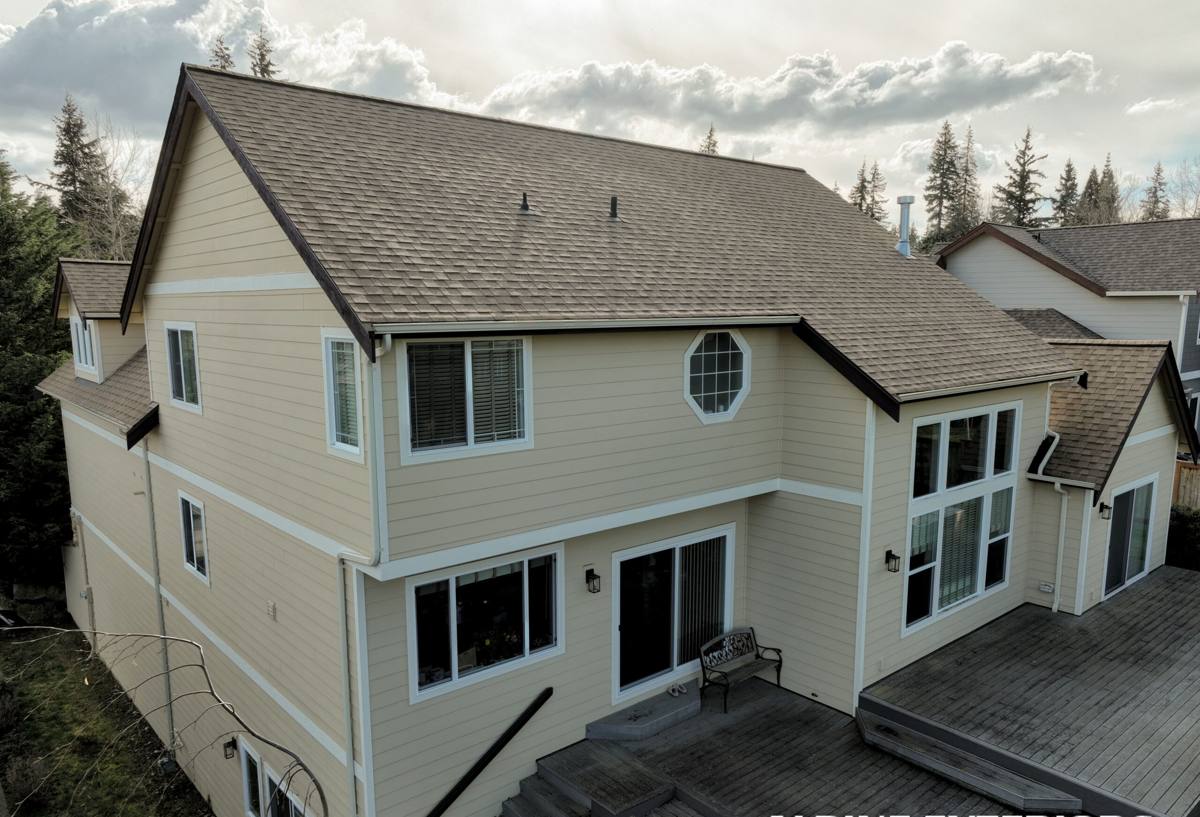
What Salt Air and Driving Rain Do to a Roof Over Time
Corrosion at the Metal Points
Every roof has metal in it somewhere — step flashing, valley flashing, drip edge, vent caps, nail heads, gutter hangers. Salt air speeds up oxidation at all of those points. It's rarely dramatic; it shows up as rust bleed streaking down a valley, a fastener that's lost its grip, or a vent boot collar that's gone brittle and cracked at the seam. Once a metal detail fails, water has a direct path underneath the roofing material, and that's when a small maintenance item turns into a repair with interior damage attached.
Wind-Driven Rain and Flashing
Straight-down rain is easy for almost any roof to shed. Rain that's being pushed sideways by wind off the water is a different problem — it finds the horizontal laps, the chimney counterflashing, the sidewall step flashing, and any spot where sealant has shrunk or cracked. Coastal Washington gets more of this wind-driven rain pattern than inland areas, which is why flashing failures are one of the most common repair calls we see on Alger roofs, even on roofs that are otherwise in decent shape.
Moss: The Slow, Steady Damage Most Owners Underestimate
The shaded, moisture-heavy conditions that make this area attractive to live in are also close to ideal for moss growth. In full sun, moss dries out and struggles. Under a tree canopy with a long overcast season, it doesn't get that break — it can stay actively growing for most of the year on north-facing slopes and shaded valleys.
Moss doesn't just sit on top of a roof looking rough. As it grows, it:
- Holds moisture directly against the roofing surface long after the rest of the roof has dried out
- Works its rhizoids under shingle tabs and shakes, gradually lifting the edges
- Accelerates granule loss on asphalt shingles, which shortens their remaining service life
- Builds up in valleys and behind chimneys, damming water and forcing it sideways under the roofing material
- Adds weight and traps debris, which keeps gutters and low spots wetter for longer
By the time moss is visible from the ground, it's usually already done some of that work. A roof repair in this area almost always includes a moss and debris assessment, not just a patch over the spot where a leak showed up inside the house.
Common Roof Repair Calls We Get in Alger
Every roof is different, but the repair calls we see in this area follow a pretty consistent pattern tied directly to the local climate:
- Cracked or lifted flashing around chimneys, skylights, and sidewalls
- Deteriorated pipe boots and vent collars letting water track down into the attic
- Moss-damaged shingle or shake sections along shaded north- and east-facing slopes
- Clogged or moss-choked valleys causing water to back up under the roofing material
- Rusted fasteners and hangers on metal roofing or gutter systems
- Wind-lifted shingle tabs and torn ridge caps after winter storm systems
- Soft or stained sheathing found only after a smaller leak has been ongoing for a while
Most of these start small. The reason they end up as repair calls instead of quick maintenance items is that the failure point is usually hidden — under a shingle tab, behind flashing, up in a valley — until water has already found its way inside.
What an Actual Correct Repair Involves
Diagnosing the Real Source, Not Just the Visible Damage
Water travels. A stain on a ceiling can trace back to a flashing failure several feet away, or to a clogged valley pushing water sideways under the roofing. A correct repair starts by tracing the path back to the actual entry point, not just patching the spot where the damage became visible indoors.
Matching Materials, Not Just Patching
Roofing materials weather and fade over years of exposure to sun, moisture, and salt air. A repair that uses mismatched shingles, shakes, or metal — or the wrong underlayment for what's already there — can create a new weak point even while fixing the old one. We match roofing type, profile, and where reasonably possible, color and age, so the repair blends in and performs the same as the surrounding material rather than becoming its own future failure point.
Flashing and Underlayment Detail Work
Given how much local repair work traces back to flashing failure, we treat flashing details as the core of the job, not an afterthought. That means correctly lapped step flashing, properly sealed counterflashing, and underlayment that extends far enough under adjoining courses to handle wind-driven rain rather than just standard vertical runoff.
Checking Attic Ventilation While We're There
Poor attic ventilation traps moisture underneath the roof deck, which speeds up rot and can shorten the life of a repair from the inside out. Since we're already on the roof and often in the attic to trace a leak, we check ventilation as a standard part of the visit rather than as a separate paid inspection.
Our Roof Repair Process
- Inspection and diagnosis — we get on the roof and, where relevant, into the attic to trace the actual source of the problem, not just the symptom.
- Written scope and honest recommendation — we explain what we found, what needs to be repaired, and whether repair is the right call versus a larger fix.
- Moss and debris clearing where needed — before any patch work, we clear what's holding moisture against the roof so the repair isn't sealed over an active problem.
- Repair with matched materials — flashing, underlayment, and roofing material selected to match what's already on the roof and to handle this climate's rain and salt exposure.
- Final check — we walk the repaired area and the surrounding sections so nothing nearby gets missed.
Repair or Replace? How We Help You Decide
Not every roof problem in Alger needs a full replacement, and not every roof is a good candidate for another round of patching. We look at a handful of practical factors and give you a straight answer:
| Factor | Leans Toward Repair | Leans Toward Replacement |
|---|---|---|
| Roof age | Under roughly two-thirds of expected material lifespan | At or beyond expected material lifespan |
| Damage extent | Isolated to one or two areas (a valley, a flashing point) | Spread across multiple slopes or repeated leak history |
| Decking condition | Solid, dry sheathing under the damaged section | Soft, stained, or rotted decking found during inspection |
| Moss/granule loss | Surface-level, recently developed | Widespread granule loss and long-term moss undermining shingles |
| Material availability | Existing material can still be matched | Discontinued or heavily faded material that won't blend |
We'll tell you plainly which side of that table your roof falls on, and why — including when a repair is genuinely the smarter move, not just the easier sale for us.
Why It Matters That We Already Work in Alger
A roofer who mostly works drier, sunnier parts of the state will diagnose a leak the way they're used to — and that instinct doesn't always hold up here. Knowing how far wind-driven rain typically travels up a valley in this area, how long moss takes to re-establish on a shaded slope, and which flashing details tend to fail first on local homes comes from repeatedly working roofs in this specific climate along Chuckanut and the surrounding Whatcom County communities, not from a general roofing background.
There's also a practical side to hiring local: shorter travel time between the estimate and the actual repair, easier scheduling for a follow-up if weather interrupts the work, and a crew that's already familiar with how homes in this area are typically built and roofed. When a leak is active, that responsiveness matters as much as the technical fix.
Keeping a Repair Lasting: Simple Maintenance
A well-done repair can be undone early by the same conditions that caused the original problem. A little regular attention goes a long way in this climate:
- Have moss treated or removed before it spreads back across a full slope, not after
- Keep gutters and valleys clear of needles and debris so water has a clean path off the roof
- Trim back overhanging branches to cut down on the shade and debris that feed moss growth
- Walk the attic after a hard windstorm and check for new light gaps, staining, or damp insulation
- Have flashing points and pipe boots checked every couple of years, since they're the first parts to fail
- Address small leaks right away — in this climate, a small leak rarely stays small for long
If you're dealing with a leak, damaged flashing, moss buildup, or you just want a straight opinion on the condition of your roof, we're happy to take a look. Reach out for a free, no-pressure estimate using the form below and we'll give you an honest read on what your Alger home actually needs.