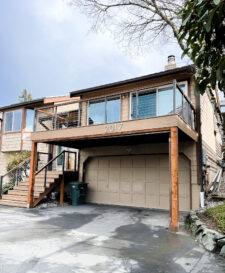
 Chuckanut Exterior
 Why Window Replacement Works Differently in Mount Vernon
Homes in the Mount Vernon area take a slow, steady beating from the weather. It's rarely one dramatic storm that ruins a window — it's years of salt-tinged air, driving rain that hits siding sideways, and long stretches of damp, shaded moss season where wood, vinyl, and even metal components stay wet far longer than they would in a drier climate. Windows are one of the first places that shows up. Seals fail quietly. Frames absorb moisture at the corners. Glass fogs between panes. By the time it's obvious from inside the house, the damage has usually been building for a while.
That's the difference between a generic window replacement and one done with this region in mind. We're not guessing at what the climate will do to a window over the next fifteen years — we've pulled out enough failed units around western Washington to know exactly which failure patterns show up first, and where.
Signs a Mount Vernon Home Needs Window Replacement, Not Just Repair
Not every window problem means full replacement. But there's a point where patching a window costs more in the long run than replacing it correctly. Here's what we look for:
- Fogging or a milky haze between panes — the seal has failed and the insulating gas is gone
- Soft or discolored wood at the sill or lower corners, a sign moisture has been sitting there
- Windows that are hard to open, stick, or won't stay up on their own
- Visible daylight or a draft you can feel around the frame when it's windy outside
- Condensation forming on the inside of the glass regularly, especially in cooler months
- Paint that's bubbling or peeling right at the window trim, even if the rest of the siding looks fine
Any one of these on its own might be a repair. Several of them on the same window, or the same symptoms repeating across multiple windows on one side of the house, usually points to replacement being the more honest recommendation.
Why Rot Shows Up Faster Here
Long moss season means extended periods where surfaces around windows — trim, sills, the siding just above and below — stay damp instead of drying out between rain events. Wood-frame and even some clad windows that would hold up fine in a drier climate can start breaking down years earlier here if the original installation didn't account for drainage and airflow. That's the piece homeowners usually can't see from the outside: the window itself might be fine, but the flashing and drainage path behind it failed years ago.
What a Correct Window Replacement Actually Involves
A window replacement is easy to do poorly and easy to make look fine for the first year or two. The difference shows up in year five, when a badly flashed window starts letting water into the wall cavity instead of shedding it back outside. Here's what we consider non-negotiable on every job:
- Full removal and inspection of the opening — not just popping the old sash out of the existing frame
- Sheathing and framing checked for hidden rot or water damage before anything new goes in
- Proper flashing sequence — sill pan, jamb flashing, and head flashing installed so water is directed out and down, never trapped
- Correct air-sealing and insulation around the frame, not just caulk smeared around the trim
- Weather-resistant barrier integration so the window ties into the existing wall's drainage plane instead of interrupting it
- Exterior sealant appropriate for this climate, applied at the right joints — not every seam needs to be sealed, and sealing the wrong ones can trap moisture
That last point surprises people. A common mistake is sealing a window completely airtight on every side, including the bottom, which gives any water that does get behind the trim nowhere to escape. A correct install leaves the right paths open for drainage while sealing the paths that matter for keeping wind and rain out.
Choosing Windows for a Salt-Air, High-Rain Climate
Material choice matters more here than in a lot of the country. Salt-laden air accelerates corrosion on certain hardware and finishes, and constant moisture exposure is unforgiving of anything with a weak point in its moisture management. We steer homeowners toward materials with a track record in coastal Pacific Northwest conditions, and we're upfront about the trade-offs of each.
| Material | Moisture Behavior | Maintenance | Typical Lifespan Here |
|---|---|---|---|
| Vinyl | Won't rot; seams and welds are the weak point if installed poorly | Low — occasional cleaning | 20-30 years |
| Fiberglass | Very stable, minimal expansion/contraction, handles wet-dry cycling well | Low | 30+ years |
| Wood-clad | Good if cladding stays intact; exposed wood at cuts or joints is vulnerable | Moderate to high — needs inspection and occasional refinishing | 20-25 years with upkeep |
| Aluminum | Prone to corrosion in salt air unless properly coated; conducts cold | Moderate | Varies widely — coating quality dependent |
We don't push one brand as the only acceptable option. What we do insist on is understanding how a given product's warranty, hardware finish, and seal design hold up to sustained damp exposure — not just how it performs in a showroom. If a product has a known maintenance burden in wet climates, we'll tell you that upfront rather than let you find out in year six.
Glass Packages Worth Considering
Double-pane, low-E glass is the standard baseline for this region — it manages both heat loss and the condensation risk that comes with our humidity. Triple-pane can make sense on north-facing walls or homes with persistent condensation issues, but it's not automatically worth the added cost on every window. We'll walk through where it actually pays off on your specific house rather than upselling it across the board.
Our Window Replacement Process
- On-site assessment — we look at every window being considered, not just the ones you flagged, and check the surrounding wall condition
- Honest scope recommendation — repair, partial replacement, or full replacement, with reasoning you can follow
- Material and glass selection — matched to the specific exposure of each wall (a south-facing wall and a shaded north wall don't always need the same spec)
- Removal and structural check — old windows come out, framing and sheathing get inspected before new units go in
- Installation with full flashing and drainage detailing — the part that actually determines whether the job lasts
- Interior and exterior finish work — trim, caulking, and paint or stain matched to the rest of the house
- Final walkthrough — we show you the operation of each window and answer questions before we consider the job done
What Window Replacement Costs Depend On
We're not going to quote a number here that doesn't apply to your house — window replacement pricing depends on too many specifics for that to be honest. What we can do is explain the variables that move the price, so an estimate makes sense when you get one.
| Factor | Why It Matters |
|---|---|
| Number and size of windows | Larger openings and specialty shapes cost more in both material and labor |
| Material and glass package | Vinyl, fiberglass, and wood-clad carry different price points; triple-pane adds cost |
| Condition of the existing opening | Hidden rot or framing damage found during removal adds repair scope |
| Access and height | Second-story or hard-to-reach windows take more time and equipment |
| Trim and finish work | Matching existing exterior trim profiles or repainting adds labor |
| Number of windows done at once | Bundling windows into one project usually reduces the per-window cost |
A useful rule of thumb: get the scope defined before you compare prices between contractors. Two quotes that look far apart are often quoting two different jobs — one accounting for proper flashing and any rot repair, and one that's just swapping glass into the existing opening.
Why a Crew That Already Works in Mount Vernon Matters
Window installation isn't identical everywhere. A crew used to installing in a dry climate can do everything "by the book" and still miss details that matter here — because the book they learned from wasn't written for sustained coastal rain and a moss season that stretches for months. A crew that regularly works Mount Vernon homes has already seen what fails in this specific climate: which flashing details actually shed water in driving rain, which sealant products hold up under repeated wet-dry cycling, and which trim details invite moisture instead of shedding it.
There's also a practical side to hiring local. Warranty service, follow-up questions, and adjustments after a job are all easier when the crew that installed your windows is a short drive away rather than a call center. We stand behind our work because we're still in this area next year, and the year after that.
Keeping New Windows Performing in This Climate
A correctly installed window still benefits from basic upkeep, especially given how much moisture this region deals with. A short annual routine goes a long way:
- Check exterior caulking and sealant joints each fall before the wet season sets in
- Clear debris and moss buildup from sills and adjacent trim so water doesn't pool
- Operate each window a few times a year — locking hardware that sits unused can seize
- Look for early condensation between panes, which signals a seal starting to fail
- Keep gutters and downspouts clear so water isn't sheeting down across window heads
- Repaint or refinish wood trim before bare wood is exposed, not after
None of this is complicated, but skipping it is exactly how a well-installed window ends up with an avoidable problem five or six years in.
Get a Straight Answer on Your Windows
If you're not sure whether your windows need replacing, repair, or just some overdue maintenance, that's a reasonable thing to have someone look at in person. We'll give you a straightforward assessment and a free, no-pressure estimate — no upsell script, just what your house actually needs. Fill out the form below to get started.