 Chuckanut Exterior
 Why Larrabee Siding Takes More Abuse Than Siding Ten Miles Inland
Homes tucked into the Larrabee area near Chuckanut sit right where Puget Sound weather does its worst work on exterior cladding. Salt-laden air off the water accelerates corrosion on fasteners, trim, and any exposed wood. Driving rain — the kind that comes in sideways off a southwest blow — finds every gap, seam, and nail hole that a calmer climate would never test. And because this stretch of Whatcom County stays cool and damp for months at a stretch, moss and algae get a long runway to establish themselves on north-facing walls and anything shaded by trees. None of that is exotic knowledge to anyone who's lived here a few winters, but it matters enormously when you're deciding how to repair siding correctly instead of just patching what's visible.
Siding that looks fine from the driveway can be failing quietly behind the surface. That's the pattern we see most often on repair calls in this area: a homeowner notices one soft spot or a stain, and once we open it up, the damage tells a longer story about how moisture has been moving through the wall assembly for a while.
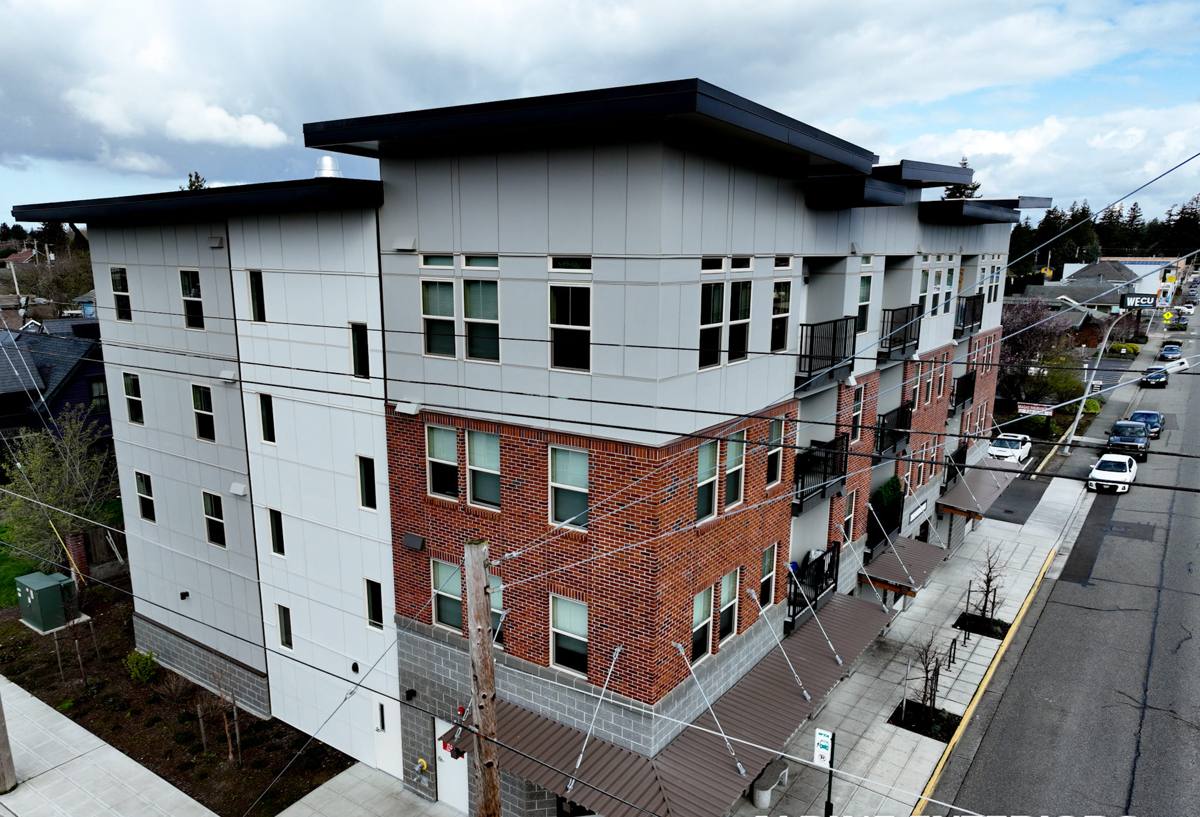
Signs Your Siding Needs Repair — Not Just a Paint Job
A lot of siding problems get masked with caulk and paint for a season or two before they resurface worse. Here's what actually signals a repair is due, as opposed to cosmetic upkeep:
- Soft or spongy spots when you press on the siding, especially near the bottom courses or below windows
- Visible cracking, splitting, or buckling in individual boards or panels
- Persistent dark streaking or moss growth that comes back within a season of cleaning
- Paint that's bubbling, peeling, or failing faster than the rest of the house
- Gaps opening up around window and door trim, or at butt joints between siding pieces
- Interior signs — a musty smell, a stain on drywall, or trim that's warping near an exterior wall
- Fasteners backing out or leaving rust streaks below them
Any one of these on its own might be minor. Two or three together, especially on a wall that faces the weather, usually means moisture has already gotten past the surface layer.
What a Correct Repair Actually Involves
It starts with what's behind the siding, not the siding itself
The visible damage is rarely the whole problem. A proper repair means pulling back the affected section far enough to check the water-resistive barrier, the flashing at windows and penetrations, and the sheathing underneath. If the sheathing has gone soft or the house wrap has failed at a seam, replacing the siding without addressing that will just buy you a couple of years before the same spot fails again.
Matching materials and fastening correctly
Repairs also need to match the existing product's expansion behavior, fastening pattern, and clearances — a patch that's caulked in tight against a window frame or run flush to a deck surface will trap water instead of shedding it. Getting the gaps, flashing laps, and fastener spacing right is what separates a repair that lasts from one that just looks fixed.
Finish and color matching
On painted or factory-finished siding, matching color and sheen on a patch is its own skill. A poor color match turns a $400 repair into an eyesore that pushes homeowners toward a full re-side sooner than they'd planned.
Repairing Different Siding Types We See in Larrabee
Larrabee has a real mix of siding ages and materials — older cedar, vinyl from various decades, some LP SmartSide, and a growing number of James Hardie fiber cement installs. Each one behaves differently once damage sets in, and that changes what "repair" actually means.
| Siding Type | Common Damage in This Climate | Repair Reality |
|---|---|---|
| Cedar / wood lap | Rot at butt joints, checking, moisture absorption in end grain | Repairable if caught early; repeated repair becomes a maintenance cycle as wood ages |
| Vinyl | Cracking in cold snaps, warping near heat sources, UV fade mismatch on patches | Individual panels can be swapped but exact color match gets harder every year the product's been discontinued |
| LP SmartSide (OSB-based) | Edge swelling where moisture penetrates the engineered wood core | Once swelling starts at an edge or seam, it tends to spread; patch repairs are often short-term |
| James Hardie fiber cement | Impact damage, caulk failure at joints, rare — moisture-driven core damage | Non-combustible, dimensionally stable core resists the swelling failure mode; damaged boards replace cleanly with ColorPlus-matched product |
We're a Hardie installer, not a vinyl or LP crew, so on those other materials our job on a repair call is to give you an honest read: is this a spot repair that will hold, or are you buying a couple more years before you're looking at a larger project. We'd rather tell you that upfront than sell you a patch we don't believe in.
Our Repair Process on a Larrabee Job
- Inspection. We look at the damaged area and the surrounding wall — sightlines, adjacent courses, flashing points, and anywhere moisture could be tracking from.
- Probe and open. If there's any sign the damage extends past the surface, we open the section up to check sheathing and the water-resistive barrier before quoting anything final.
- Address the cause, not just the symptom. Failed flashing, poor caulk joints, or missing kick-out flashing at rooflines get corrected as part of the repair, not left in place under new material.
- Repair or replace the affected section. Matching product, fastening to spec, and proper clearances at grade, decks, and trim.
- Finish and blend. Caulk, paint, or factory-finish matching so the repair doesn't stand out.
- Walkthrough. We show you what we found and what we did about it — including anything worth watching going forward.
When Repair Isn't Enough
Sometimes a repair call turns into a harder conversation. If we open up a section and find the damage has spread — rot tracking along multiple courses, or an older wood or LP product that's failing broadly rather than in one spot — patching it isn't doing you any favors. In those cases we'll tell you plainly what we're seeing and what the honest options are, including partial re-siding of just the affected elevation.
When that conversation happens, our answer is James Hardie fiber cement: it's non-combustible, it's engineered for exactly the wet, marine-influenced conditions this part of Whatcom County deals with, it holds ColorPlus factory finish instead of relying on field paint, and it carries a strong transferable warranty. We don't install vinyl, LP SmartSide, Cemplank, Allura, or unfinished wood siding — not because those products have no merits, but because we've chosen to put our name behind one system we trust to hold up here long-term, and we'd rather steer you toward that than sell a repair on a product we wouldn't warranty ourselves.
Cost Factors on a Siding Repair
| Factor | Why It Matters |
|---|---|
| Extent of hidden damage | Sheathing or house wrap replacement adds labor and material beyond the visible patch |
| Material availability | Discontinued vinyl colors or older cedar profiles can be harder to match than current Hardie lines |
| Access and elevation | Second-story or steep-lot repairs (common on sloped Larrabee lots) take more setup time |
| Root cause fixes | Correcting flashing or drainage issues costs more upfront but prevents repeat calls |
| Finish matching | Custom paint blending versus factory-matched ColorPlus product affects both cost and durability |
What to Ask Before Hiring a Repair Contractor Here
- Will you check behind the siding, or just patch what's visible?
- Do you carry current liability insurance and, if applicable, bonding for work in Whatcom County?
- Can you show me the source of the moisture, not just the damage it caused?
- What's your plan if you find the sheathing is compromised once you open the wall?
- Do you work with the siding material already on my house, and if not, what's your honest recommendation?
- Will the repair be finished to match, or will it be visibly patched?
A contractor who answers these plainly, without dodging the sheathing question, is generally one who's done this enough times to know it's the part that actually matters.
Why It Helps to Hire a Crew That Already Works Larrabee
Siding repair isn't uniform across Whatcom County. A crew that regularly works the Chuckanut and Larrabee area already knows which elevations tend to take the worst weather, how moss establishes on shaded north walls near the tree line, and what moisture patterns show up on homes exposed to Sound-driven wind and salt air. That local pattern recognition shortens the diagnostic part of the job and reduces the odds of a repair that looks fine for a year and then fails again in the same spot.
If you're seeing early signs of siding trouble on a Larrabee-area home, it's worth getting a straight assessment before the next wet season makes the problem bigger. We're happy to take a look, tell you honestly what we find, and put together a free, no-pressure estimate — whether that ends up being a targeted repair or a larger conversation about your siding's long-term condition.