 Chuckanut Exterior
 Why Decks Near Edison Take More Abuse Than Decks Inland
Edison sits close enough to the water and the sloughs that a deck out here lives a different life than one twenty miles inland. Salt-laden air moves through on a regular basis and settles into anything porous or metal. Add Whatcom County's long wet season — months where boards rarely get a full day to dry out — and you've got a recipe for the two things that ruin decks fastest: fastener corrosion and moisture trapped where it can't escape. Moss doesn't help either. Once it gets a foothold on a shaded deck surface or between boards, it holds water against the material for weeks at a time.
None of this means a deck near Edison can't last. It means the build has to account for the conditions from day one — not get treated like it's going in in Spokane. That's the difference between a deck that looks tired in five years and one that still looks good in twenty.
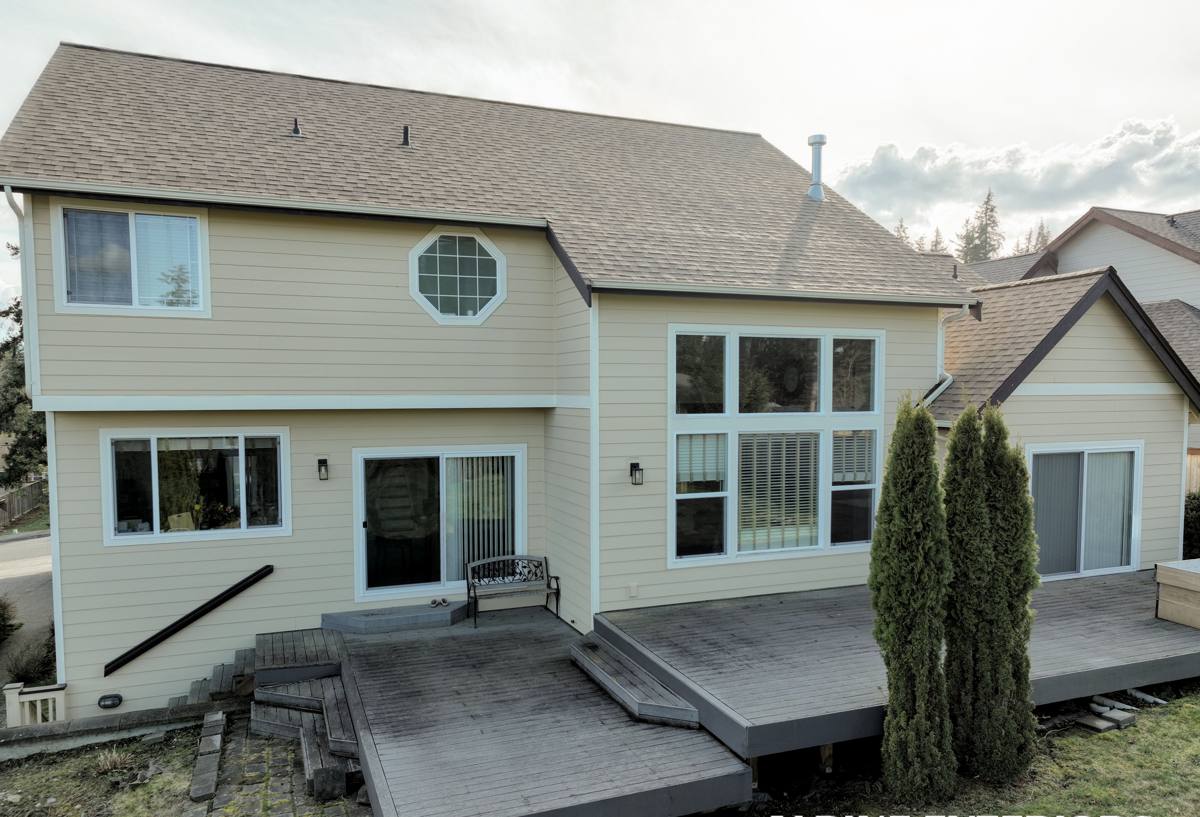
What Composite Decking Actually Solves Here
Composite decking is a blend of wood fiber and plastic, and in a climate like this one its main advantage is simple: it doesn't rot, it doesn't need refinishing, and it doesn't feed moss the way bare wood does. That's a real advantage in a place with a long moss season and a lot of shoulder-season rain. But composite isn't maintenance-free, and it isn't automatically the right call for every home — it's a tool that fits certain situations very well.
Where composite makes the most sense
- Homes with tree cover or north-facing decks that stay damp and grow moss on wood
- Owners who want to stop the annual sand-and-refinish cycle for good
- Decks close to the water where salt air chews through fasteners and finishes faster
- Households with kids or pets where splinters and board warping are a real concern
Where it's a trade-off, not a slam dunk
Composite costs more up front than pressure-treated wood, and if a board is ever damaged (a dropped grill, a dragged planter), you're replacing a board rather than sanding out a mark. It's a good long-term decision, but it's not automatically the cheap or easy one — we'll tell you that straight when we walk your property.
Composite vs. Other Decking Options in This Climate
| Material | Moisture behavior here | Moss resistance | Upkeep |
|---|---|---|---|
| Pressure-treated wood | Absorbs water, cycles wet/dry constantly | Low — feeds moss growth | Annual cleaning, periodic staining/sealing |
| Cedar | Naturally rot-resistant but still absorbs moisture | Moderate | Regular oiling to prevent graying and cracking |
| Uncapped composite | Resists rot but can absorb surface moisture at the core | Moderate — still needs cleaning | Periodic washing, watch cut edges |
| Capped composite | Fully sealed shell sheds water, doesn't take on moisture | High | Occasional washing only |
For Edison-area homes, we steer most homeowners toward capped composite specifically because of the moisture cycling this region puts a deck through. Uncapped boards aren't a bad product, but their cut ends and edges are more exposed to the kind of sustained dampness this climate produces, and that's exactly the spot where problems start.
What a Correct Installation Actually Involves
The composite board itself gets most of the attention, but the board is the last thing that determines how a deck holds up here. The structure underneath and the details around it matter more.
Substructure and framing
We build to proper joist spacing for the specific composite product being used — composite manufacturers are stricter about spacing than typical wood-deck framing, and skipping that spec is one of the most common causes of bounce and sag down the road. Framing lumber gets treated for ground contact where it's close to grade, and we don't cut corners on joist tape, which protects the top of each joist from the moisture that collects under the decking.
Fasteners and hardware
Salt air is hard on standard fasteners. We use stainless or coated hardware rated for coastal exposure, and hidden fastener systems where the board allows it — that keeps water from pooling in screw heads on the walking surface, which is a slow but steady source of surface staining and mildew.
Ventilation and drainage
A composite deck that can't breathe underneath will hold moisture against the framing no matter how good the boards on top are. We keep proper clearance between the decking and grade, plan joist spacing and picture-framing details so air can move, and grade or drain the area beneath low decks so water doesn't just sit there through the wet months.
Flashing where the deck meets the house
Ledger board flashing is where a huge share of hidden rot problems start on any deck, composite or wood. We flash that connection properly so water sheds away from the house rather than running behind the ledger and into the rim joist. It's not visible once the deck is finished, but it's one of the details we won't skip.
How We Approach an Edison Composite Decking Project
- Site walk and honest assessment. We look at sun and shade exposure, existing moss or moisture problems, drainage around the footprint, and how close the deck sits to salt air exposure or standing water.
- Board and structure recommendation. We tell you what fits your specific situation, including where a cheaper option is genuinely fine and where it isn't worth the risk.
- Permitting. Deck projects in Whatcom County typically require a permit depending on height and footprint — we handle that so you don't have to chase it down.
- Demo and structural build. Old decking removed, framing inspected or rebuilt, joist tape and flashing installed before a single composite board goes down.
- Composite installation. Boards, fastening, and trim installed per manufacturer spec, including expansion gaps that matter more here because of the temperature and moisture swings.
- Final walkthrough. We go over cleaning and care with you directly before we consider the job done.
Maintenance: What to Actually Expect After Installation
Composite is low-maintenance, not no-maintenance. Here's what a realistic care routine looks like for a deck in this climate:
- Sweep debris and standing organic matter off regularly — wet leaves and needles are what feed moss and staining
- Wash the surface with a soft-bristle brush and mild soap once or twice a year, more often in heavily shaded areas
- Rinse salt residue off after storms if the deck is exposed to wind off the water
- Keep gutters and downspouts near the deck clear so runoff isn't dumping onto the surface
- Check fastener lines and board ends each season for any early signs of movement or staining
None of this is heavy labor — it's a fraction of what a wood deck needs — but skipping it entirely is how even a good composite deck ends up looking neglected.
Cost Factors for a Composite Deck Near Edison
| Factor | Why it moves the price |
|---|---|
| Board tier (uncapped vs. capped, entry vs. premium) | Capped and premium lines cost more per square foot but resist this climate's moisture and moss pressure better |
| Substructure condition | Rebuilding rotted or undersized framing adds cost but is not optional if it's compromised |
| Height and access | Elevated decks need railing, stairs, and sometimes footings that ground-level decks don't |
| Site exposure | Decks close to salt air or heavy shade often justify upgraded fasteners or drainage work |
| Size and layout complexity | Picture framing, curves, and multiple levels add labor beyond straight square footage |
We'd rather give you a real range after seeing the site than a number that doesn't hold up once we're standing on your existing deck. Broadly, composite decking projects run more than a basic pressure-treated rebuild but less than most homeowners expect once they factor in what they're not paying for down the road — no annual staining, no sanding, no early replacement from rot.
Why It Matters That We Already Work in Edison
A crew that mostly works subdivisions twenty miles inland doesn't think about salt exposure, moss cycles, or the specific drainage challenges of low-lying ground near the sloughs — because they don't have to, most of the time. Working this area regularly means we've already seen what happens when a deck's ledger flashing wasn't done right in a wet climate, what fastener corrosion looks like after a few seasons of salt air, and which composite lines actually hold their color and shape out here versus which ones look great in a showroom and struggle in real conditions. That's not something you can fully get from a spec sheet — it comes from building and repairing decks in Whatcom County's actual weather, year after year.
If you're weighing composite decking for a home in or near Edison, we're glad to come take a look, walk you through what your specific site needs, and give you a straightforward, no-pressure estimate — no upsell, just an honest read on what your deck actually requires.